
What Is a Meter?
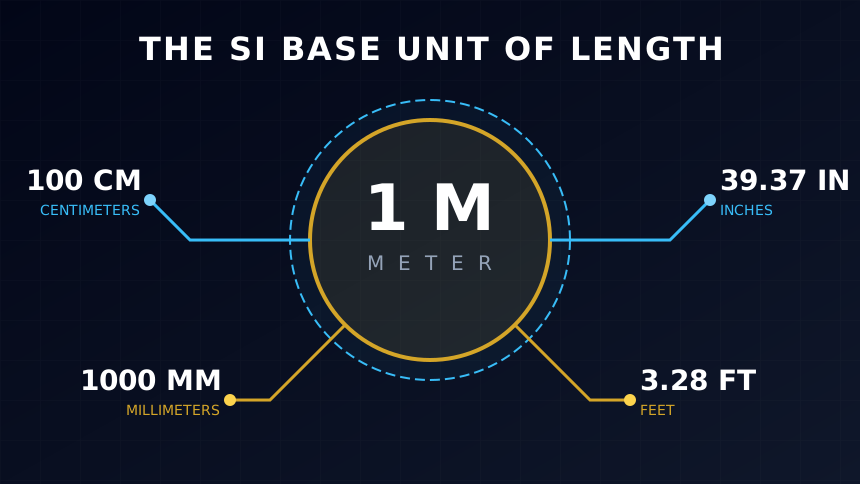
A meter is the base metric unit of length in the International System of Units (SI). One meter equals exactly 100 centimeters, 1,000 millimeters, 39.3701 inches, or 3.28084 feet.
The meter measurement sits above centimeters and below kilometers. People use meters for height, room size, fabric, sports distances, maps, surveying, construction, science, engineering, and medical records. The symbol is lowercase m, so a height of 1.78 m means 1.78 meters.
This guide explains the meter definition, m meaning, how long is a meter, how meters convert to inches and feet, and how the meter became the global standard inside the measurement systems used for height and length.
What Is a Meter? Quick Definition
A meter is the SI base unit of length equal to 100 centimeters.
In scientific language, the meter is defined by the distance light travels in vacuum during 1/299,792,458 of a second. In everyday language, one meter is the length of a meter stick and a little longer than a yard.
Meter Definition and Exact Equivalents
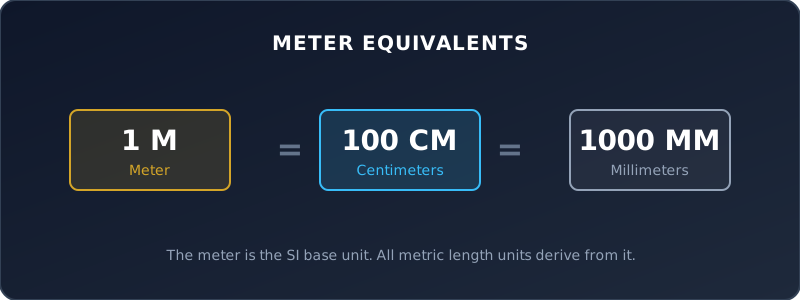
The modern meter has a fixed value. It does not change by country, ruler, lab, industry, or spelling. American English writes meter. British English often writes metre. Both spellings describe the same SI base unit of length.
| Unit | Equivalent | Use |
|---|---|---|
| 1 meter | 100 centimeters | Metric height notation |
| 1 meter | 1,000 millimeters | Rulers, plans, and precision work |
| 1 meter | 39.3701 inches | Meters to inches conversion |
| 1 meter | 3.28084 feet | Meters to feet conversion |
| 1 meter | 1.09361 yards | Meter vs yard comparison |
| 1 meter | 0.001 kilometers | Distance and map scale |
The key metric relationship is simple: 1 m = 100 cm. For imperial conversion, use the exact inch relationship: 1 inch = 0.0254 m.
M Meaning, Symbol, and Correct Writing
M meaning in measurement is meter when the symbol appears as lowercase m. SI unit symbols use fixed capitalization. Write 1 m, 2 m, 1.78 m, or 100 m. Do not add an s after the symbol.
A capital M means the metric prefix mega in formal SI notation, as in MW for megawatt. For length, the meter symbol stays lowercase.
Correct: 1.80 m
Avoid: 1.80 meters in a table heading, 1.80 ms, 1.80 M
How Long Is a Meter?
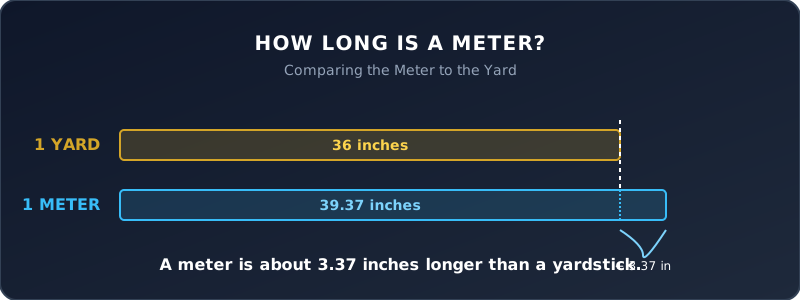
A meter is 100 centimeters long. A meter stick gives the cleanest physical reference. A meter is slightly longer than a yard, since 1 yard equals 0.9144 m and 1 meter equals 1.09361 yards.
For height, meters usually appear as decimals. A person who is 180 cm tall is 1.80 m tall. A person who is 5 feet 10 inches tall is 1.778 m tall. Centimeters often feel more practical for everyday human height, while meters fit scientific, medical, athletic, and official records.
| Example | Meters | Metric Equivalent | Context |
|---|---|---|---|
| Meter stick | 1 m | 100 cm | Best everyday reference for one meter |
| A yardstick plus 3.37 inches | 1 m | 39.37 in | Meter compared to a yard |
| Standard US interior door height | 2.032 m | 80 in | Home measurement |
| Basketball rim height | 3.048 m | 10 ft | Sports reference |
| Adult height of 5 ft 10 in | 1.778 m | 177.8 cm | Common height conversion |
| Olympic 100 m race | 100 m | 328.08 ft | Track and field distance |
Meter Measurement in the Metric Unit of Length System
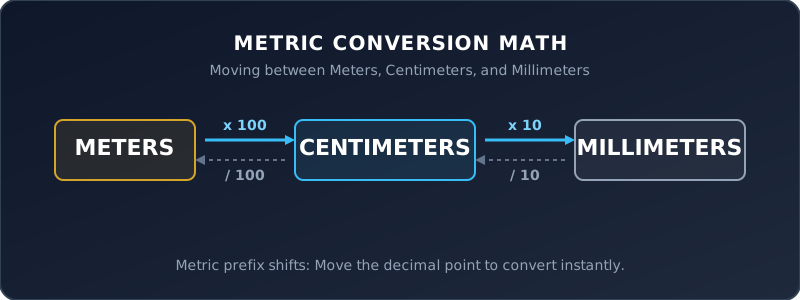
The meter anchors the metric unit of length system. Smaller units use decimal prefixes: millimeter means one thousandth of a meter, centimeter means one hundredth of a meter, and kilometer means one thousand meters. This decimal structure makes metric length conversion fast.
Meters, centimeters, and millimeters
Use millimeters for small parts, centimeters for body measurements and everyday objects, meters for rooms and sports distances, and kilometers for roads and maps. The unit changes with scale, but the system stays decimal.
Meters in height measurement
Meters work well when a form needs decimal notation. A height of 1.78 m equals 178 cm, 70.08 inches, or about 5 ft 10.1 in. For home measurement steps, use How to Measure Your Height at Home and record the result in centimeters before converting to meters.
Meters to Inches Formula
To convert meters to inches, multiply meters by 39.3701. The exact relationship comes from 1 inch = 0.0254 m.
Formula: meters x 39.3701 = inches
Example: 1.80 m x 39.3701 = 70.87 inches
To convert inches to meters, multiply inches by 0.0254. Example: 70 inches x 0.0254 = 1.778 m. Use the inches to meters calculator when you need an instant result.
Common Conversion Examples
Meter conversion uses a short set of fixed formulas. The table covers the conversions used most often in height, forms, sports, construction, and product dimensions.
| Conversion | Formula | Example |
|---|---|---|
| Meters to centimeters | m x 100 = cm | 1.78 m x 100 = 178 cm |
| Meters to millimeters | m x 1,000 = mm | 1.2 m x 1,000 = 1,200 mm |
| Meters to inches | m x 39.3701 = in | 1.8 m x 39.3701 = 70.87 in |
| Meters to feet | m x 3.28084 = ft | 1.8 m x 3.28084 = 5.91 ft |
| Inches to meters | in x 0.0254 = m | 70 in x 0.0254 = 1.778 m |
| Feet to meters | ft x 0.3048 = m | 6 ft x 0.3048 = 1.8288 m |
For feet-and-inches height, convert the height to total inches first, then multiply by 0.0254. The feet to inches calculator handles that first step.
Conversion Table for Height in Meters
The table below converts common adult-height meter values into centimeters, total inches, and feet-and-inches notation.
| Meters | Centimeters | Total Inches | Feet & Inches |
|---|---|---|---|
| 1.50 m | 150 cm | 59.06 in | 4 ft 11.1 in |
| 1.60 m | 160 cm | 62.99 in | 5 ft 3.0 in |
| 1.70 m | 170 cm | 66.93 in | 5 ft 6.9 in |
| 1.75 m | 175 cm | 68.90 in | 5 ft 8.9 in |
| 1.80 m | 180 cm | 70.87 in | 5 ft 10.9 in |
| 1.90 m | 190 cm | 74.80 in | 6 ft 2.8 in |
| 2.00 m | 200 cm | 78.74 in | 6 ft 6.7 in |
Where Meters Are Used
Meters appear wherever people need a practical medium-scale length. You will see meters in these contexts:
Height, medicine, sports, and official forms
Many official forms accept height in meters, such as 1.75 m. Sports use meters for race distances, long jump, high jump, throwing events, and pool lengths. Medical records often store height in centimeters, then display meters when decimal notation fits the format.
Construction, rooms, fabric, and water depth
Metric construction plans use meters for room dimensions, ceiling heights, floor areas, and site boundaries. Fabric stores may sell fabric by the meter, where the length is 1 m and the width depends on the roll. A meter of water describes a water depth of 1 m or a water column 1 m high.
Science, surveying, mapping, and engineering
Physics, precision engineering, geodesy, GPS technology, surveying tools, 3D laser scanning, LIDAR, and time-of-flight measurement rely on meters because the unit links directly to SI constants. Laboratories such as the National Institute of Standards and Technology (NIST), the National Physical Laboratory (NPL), and Physikalisch-Technische Bundesanstalt (PTB) maintain high-accuracy measurement practice for science and industry.
How Professionals Measure Meters Accurately
A ruler works for everyday meter measurement. Professional metrology uses calibrated instruments that match the job, the distance, and the required tolerance.
| Tool | Common Use | What It Measures |
|---|---|---|
| Meter stick or ruler | Classrooms, desks, small objects | Direct physical length |
| Tape measure | Rooms, furniture, body dimensions | Flexible length measurement |
| Laser distance meter | Rooms, construction, real estate | Fast distance reading |
| Total station | Surveying and construction layout | Angles plus distance |
| 3D laser scanning and LIDAR | Buildings, terrain, mapping, vehicles | Point clouds and time-of-flight measurement |
| GPS and geodesy tools | Land, maps, Earth-scale position | Coordinate and distance modeling |
At the highest accuracy levels, metrology labs use laser interferometry, optical frequency combs, and atomic time standards. Albert Michelson's interferometer work helped build the path from physical meter bars to optical length measurement.
How the Meter Became the SI Standard
The history of meter standardization moved from Earth measurement to physical artifacts to light. The Bureau International des Poids et Mesures (BIPM) and the General Conference on Weights and Measures (CGPM) maintain the international SI framework.
| Period | Standard | Why It Matters |
|---|---|---|
| 1790s | Earth meridian concept | The early meter came from a decimal fraction of the distance from the equator to the North Pole along a meridian. |
| 1889 | International prototype meter | A platinum-iridium meter bar became the physical international standard. |
| 1960 | Krypton-86 wavelength standard | The meter moved from a bar to a wavelength of light produced by krypton-86. |
| 1983 | Speed of light definition | The General Conference on Weights and Measures fixed the meter through the speed of light in vacuum. |
| Today | Constant-based metrology | Labs realize the meter with time standards, optical frequency combs, and laser interferometry. |
The 1983 definition ties the meter to the speed of light, fixed at exactly 299,792,458 meters per second. The second comes from atomic timekeeping, including cesium fountain clock technology. This gives the meter a constant-based definition that any advanced lab can realize.
Official references from the BIPM and NIST give the current SI definition. For historical context on everyday height units, read How Height Standards Evolved Over Time.
Common Mistakes With Meters
Confusing meters and centimeters
One meter equals 100 centimeters. A height of 180 cm equals 1.80 m. A height of 180 m describes a very tall structure, not a human height.
Writing the symbol with the wrong capitalization
Write m for meter. Do not write M for meter in SI notation. Unit symbols stay the same for singular and plural values.
Treating decimal meters as feet and inches
A height of 1.8 m equals 180 cm or about 5 ft 10.9 in. It does not mean 1 foot 8 inches. Check the unit before entering a value into a form or calculator.
Related Meter and Height Resources
Use these supporting resources to move through the measurement-systems silo and related conversion tools.
Supporting guides
Relevant calculators
Frequently Asked Questions
What is a meter?
A meter is the SI base unit of length. One meter equals exactly 100 centimeters, 1,000 millimeters, 39.3701 inches, or 3.28084 feet.
What does m mean in measurement?
m means meter. The lowercase symbol m is the standard SI unit symbol for the meter, so 1.8 m means 1.8 meters.
How long is a meter?
A meter is 100 centimeters long. It is slightly longer than a yard by 8.56 centimeters, or 3.37 inches.
What is a meter in feet and inches?
One meter equals 3.28084 feet, which is 3 feet and about 3.37 inches. It also equals 39.3701 total inches.
What is a meter compared to a foot?
A meter is longer than a foot. One meter equals 3.28084 feet, and one foot equals 0.3048 meters.
What is a meter compared to a mile?
One mile equals 1,609.344 meters. One meter equals about 0.000621371 miles.
What is a meter of fabric?
A meter of fabric is a length of fabric measuring 1 meter along the bolt. The fabric width is separate and depends on the roll, such as 112 cm or 150 cm wide.
What is a meter squared?
A meter squared, written as m2 or square meter, is an area equal to a square that measures 1 meter on each side. It is different from a meter, which measures length.
Is a meter the same as a measuring device?
No. A meter can mean a unit of length or a measuring instrument. In this guide, meter means the metric unit of length. A parking meter, water meter, voltmeter, ammeter, or gas meter is a device.
What Is a Meter?
What Is a Meter? It is the SI base unit of length and the central meter measurement standard for the metric system. One meter equals exactly 100 centimeters, 1,000 millimeters, 39.3701 inches, or 3.28084 feet.
Remember three anchor facts: m means meter, 100 centimeters make 1 meter, and meters convert to inches by multiplying by 39.3701. With those relationships, you can read metric height, compare meters with feet and inches, and use the right unit for forms, tools, charts, and technical work.