
How Height Standards Evolved Over Time

Height standards evolved from body-based units like cubits and thumb-widths into globally fixed definitions through 5,000 years of trade pressure, scientific advancement, and international agreements. The 1959 International Yard Agreement locked the inch at exactly 2.54 centimeters, ending centuries of variation between countries and creating the conversion factor used in every modern height calculator.
This guide traces measurement standardization from ancient Egypt through medieval barleycorn definitions, the creation of the metric system in 1795, and the international treaties that produced today's height measurement units. It covers the origin of inches and feet, the history of the metric system, how measurement tools evolved from rods to digital stadiometers, and how standardized height data transformed healthcare and science.
Understanding how height standards evolved over time explains why 1 inch equals 2.54 cm, why most countries use metric while the United States uses imperial, and how ancient measurement errors shaped the precision standards that govern medical records, construction codes, and aerospace engineering today.
Why Humans Needed Standard Height Measurements
Humans needed standardized height measurements for 3 reasons: consistent construction, fair trade, and reliable record-keeping. A building that mixes two different "foot" lengths collapses. A merchant who measures cloth with a shorter cubit cheats buyers. A medical record with unstandardized height produces wrong dosage calculations.
Early Challenges of Measuring Height
Early height measurement faced 3 challenges. Body-based units varied between individuals by 5 to 15 percent. A tall person's cubit measured 53 cm (20.87 inches) while a short person's cubit measured 44 cm (17.32 inches). No central authority enforced a single definition across regions. And no permanent physical reference existed that both parties in a transaction could consult.
Construction projects suffered most from this inconsistency. The Great Pyramid of Giza required thousands of workers cutting stones to identical dimensions. Without standardized measurement, blocks would not fit together. Egypt solved this with cubit rods distributed to work crews, but the solution was local. A cubit in Memphis differed from a cubit in Thebes.
From Body-Based Measurements to Fixed Standards

The shift from body-based measurements to fixed standards happened in 4 stages across 4,000 years:
- Body reference (3000 BCE) - Cubits, palms, digits measured against human anatomy
- Physical artifacts (2500 BCE) - Cubit rods, measuring sticks, master standards kept in temples
- Legal definitions (1300s CE) - Kings and parliaments defined units by law
- Scientific definitions (1795 onward) - Units tied to Earth's dimensions, then to physical constants
Each stage reduced variation. Body references varied 15 percent between users. Physical artifacts varied 2 to 3 percent between cities. Legal definitions varied 0.01 percent between nations. Scientific definitions vary zero percent: 2.54 cm per inch is exact.
Why Consistency Became Important
Consistency in height measurement became critical as 3 factors expanded: international trade, scientific research, and military logistics. Trade routes connecting different measurement regions created constant disputes over quantity and price. Scientific papers using inconsistent units could not be replicated. Military uniforms, weapons, and equipment required standardized body measurements across entire armies.
Military height standards provide a clear example. The British Army set minimum recruitment heights of 5'4" (162.56 cm) during the Napoleonic Wars. This threshold required consistent measurement across recruitment offices in London, Edinburgh, Dublin, and colonial territories. A 5'4" recruit in London needed to be the same physical height as a 5'4" recruit in Calcutta.
How Ancient Civilizations Measured Height
Ancient civilizations measured height using body-based units that reflected the anatomy of their rulers and builders. These ancient height measurement units served local needs for 3,000 years before international standards replaced them.
Height Measurement in Ancient Egypt
Egypt used the royal cubit as its primary measurement unit from approximately 3000 BCE. The royal cubit measured the distance from the pharaoh's elbow to the tip of the middle finger, plus the width of the palm: approximately 52.5 cm (20.67 inches). The common cubit (elbow to fingertip without the palm extension) measured approximately 45 cm (17.72 inches).
Egyptian engineers distributed granite and wood cubit rods to construction crews. Surviving cubit rods from archaeological sites show the royal cubit subdivided into 7 palms of 4 digits each (28 digits total). These rods varied from the standard by less than 2 mm, showing that Egyptian quality control for measurement standards was precise to within 0.4 percent.
Height Measurement in Greece and Rome
Greece and Rome used the foot as the base unit for height and construction. The Greek foot (pous) measured approximately 30.8 cm (12.13 inches). The Roman foot (pes) measured approximately 29.6 cm (11.65 inches). Both differed from the modern foot of 30.48 cm (12 inches).
Roman engineers used the pes in building roads, aqueducts, and military camps across the empire. The Roman mile (mille passus) equaled 1,000 double paces or 5,000 Roman feet (approximately 1,480 meters or 4,856 modern feet). Roman soldiers measured distances by counting paces, providing consistent survey data across the Mediterranean. Roman anthropometry (body measurement science) recorded soldier heights for equipment allocation.
Cubits, Palms, and Spans Explained
| Unit | Body Reference | Approximate Length | Civilization |
|---|---|---|---|
| Royal Cubit | Elbow to fingertip + palm width | 52.5 cm (20.67 in) | Egypt |
| Common Cubit | Elbow to fingertip | 45 cm (17.72 in) | Mesopotamia, Egypt |
| Palm | Width of four fingers | 7.5 cm (2.95 in) | Egypt, Greece, Rome |
| Digit | Width of one finger | 1.9 cm (0.75 in) | Egypt, Greece, Rome |
| Span | Thumb to pinky (stretched) | 23 cm (9.06 in) | Ancient Near East |
| Fathom | Fingertip to fingertip (arms out) | 180 cm (70.87 in) | Maritime cultures |
| Foot (Roman) | Length of foot | 29.6 cm (11.65 in) | Rome |
| Foot (Greek) | Length of foot | 30.8 cm (12.13 in) | Greece |
The Limits of Early Measurement Systems
Early measurement systems had 4 limits that prevented them from scaling beyond local use:
- Individual variation - A cubit ranged from 44 to 53 cm depending on the person's arm length
- Regional inconsistency - The foot in Athens differed from the foot in Sparta by over 1 cm
- No decimal structure - Subdivisions used irregular ratios (1 cubit = 7 palms = 28 digits)
- Physical degradation - Wooden measuring rods warped, stone standards chipped, reference objects aged
The Origins of the Inch and Foot
The history of the inch and foot spans from Roman antiquity through medieval England to the modern legal definition. Both units survived 2,000 years of use because they match human-scale objects: a foot is roughly a shoe length, an inch is roughly a thumb-width.
Where the Inch Came From
The inch originated from the Latin word "uncia," meaning one-twelfth. Romans divided their foot (pes) into 12 unciae. The physical reference for the uncia was the width of a thumb at its base. As Roman influence spread across Europe, local languages adapted the word: "inch" in English, "Zoll" in German, "pouce" (thumb) in French.
Medieval Europe inherited the thumb-width definition but applied it inconsistently. A Flemish inch differed from a Prussian inch by as much as 6 mm (0.24 inches). This variation persisted until the 14th century when English law created the first formal definition.
How the Foot Became a Standard Unit
The foot became a standard unit through Roman military infrastructure. Roman legions built roads measured in pedes (feet) across Europe, North Africa, and the Middle East. When the Roman Empire collapsed, local populations retained the foot as a measurement unit but gradually altered its length.
By the medieval period, Europe had dozens of "foot" definitions ranging from 25 cm (9.84 inches) to 34 cm (13.39 inches). The English foot stabilized near 30.5 cm through repeated royal decrees. Henry I of England reportedly defined the yard as the distance from his nose to his outstretched thumb, making the foot one-third of that distance.
The Barleycorn Definition of an Inch
In 1324, King Edward II of England issued a statute defining 1 inch as 3 round, dry barleycorns placed end-to-end. This barleycorn definition gave England a reproducible physical standard. Anyone with access to barleycorn grain could approximate the legal inch without needing a royal measuring rod.
The barleycorn standard persisted in English law for over 600 years. British shoe sizes still use barleycorn increments: each full size represents one-third of an inch (one barleycorn length). The definition was only superseded in 1959 when the International Yard Agreement replaced it with the exact metric equivalent of 2.54 cm.
Medieval Measurement Standards
Medieval measurement standards relied on 3 enforcement methods: royal decrees that defined units by law, physical standard bars kept in government buildings, and market inspectors who checked merchants' measuring tools against the official standard. England's Exchequer kept iron yardsticks that served as the legal reference.
Charlemagne attempted to standardize measurements across the Carolingian Empire in the 9th century. The effort failed because local authorities lacked the infrastructure to enforce a single standard across vast distances. Regional markets continued using local units until the French Revolution finally imposed uniform standards across France in 1795.
The Development of the Imperial System
The imperial system history spans from medieval English statute law through the British Weights and Measures Act of 1824, which unified English measurement units into the system still used in the United States and informally in the United Kingdom.
Standardizing Inches, Feet, and Yards
Britain standardized inches, feet, and yards through a series of parliamentary acts between 1824 and 1878. The Weights and Measures Act of 1824 defined the Imperial Standard Yard as the distance between two marks on a bronze bar kept at the Houses of Parliament. One yard equaled 3 feet. One foot equaled 12 inches.
When fire destroyed the original yard bar in 1834, Parliament commissioned a new Imperial Standard Yard Bar in 1845. This replacement, made of a special bronze alloy by the firm Troughton and Simms, served as the legal definition of the yard until the 1959 International Yard Agreement replaced all physical standards with a metric-based definition.
How Britain Influenced Global Measurements
Britain exported the imperial system to every territory in the British Empire. The American colonies adopted English units before independence in 1776, which is why the United States still uses feet and inches for height. Canada, Australia, India, and dozens of other former colonies received British measurement standards through colonial administration.
The US and UK inches diverged slightly after American independence. Without a shared physical standard bar, the two definitions drifted apart by approximately 0.000009 inches over the next 180 years. This tiny difference (2 millionths of an inch) created real problems in precision manufacturing, aerospace, and cross-border engineering projects.
Countries That Adopted the Imperial System
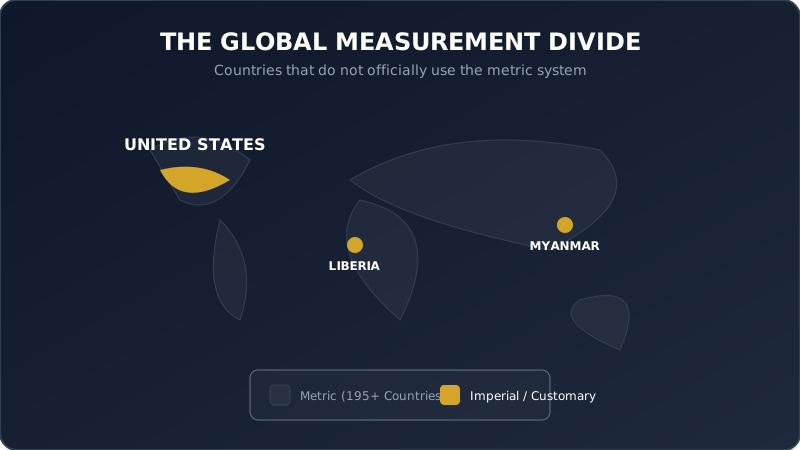
At its peak influence, the imperial system governed measurements in over 50 countries and territories across the British Empire. Today, only 3 countries have not officially adopted the metric system: the United States, Liberia, and Myanmar. The UK officially metricated in 1965 but retains imperial units for road signs (miles) and informal personal measurement (height in feet and inches, weight in stones).
Canada switched officially to metric in 1970 but Canadians still commonly report personal height in feet and inches. Australia switched in 1966 and completed the transition by 1988. India adopted metric in 1958. In each case, the transition took 10 to 30 years because replacing road signs, industrial equipment, and public habits requires sustained government effort.
The Birth of the Metric System
The history of the metric system begins in revolutionary France, where scientists designed a decimal measurement system to replace the chaotic mix of over 250,000 different local measurement units used across French provinces.
Why France Created the Metric System
France created the metric system in 1790 because pre-revolutionary France used an estimated 250,000 different measurement units. Each province, city, and trade guild maintained its own standards. A "pied" (foot) in Paris differed from a "pied" in Lyon. Tax collectors exploited this confusion, using larger measures when collecting grain and smaller measures when distributing it.
The French National Assembly commissioned the Academie des Sciences to create a universal system in 1790. The design goals were: base-10 arithmetic for easy calculation, a reference tied to nature (not a king's body), and units scalable from laboratory science to international trade. Scientists Pierre Mechain and Jean-Baptiste Delambre spent 6 years measuring the meridian from Dunkirk to Barcelona to define the meter.
The Introduction of Meters and Centimeters
France officially adopted the meter on April 7, 1795. The meter was defined as one ten-millionth of the distance from the equator to the North Pole along the meridian passing through Paris. The centimeter (1/100 of a meter) and millimeter (1/1000 of a meter) provided smaller subdivisions for practical height measurement.
The metric system's decimal structure meant all conversions within the system used powers of 10: 1 m = 100 cm = 1,000 mm. Converting 1.75 m to cm requires moving the decimal 2 places: 175 cm. This simplicity gave the metric system a practical advantage over imperial units, where converting feet to inches requires multiplying by 12 and yards to feet requires multiplying by 3.
How the Metric System Spread Worldwide
The metric system spread worldwide in 3 waves. Napoleon exported it to conquered territories between 1800 and 1815. The Metre Convention of 1875 created an international governing body (the Bureau International des Poids et Mesures, or BIPM) that attracted voluntary adoption by 17 founding nations. Post-colonial independence movements in the 20th century brought metric adoption to Africa, Asia, and the Pacific.
By 2024, 62 member states and 36 associate states participate in the BIPM. The World Health Organization (WHO) uses metric units exclusively for height data in its Multicentre Growth Reference Study. The Centers for Disease Control and Prevention (CDC) records height in centimeters for the National Health and Nutrition Examination Survey (NHANES) data.
Advantages of Metric Standardization
The metric system offers 4 advantages for height measurement. Decimal arithmetic eliminates complex fraction calculations. A single base unit (meter) scales with prefixes (centi-, milli-, kilo-) for any magnitude. International consistency means a height recorded in Germany reads identically in Japan. And scientific formulas (BMI = kg/m squared) work directly with metric inputs without conversion steps.
The 1959 International Yard Agreement
The 1959 International Yard Agreement unified the imperial measurement definitions across 6 English-speaking countries and tied them to the metric system with exact mathematical relationships. This treaty produced the conversion factors used in every modern height calculator.
Why a Global Standard Was Needed
By the 1950s, the US and UK inch definitions had diverged enough to cause problems in 3 areas: aerospace manufacturing (where tolerances measure in thousandths of an inch), geodetic surveying (where tiny per-unit errors compound over miles), and scientific instrumentation (where international calibration required a single standard).
The US inch (based on the 1893 Mendenhall Order: 1 meter = 39.37 inches) produced 1 inch = 2.540005 cm. The UK inch (based on the Imperial Standard Yard Bar) produced 1 inch = 2.539996 cm. The difference: 0.000009 inches (0.0002 mm). Small in absolute terms, but cumulative over long distances and large manufacturing runs.
Defining 1 Inch as Exactly 2.54 Centimeters
On July 1, 1959, the national standards bureaus of the United States, United Kingdom, Canada, Australia, New Zealand, and South Africa agreed that 1 yard = 0.9144 meters exactly. This definition fixed 3 relationships simultaneously:
1 yard = 0.9144 meters (exactly)
1 foot = 0.3048 meters (exactly)
1 inch = 2.54 centimeters (exactly)
The National Institute of Standards and Technology (NIST) in the United States adopted this definition immediately. These values have not changed since 1959 and form the basis of every height conversion formula used today.
Impact on International Measurement Systems
The 1959 agreement produced 4 lasting effects on measurement standardization:
- Eliminated US-UK inch discrepancy - One global inch value replaced two national definitions
- Tied imperial to metric permanently - Imperial units became derived from metric, not independent of it
- Ended physical standard dependence - No more bronze bars; the definition is a pure number
- Enabled exact digital conversion - Calculators can convert with zero rounding error because 2.54 is exact
How Height Measurement Tools Evolved
Height measurement tools evolved from carved stone rods to digital stadiometers over 5,000 years. Each generation of tools increased accuracy, reduced measurement variation, and expanded access to precise height data.
Measuring Rods and Rulers
The earliest dedicated measuring tools were cubit rods from Egypt (approximately 2700 BCE). These rods, carved from granite or wood, provided a physical standard that workers could carry to construction sites. Roman bronze rulers with marked subdivisions appeared by 100 CE. Medieval guilds kept certified measuring sticks locked in guild halls.
Wooden rulers dominated from the medieval period through the 19th century. They warped in humidity, shrank in dry conditions, and wore at the ends. Metal rulers solved the warping problem but were expensive until industrial manufacturing made them affordable in the 1800s.
Early Height Measuring Devices
Military recruitment drove the first purpose-built height measuring devices in the 18th century. Armies needed to quickly measure large numbers of recruits against minimum height standards. Wall-mounted height scales with sliding headpieces appeared in recruitment offices across Europe by 1750. These devices measured to the nearest quarter-inch (0.64 cm) and processed 50 to 100 recruits per hour.
The Rise of the Stadiometer

The stadiometer became the clinical standard for height measurement in the 20th century. A stadiometer consists of a vertical ruler fixed to a wall or base plate, with a horizontal sliding headpiece that rests on the subject's head. Modern stadiometers measure to the nearest 0.1 cm (0.04 inches).
The Harpenden stadiometer, developed by James Tanner at the Institute of Child Health in London, became the gold standard for auxology (the science of human growth). Tanner used Harpenden stadiometers in the longitudinal growth studies that produced the Tanner Scale for pubertal development. Modern clinics use wall-mounted or portable stadiometers manufactured to International Society for the Advancement of Kinanthropometry (ISAK) standards.
Modern Digital Measurement Technology
Digital height measurement entered clinical practice in the 2000s. Ultrasonic stadiometers emit sound pulses that bounce off the subject's head and calculate height from the time delay. Accuracy: within 0.1 cm (0.04 inches). Infrared and LiDAR-based systems scan the body in 3D, capturing height alongside other anthropometric data.
Smartphone apps now estimate height using augmented reality (AR) and LiDAR sensors. Apple's Measure app on iPhone 12 Pro and later uses LiDAR to measure height with reported accuracy of 1 to 2 cm (0.4 to 0.8 inches). These tools work for casual use but do not meet clinical standards, where stadiometer-level precision of 0.1 cm remains required for growth tracking and research.
How Height Standards Changed Healthcare and Science
Standardized height measurements transformed 3 areas of healthcare and science: pediatric growth monitoring, population health research, and international data comparability. Without uniform standards, none of these fields could produce reliable results.
Growth Tracking and Medical Records
Standardized height measurement enabled pediatric growth charts that track children against population norms. The WHO Multicentre Growth Reference Study (MGRS) measured 8,440 children across 6 countries (Brazil, Ghana, India, Norway, Oman, and the United States) using identical stadiometer protocols and metric units. The resulting WHO Child Growth Standards provide height-for-age z-scores used by pediatricians in 140 countries.
The CDC growth charts used in the United States derive from NHANES data collected since 1963. A child's height percentile (e.g., 75th percentile for age) is meaningful only because every measurement in the reference dataset used the same standardized technique and unit. A 1 cm measurement error shifts a child's percentile by 3 to 8 points.
Height Data in Research Studies
Height data in research studies reveals secular trends in human growth. The secular trend in height refers to the generational increase in average adult stature observed across industrialized nations since 1850. Dutch men averaged 165 cm (5'5") in 1860 and 183.8 cm (6'0.3") in 2020: a gain of 18.8 cm (7.4 inches) in 160 years.
The Dutch Hunger Winter Study (1944-1945) demonstrated how malnutrition disrupts height development. Children conceived during the famine averaged 1.8 cm (0.71 inches) shorter than those born before or after. The Fels Longitudinal Study, running since 1929 in Ohio, tracks intergenerational height changes using consistent measurement protocols across 90+ years of data collection.
Standardized Measurements Across Countries
International health organizations compare height data across countries to assess nutrition, economic development, and disease burden. The World Bank Human Capital Index uses average height as one indicator of childhood nutrition quality. UNICEF Child Growth Standards track stunting (height-for-age below -2 standard deviations) across 190 countries. These comparisons require identical measurement definitions: a centimeter in Bangladesh must equal a centimeter in Brazil. The 1959 agreement and universal metric adoption in science make this possible.
Height Measurement Around the World Today
Height measurement systems today split into metric (used officially by 195 of 197 countries) and imperial (used daily in the United States and informally in several other English-speaking nations).
Countries Using the Metric System
Approximately 195 of 197 countries use the metric system as their official measurement standard. All of Europe, Asia, Africa, South America, and Oceania measure height in centimeters and meters for government, medical, and scientific purposes. Medical records in metric countries list height as a 3-digit centimeter value (e.g., 175 cm) or a decimal meter value (1.75 m). Passports, driver's licenses, and identification documents in these countries report height in centimeters.
Countries Using Feet and Inches
The United States uses feet and inches for height in daily life, medical intake forms, driver's licenses, and passports. The UK uses feet and inches informally for personal height despite official metrication in 1965. Canada reports height in feet and inches in casual conversation but uses centimeters on government documents.
US medical systems record height in both units. An electronic health record might store 175.26 cm internally while displaying 5'9" on the patient-facing summary. The feet to inches calculator and inches to CM calculator handle these conversions using the exact 2.54 factor from the 1959 agreement.
Why Multiple Systems Still Exist
Multiple measurement systems persist because of 3 factors: institutional inertia, cultural identity, and conversion cost. The US attempted metrication through the Metric Conversion Act of 1975 but made it voluntary. Without mandatory enforcement, public adoption stalled. Road signs, construction standards, and consumer products remain in imperial units because replacing them costs billions.
Cultural identity reinforces the split. Americans perceive "5 foot 9" as intuitive and "175 centimeters" as foreign. British people maintain feet-and-inches for height as a point of cultural distinction despite using metric in scientific and commercial contexts. The coexistence of both systems creates the daily need for height conversion math that tools like the inches to feet calculator serve.
Key Milestones in Height Measurement History
The timeline below summarizes 5,000 years of measurement standardization history in 5 periods, from ancient civilizations through modern digital measurement.
| Period | Date Range | Key Development | Impact |
|---|---|---|---|
| Ancient Civilizations | 3000 BCE - 500 CE | Cubits, palms, digits, Roman foot | Body-based measurement enabled construction and trade within regions |
| Medieval Europe | 500 - 1500 CE | Barleycorn inch (1324), royal yard definitions | Legal standards reduced variation within nations |
| Creation of Metric | 1790 - 1875 | Meter defined (1795), Metre Convention (1875) | Decimal system enabled international scientific cooperation |
| The 1959 Agreement | 1959 | Inch fixed at 2.54 cm exactly | Unified imperial-metric relationship permanently |
| Modern Standards | 1960 - present | SI system, digital measurement, WHO growth standards | Global height data comparability for health and science |
Common Myths About Measurement History
Three common myths about measurement history circulate in popular culture. The historical record contradicts each one.
Was the Foot Based on a King's Foot?
No single king's foot defined the unit. The foot predates any known royal decree. Roman soldiers used the pes (29.6 cm) centuries before medieval English kings. The popular story that Henry I defined the yard from his nose to his thumb (making the foot one-third of that length) appears in no contemporary documents. The foot evolved through centuries of gradual standardization, not a single royal act. Multiple English statutes between 1266 and 1824 refined the definition incrementally.
Did Ancient People Measure Height Accurately?
Yes, within their system's precision limits. Egyptian cubit rods varied by less than 2 mm from the standard, achieving 0.4 percent accuracy. The Great Pyramid's base sides differ by less than 58 mm (2.28 inches) across 230 meters (755 feet), an error rate of 0.025 percent. Ancient people measured with high relative precision using their local standards. What they lacked was universal consistency across cultures, not skill within their own system.
Is the Imperial System Older Than the Metric System?
Yes, the imperial system is older than the metric system by centuries. The foot and inch existed as English legal standards from at least 1324 (Edward II's barleycorn statute). The metric system launched in 1795. The imperial system is roughly 470 years older as a formalized legal system. The units themselves (foot, inch) are even older, tracing to Roman antiquity around 200 BCE. The metric system is younger but reached global adoption faster because of its decimal design and scientific backing.
Frequently Asked Questions
Conclusion
Height standards evolved over time through 5,000 years of incremental progress: from body-based cubits in ancient Egypt, through medieval barleycorn definitions, to the metric system's creation in 1795, and finally to the 1959 International Yard Agreement that fixed the inch at exactly 2.54 cm. Each stage reduced measurement variation until the modern system achieved mathematical exactness.
The evolution of measurement standards produced the conversion factors that power every height calculation today. The imperial system history and metric system history converged in 1959, when six countries agreed on exact relationships between inches, feet, centimeters, and meters. These fixed values make accurate height conversion possible without ambiguity.
Use the Inches to CM Calculator to apply the exact 2.54 conversion factor, or the Inches to Meters Calculator for BMI-ready conversions. Read the Height Conversion Math guide to learn the step-by-step arithmetic behind every formula.
Related guides in this section: