
The 1959 International Yard Agreement: Why 1 Inch Equals Exactly 2.54 CM

Every time you convert inches to centimeters and multiply by 2.54, you are using a number that was fixed by international treaty on July 1, 1959. Before that date, the United States and United Kingdom used slightly different definitions of the inch, the foot, and the yard. The discrepancy was tiny but real, and it caused measurable problems in precision manufacturing, scientific publication, and cross-border engineering.
The 1959 International Yard and Pound Agreement resolved the conflict in a single document, defining the yard as exactly 0.9144 meters across all six signatory nations and locking the inch to exactly 25.4 millimeters forever.
This guide covers what the 1959 International Yard Agreement was, why it was needed, what each country agreed to, how the defined values were chosen, and how the agreement affects every height conversion calculation in use today.
Quick Answer: What Was the 1959 International Yard Agreement?
The 1959 International Yard and Pound Agreement was a treaty signed by 6 English-speaking nations that fixed the yard at exactly 0.9144 meters and the pound at exactly 0.45359237 kilograms. The 3 exact length values it established are:
| Imperial Unit | Exact Metric Equivalent | Derived From |
|---|---|---|
| 1 yard | 0.9144 meters (exact) | Defined directly |
| 1 foot | 0.3048 meters (exact) | 1/3 of 0.9144 |
| 1 inch | 0.0254 meters = 2.54 cm (exact) | 1/36 of 0.9144 |
The agreement took effect on July 1, 1959, and the values it defined remain in force today as the legal definition of the inch in every country that uses the imperial or US customary system.
Why Measurement Standardization Was Needed
Differences Between National Standards
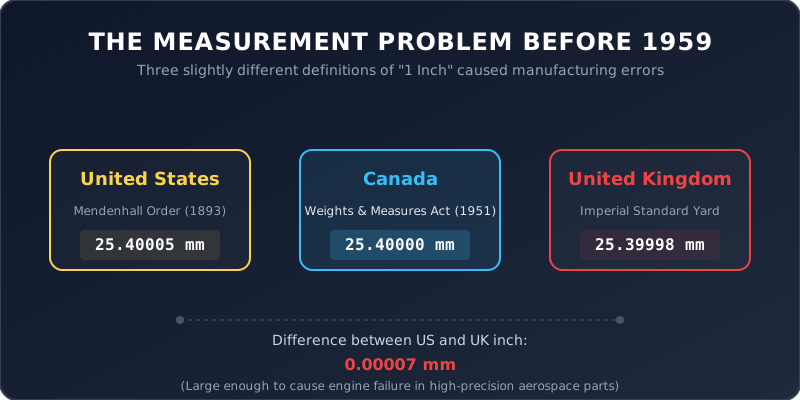
Before 1959, the United States and United Kingdom each defined the inch independently, producing values that differed by approximately 2 parts per million. The discrepancy arose from how each country had historically defined the inch in terms of the meter.
| Country | Inch Definition | Value in mm |
|---|---|---|
| United States | 1/39.37 meters (from 1893 Mendenhall Order) | 25.4000508 mm |
| United Kingdom | Derived from UK yard standard bar | 25.3999772 mm |
| 1959 International | Defined: exactly 25.4 mm | 25.4000000 mm (exact) |
The difference between the US and UK inch was 0.0000736 mm per inch. Over a 100-foot span, that accumulated to about 0.88 mm. That gap is insignificant for everyday use but became a real source of error in precision machining, land surveying, and scientific measurement, where tolerances could be as tight as a few thousandths of an inch.
Problems for Trade, Science, and Engineering

The pre-1959 inch discrepancy created 4 specific problems that motivated the agreement.
- Precision manufacturing: components designed to inch tolerances in the US and manufactured in the UK to UK-inch tolerances would not fit together perfectly, requiring rework and increasing costs
- Scientific publications: researchers in different countries using the same unit name were technically reporting slightly different quantities, introducing small systematic errors into international data comparison
- Surveying and mapping: land surveys conducted under US-inch standards could not be directly compared with surveys conducted under UK-inch standards without applying a small correction factor
- Standards documentation: engineering standards that specified dimensions in inches required separate versions for US and UK users, adding administrative overhead and increasing the risk of using the wrong specification
What Was the International Yard and Pound Agreement?
The Purpose of the Agreement
The International Yard and Pound Agreement was a bilateral technical agreement intended to eliminate the slight numerical differences between national definitions of the yard, foot, inch, and pound. It was not a treaty requiring parliamentary ratification but rather an administrative agreement between the national standards bodies of the signatory countries.
The National Bureau of Standards (NBS) represented the United States. The National Physical Laboratory (NPL) represented the United Kingdom. Equivalent bodies represented Canada, Australia, New Zealand, and South Africa. The agreement was negotiated over several years during the 1950s as part of broader post-war efforts to harmonize technical standards among English-speaking nations.
The chosen implementation date of July 1, 1959 gave industries and standards bodies time to update their documentation and tooling. The 6 months from signing to implementation was considered sufficient for the relatively minor numerical changes involved.
Key Measurement Standards Established
The agreement established exact metric equivalents for 2 base units, from which all other imperial length and mass conversions derive.
| Unit | Exact Metric Definition | Type |
|---|---|---|
| International yard | 0.9144 meters exactly | Length |
| International pound | 0.45359237 kilograms exactly | Mass |
All other imperial length units, including the inch (1/36 of a yard), the foot (1/3 of a yard), the rod (5.5 yards), the furlong (220 yards), and the mile (1,760 yards), derive their exact metric values from the defined yard. Similarly, all imperial weight units derive from the defined pound.
Which Countries Signed the Agreement?
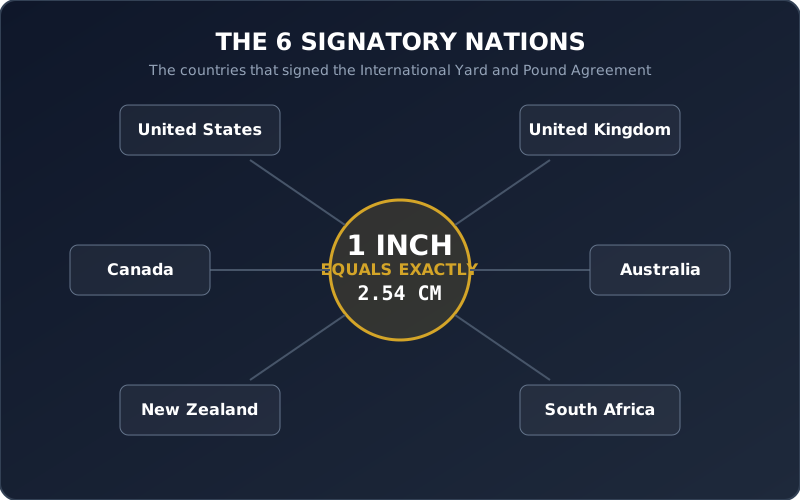
Six nations signed the 1959 International Yard and Pound Agreement. Each country had a different relationship with the yard and pound, and each experienced different downstream effects from the standardization.
United States
The US entered the agreement with an inch defined as 1/39.37 meters (approximately 25.4000508 mm), giving up about 0.5 nanometers per inch to reach the agreed 25.4 mm value. The change had no practical effect on everyday measurement but was significant for the land surveying community, which used slightly different calculations for geodetic (large-scale Earth-surface) measurements.
To protect existing land survey records, the US retained a separate "US survey inch" equal to 1/39.37 meters for surveying purposes. This survey inch coexisted with the international inch for over 60 years until NIST deprecated it on January 1, 2023.
United Kingdom
The UK entered the agreement with its inch defined through the British yard standard bar, producing an inch value of approximately 25.3999772 mm, fractionally shorter than the agreed 25.4 mm. The UK's adjustment upward was also sub-nanometer per inch and had no practical everyday impact.
The agreement aligned well with the UK's ongoing discussions about metrication. The 1963 Weights and Measures Act formally incorporated the international inch into British law, and the UK began its official metrication program in 1965, transitioning most measurements to metric over the following decades.
Canada
Canada used the same yard standard as the UK before 1959 and adopted the international inch as part of its commitment to harmonizing measurement with both the US and UK, its two largest trading partners. Canada's economic position between the two markets made measurement compatibility particularly important for its manufacturing sector.
Canada began formal metrication in 1970 and completed most official conversion by 1985. Despite official metric status, Canada's proximity to the US means imperial units remain in everyday informal use, particularly for height (feet and inches), weight (pounds), and residential construction (feet and square feet).
Australia
Australia signed the agreement while using UK-derived yard standards through its status as a British Commonwealth member, and adopted the international values as part of its broader alignment with Commonwealth measurement standards.
Australia undertook one of the most comprehensive national metrication programs in history between 1966 and 1988, covering currency (decimal currency in 1966), length and mass (1970), temperature (1972), and road signs and speed limits (1974). Today Australia uses metric almost exclusively in official and everyday contexts.
New Zealand
New Zealand signed as a Commonwealth nation using UK-derived standards, and completed one of the fastest national metrication programs among the signatory countries, converting from imperial to metric between 1969 and 1976.
New Zealand's metrication was driven by trade practicalities rather than ideology. As a primary producer exporting to increasingly metric European markets, the country had strong commercial incentives to align with international measurement standards as quickly as possible.
South Africa
South Africa signed the agreement as a Commonwealth member and subsequently carried out a phased metrication program from 1971 to 1977 under the Metrication Advisory Board.
South Africa's conversion was notable for its systematic approach, converting one industry sector at a time with dedicated training programs for each. The country now uses metric exclusively for all official purposes.
The Definition of the International Yard
How the Yard Was Defined
The international yard was defined as exactly 0.9144 meters, a value chosen because it is the closest round number to the weighted average of the pre-existing US and UK yard definitions. The US yard before 1959 was approximately 0.9144018288 meters (derived from 3,600/3,937 meters). The UK yard before 1959 was approximately 0.9143992 meters (derived from the physical yard standard bar held at the Board of Trade).
The value 0.9144 meters was not derived from any physical measurement during the negotiation. It was selected arithmetically as the number that minimized the combined adjustment required of both parties while remaining a clean decimal value in metric terms.
1 foot = 0.3048 m (exact: 0.9144 / 3)
1 inch = 0.0254 m = 2.54 cm (exact: 0.9144 / 36)
1 mile = 1,609.344 m (exact: 0.9144 x 1,760)
Relationship Between Yards, Feet, and Inches
The internal structure of the imperial length system (12 inches per foot, 3 feet per yard) was not changed by the 1959 agreement. Only the relationship between the yard and the meter was altered. This means the agreement's effects flow through the entire imperial length system automatically:
| Imperial Unit | Inches | Exact Metric Value (post-1959) |
|---|---|---|
| 1 inch | 1 | 25.4 mm = 2.54 cm |
| 1 foot | 12 | 304.8 mm = 30.48 cm |
| 1 yard | 36 | 914.4 mm = 91.44 cm |
| 1 rod | 198 | 5,029.2 mm = 5.0292 m |
| 1 furlong | 7,920 | 201,168 mm = 201.168 m |
| 1 mile | 63,360 | 1,609,344 mm = 1,609.344 m |
All of these conversions are exact by definition, with no rounding in the conversion factor itself. Rounding only occurs when the final result is expressed to fewer decimal places than the exact value requires.
Why 1 Inch Equals Exactly 2.54 CM
The Official Conversion Standard
1 inch equals exactly 2.54 cm because the 1959 agreement defined the yard as exactly 0.9144 meters, and 1 inch is exactly 1/36 of a yard: 0.9144 / 36 = 0.0254 meters = 2.54 cm. The choice of 0.9144 meters for the yard was made precisely because it produces a clean, round number for the inch in metric terms.
The value 2.54 had been informally used as an approximation of the inch-to-centimeter ratio for many years before 1959. The 1935 British Standards Institution had already adopted 1 inch = 2.54 cm as a working standard for engineering drawings. The 1959 agreement promoted this working approximation to an exact legal definition.
💡 Pro Tip: The most common mistake when converting inches to centimeters is using 2.5 instead of 2.54 as a mental shortcut. Over a typical adult height of 67 inches (5'7"), using 2.5 produces 167.5 cm instead of the correct 170.18 cm, an error of 2.68 cm. Always use 2.54, or use our inches to cm calculator for instant accurate results.
Impact on Measurement Accuracy
Because 2.54 is a defined value rather than a measured approximation, conversions between inches and centimeters carry no inherent rounding error from the conversion factor itself. The only rounding that occurs is in the final output, when a calculated result is expressed to fewer decimal places than the full exact value.
For example, 5 feet 9 inches = 69 inches. 69 x 2.54 = 175.26 cm exactly. That result is not approximate: it is the precise centimeter equivalent of 69 international inches. If you write 175.3 cm, you have introduced rounding, but the conversion factor 2.54 itself was exact. This is fundamentally different from how many conversions work: in science, most unit conversions involve irrational numbers or measured physical constants that introduce inherent uncertainty. Inch-to-centimeter does not.
How the Agreement Changed Global Measurements
Effects on Manufacturing
The agreement eliminated the need for country-specific correction factors when manufacturing components to inch tolerances across US and UK production facilities. Before 1959, a machinist in the UK working to a drawing specified in US inches needed to apply a small correction factor. After 1959, US inches and UK inches were the same unit by definition.
This mattered most in the aerospace and defense industries, which were undergoing rapid expansion in the late 1950s and involved close US-UK collaboration. Aircraft components, weapons systems, and electronic equipment all required tight dimensional tolerances across national boundaries, and the pre-1959 inch discrepancy had been a persistent source of low-level friction in these programs.
Effects on Engineering and Construction
For engineering and construction, the agreement meant that a drawing or specification written in inches could be used directly in any of the 6 signatory countries without conversion or correction. This simplified the exchange of technical documentation between the US, UK, Canada, Australia, New Zealand, and South Africa.
Construction standards, building codes, and structural engineering specifications were increasingly being shared across Commonwealth countries and between the US and UK in the post-war reconstruction era. A unified inch reduced the administrative complexity of working across those national boundaries.
Effects on International Trade
For international trade in manufactured goods, the agreement simplified product specifications, reduced the risk of measurement-related disputes, and made it easier for manufacturers to certify that their products met import standards in multiple markets simultaneously.
The agreement also provided a clean foundation for the inch's relationship with the metric system, which was gaining international ground through the 1960 adoption of SI units. A manufacturer who needed to express dimensions in both inches and millimeters now had an exact conversion factor (2.54) rather than an approximation, which simplified dual-unit labeling on products intended for both metric and imperial markets.
International Yard vs Previous Yard Standards
Differences Before 1959
The pre-1959 yard standards in the US and UK had different historical origins, producing a small but real numerical divergence. The US yard was derived from the 1893 Mendenhall Order, which defined the meter in terms of the US prototype meter bar, then computed the yard as 3,600/3,937 meters. The UK yard was derived from a physical bronze standard bar created in 1855 and held at the Standards Department of the Board of Trade in London.
| Standard | Yard in Meters | Inch in mm | Origin |
|---|---|---|---|
| US yard (pre-1959) | 0.9144018288 m | 25.4000508 mm | 1893 Mendenhall Order |
| UK yard (pre-1959) | approx. 0.9143992 m | approx. 25.3999772 mm | 1855 bronze standard bar |
| International yard (1959) | 0.9144 m (exact) | 25.4 mm (exact) | Agreed definition |
Why Uniform Standards Were Important
Uniform measurement standards matter not because the differences are large but because precision industries operate at tolerances where even sub-nanometer discrepancies compound across a production run. A machining operation that produces 10,000 components to a specified inch dimension will accumulate the pre-1959 US-UK inch discrepancy 10,000 times, potentially causing a systematic offset in parts that are supposed to be identical.
Uniform standards also matter for legal and contractual reasons. A contract specifying delivery of material "to a length of 100 inches" should mean exactly the same thing to both parties regardless of which country they are in. Before 1959, that contract would have required a specification of which inch definition applied. After 1959, the international inch is unambiguous.
How the 1959 Agreement Affects Height Conversions Today
Inches to CM Conversions
Every inches-to-centimeters conversion uses the factor 2.54, which is the direct result of the 1959 agreement. Without the agreement, the factor would be approximately 2.540005 in the US and approximately 2.539997 in the UK, and a height stated as "69 inches" would be technically ambiguous without specifying which national inch was intended.
| Height (ft/in) | Total Inches | Exact cm (x 2.54) |
|---|---|---|
| 5'0" | 60 in | 152.40 cm |
| 5'4" | 64 in | 162.56 cm |
| 5'7" | 67 in | 170.18 cm |
| 5'9" | 69 in | 175.26 cm |
| 6'0" | 72 in | 182.88 cm |
| 6'2" | 74 in | 187.96 cm |
Feet to CM Conversions
The 1959 agreement also fixes the foot at exactly 30.48 cm, making feet-to-centimeter conversion equally exact.
centimeters = (feet x 12 + inches) x 2.54 (exact)
For compound heights expressed as feet and inches, convert the whole height to total inches first (multiply feet by 12 and add the remaining inches), then multiply by 2.54. See our full guide on how height conversion math works for all 8 height conversion formulas with worked examples.
Height Measurement Standards
The 1959 agreement means that when a US-measured height and a metric-measured height are compared, the conversion between them is legally exact in both directions. A person recorded as 5'9" in a US medical record and 175 cm in a European medical record is not exactly the same height: 5'9" is 175.26 cm, not 175.00 cm. That 0.26 cm gap is real and would show up in a direct physical comparison.
This is why height data in scientific studies that combine US imperial and international metric records must include a conversion step, and why that conversion can be done with complete precision rather than approximation. Use our inches to cm calculator or our cm to feet calculator for exact conversions.
Interesting Facts About the Agreement
- The US survey inch survived until 2023: To avoid disrupting land survey records, the US created a separate "US survey inch" (1/39.37 m = 25.4000508 mm) that coexisted with the international inch for 64 years. NIST formally deprecated it on January 1, 2023, requiring all US surveying to use the international inch from that date.
- The 2.54 ratio had been used informally for decades: The British Standards Institution adopted 1 inch = 25.4 mm as an unofficial engineering working standard as early as 1930. The 1959 agreement turned a practical approximation into an exact legal definition.
- The pound change was larger in relative terms: While the inch changed by less than 0.0003%, the US and UK pound definitions before 1959 differed by a larger relative margin. The agreement's pound definition (0.45359237 kg) was also new territory, as neither country had previously defined the pound to that precision in metric terms.
- The agreement has no sunset clause: The 1959 definitions remain in force indefinitely. There is no mechanism or pending negotiation to change the inch from 2.54 cm. The value is stable as a legal definition even as the underlying meter definition has changed (from the platinum bar to the speed of light), because the inch is defined in terms of the meter and follows any change in the meter's physical basis automatically.
- Canada and South Africa have fully metricated since signing: Of the 6 signatory nations, 4 (UK, Canada, Australia, New Zealand, South Africa) have completed substantial metrication programs and now use metric as their primary official system. The agreement unified their inch definitions just before most of them stopped using the inch as a primary unit.
- The agreement covered avoirdupois pound only: The agreement defined the international avoirdupois pound, which is the pound used for body weight, food, and general commerce. It did not cover the troy pound (used for precious metals, approximately 373.24 g) or the apothecary pound, which are different units with the same name.
Frequently Asked Questions
What was the 1959 International Yard Agreement?
The 1959 International Yard and Pound Agreement was a treaty signed on July 1, 1959 by the United States, United Kingdom, Canada, Australia, New Zealand, and South Africa that defined the yard as exactly 0.9144 meters and the pound as exactly 0.45359237 kilograms. This made the inch exactly 2.54 centimeters and the foot exactly 30.48 centimeters. It replaced the slightly different national definitions that each country had previously used and created a single, unified standard for the inch and yard across all 6 nations.
Why was the agreement created?
The agreement was created because the US and UK used slightly different inch values, approximately 25.4000508 mm in the US and approximately 25.3999772 mm in the UK, causing problems in precision manufacturing, scientific measurement, and international trade. The 2-parts-per-million discrepancy was small enough to be invisible in everyday use but significant enough to cause errors in precision engineering and to require correction factors in cross-border technical specifications. The agreement eliminated the discrepancy by assigning a single agreed value to both countries.
Which countries signed the agreement?
Six countries signed the 1959 International Yard and Pound Agreement: the United States, United Kingdom, Canada, Australia, New Zealand, and South Africa. These were the principal English-speaking nations that used the yard and pound as primary measurement units. The national standards bodies for each country were the signing parties, not the governments directly. The agreement took effect on July 1, 1959.
Why is 1 inch exactly 2.54 cm?
One inch equals exactly 2.54 cm because the 1959 agreement defined the yard as exactly 0.9144 meters, and one inch is exactly 1/36 of a yard: 0.9144 / 36 = 0.0254 meters = 2.54 cm. The value 2.54 was chosen because it was the closest round decimal number to both the US inch (25.4000508 mm) and UK inch (25.3999772 mm), minimizing the adjustment required by either party. The British Standards Institution had already used 25.4 mm as an unofficial working standard since around 1930, so the value was already familiar to the engineering community.
Is the 2.54 cm conversion exact?
Yes. The conversion 1 inch = 2.54 centimeters is exact by international legal definition, not an approximation. It follows that 1 foot = 30.48 cm exactly, 1 yard = 91.44 cm exactly, and 1 mile = 1,609.344 meters exactly. Any rounding that appears in inch-to-centimeter calculations comes from rounding the final output to fewer decimal places, not from the conversion factor. The factor 2.54 carries zero inherent error because it is defined rather than measured.
Explore More Measurement and Conversion Guides
Dig deeper into measurement history, unit definitions, and height conversion tools.
Why 1 Inch = Exactly 2.54 CM →
The full technical story behind the 2.54 definition and the 1959 agreement.
History of the Inch →
From Roman uncia to barleycorns to the modern international definition.
Height Conversion Math →
All 8 height conversion formulas with step-by-step worked examples.
Inches to CM Calculator →
Convert any height in feet and inches to centimeters instantly.