
History of the Inch: Origins, Evolution, and Modern Definition

The inch has been used as a unit of length for over 2,000 years, tracing directly to the Roman uncia, one-twelfth of a Roman foot. It survived the fall of Rome, absorbed Anglo-Saxon customs, was formalized by medieval English kings, and was finally pinned to an exact metric value by international treaty in 1959.
Most people use inches every day, for height measurements, screen sizes, and construction dimensions, without knowing how a unit invented in ancient Rome became locked to exactly 2.54 centimeters by a group of English-speaking nations in the mid-20th century.
This guide covers the complete history of the inch: where it came from, how barleycorns shaped it, why regional versions splintered across Europe, how the 1959 international agreement settled the definition, and how the inch is used across different industries today.
Quick Answer: Where Did the Inch Come From?
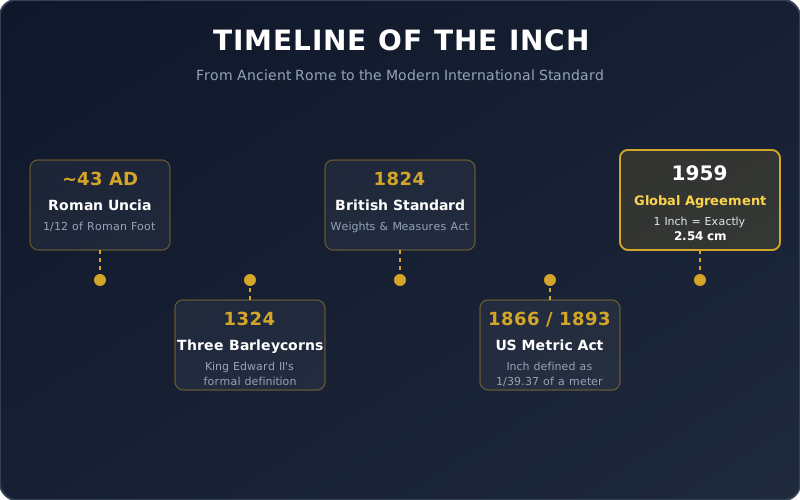
The inch comes from the Latin word uncia, meaning one-twelfth, and was the twelfth part of the Roman foot (pes). The 3 most important milestones in inch history are:
| Date | Event | Impact |
|---|---|---|
| ~43 AD | Romans bring the uncia to Britain | Foundation of the inch established |
| 1324 | Edward II defines inch as 3 barleycorns | First formal legal definition in England |
| 1959 | International Yard and Pound Agreement | 1 inch = exactly 2.54 cm, globally |
The inch is now defined in law in every country on Earth as exactly 2.54 centimeters, even in countries that use metric exclusively for everyday measurements.
What Is an Inch?
Modern Definition of an Inch
An inch is a unit of length equal to exactly 2.54 centimeters (25.4 millimeters) under the 1959 International Yard and Pound Agreement. The symbol is "in" or the double-prime mark (″). There are 12 inches in 1 foot and 36 inches in 1 yard.
The inch belongs to both the US customary system and the British imperial system. Both systems share the same inch value for all practical purposes, unified by the 1959 agreement. This makes the inch one of the few measurement units that is simultaneously part of two named measurement systems with an identical value in both.
Why the Inch Is Still Used Today
The inch persists in everyday use because cultural familiarity, established infrastructure, and industry standards all reinforce each other in ways that make switching costly. In the United States, human height is reported in feet and inches, construction blueprints use inches as their precision unit, and consumer electronics describe screen sizes in diagonal inches globally, even in metric countries.
A person who grew up knowing they are 5'10" has a physical intuition for what that means. Rebuilding that intuition in centimeters takes years of deliberate effort. Multiply that across 330 million people and the cost of conversion becomes enormous, not just in infrastructure, but in human cognition.
The Origins of the Inch
Early Roman Measurements
The direct ancestor of the inch is the Roman uncia, one-twelfth of the Roman foot (pes), which measured approximately 29.6 cm. This made the Roman uncia about 24.7 mm, slightly shorter than the modern inch of 25.4 mm. The word uncia also served as the origin for the word "ounce," since the same fraction (one-twelfth) applied to both length and weight in the Roman system.
Rome's standardized measurement system, built around the pes, uncia, and passus (pace), spread across the entire empire through military engineering, road building, and trade. When Roman legions occupied Britain from 43 AD to 410 AD, they brought these measurement standards with them. Roman roads, forts, and towns were built to Roman dimensions, embedding those measurements into British infrastructure for centuries.
After Rome withdrew, the physical structures remained, and the memory of Roman measurement conventions persisted in trade and craftsmanship.
Anglo-Saxon Influences
The Anglo-Saxons who settled Britain after the Romans adopted and adapted the Roman measurement tradition, calling the unit "ynce," the Old English form of uncia. Anglo-Saxon measurement also drew on body-based standards: the thumb width (roughly equal to an inch), the palm (4 fingers), and the cubit (forearm length). These parallel body references reinforced the Roman-derived unit and helped keep its approximate size consistent across different communities.
The thumb-width definition gave rise to a practical mnemonic that many cultures shared independently: the width of an adult male thumb at the base of the nail is approximately 1 inch. This body-reference approach made the unit easy to estimate without tools, which mattered enormously in an era before standardized measuring instruments were widely available.
Medieval England and the Inch
Medieval England produced the first formal legal definition of the inch: the 1324 Statute of Edward II, which defined 1 inch as the length of 3 barleycorns, round and dry, placed end to end. This statute also defined the foot as 12 inches and the yard as 3 feet, the same relationships still used today. The barleycorn definition was a practical improvement over body-based standards because it gave a replicable physical standard that any party to a transaction could verify.
The medieval inch was embedded in a measurement system that also included the ell (45 inches, used for cloth), the rod (198 inches), the furlong (7,920 inches), and the mile (63,360 inches). These relationships were built on commercial necessity: cloth merchants needed the ell, surveyors needed the rod and furlong, and road builders needed the mile.
The Famous "Three Barleycorns" Definition
How Barleycorns Were Used as a Measurement

Edward II's 1324 statute specified that 1 inch equaled the length of 3 barleycorns, specifically round, dry barleycorns from the middle of an ear of barley, placed end to end in a straight line. A single barleycorn measured approximately 8.47 mm, making 3 barleycorns approximately 25.4 mm, which aligns almost exactly with the modern international inch of 25.4 mm.
The barleycorn survived as a unit in British shoe sizing. UK shoe sizes are still measured in barleycorns: each whole shoe size equals 1 barleycorn (1/3 inch, approximately 8.47 mm). A UK men's size 9 shoe is 3 barleycorns larger than a size 6. The shoe sizing barleycorn is one of the few direct links between medieval measurement practice and a modern consumer application.
💡 Pro Tip: You can still verify the barleycorn definition yourself. Take 3 round, dry barleycorns from the middle section of a barley stalk, lay them end to end, and measure them. They will be within 1 to 2% of exactly 1 inch. The medieval standard is remarkably accurate by modern measurement.
Limitations of Early Measurement Methods
Natural standards like barleycorns had a core limitation: barleycorns from different regions, harvests, and storage conditions varied in size. A well-stored English barleycorn from a good harvest measured differently from a French barleycorn from a drought year. This variability meant that the inch could drift by several percent between regions and trade partners.
Body-based standards had the same problem. A king's thumb was not the same size as a peasant's thumb. A measuring rod cut to the right length in London would not match a rod cut in York. Pre-industrial England had dozens of local inch definitions in use simultaneously, causing constant friction in trade, land measurement, and taxation.
How the Inch Evolved Over Time
Regional Variations
Before international standardization, the inch varied significantly across Europe, with different countries defining the unit differently based on their own foot standards.
| Country / Region | Local Inch Name | Approximate Length |
|---|---|---|
| England | Inch | ~25.4 mm (from barleycorn) |
| France | Pouce | ~27.07 mm (pre-metric) |
| Prussia / Germany | Zoll | ~26.15 mm |
| Netherlands | Duim | ~25.4 mm (Amsterdam foot) |
| Scotland | Inch (Scots) | ~25.29 mm |
| Norway / Denmark | Tomme | ~26.15 mm |
These variations created real problems for international trade. A cloth merchant selling English fabric to a French buyer by the inch was delivering a different amount than a French cloth merchant would expect. Conversion tables between national inch definitions were published in trade manuals throughout the 17th and 18th centuries.
Standardization Efforts
Efforts to standardize the inch accelerated alongside the industrial revolution, as manufacturing tolerances and international trade required precise, reproducible measurements. 4 key standardization events shaped the modern inch:
- 1824 British Weights and Measures Act: standardized the British yard as the primary unit, from which the inch derived as exactly 1/36 of a yard; the inch inherited formal legal status for the first time in British law
- 1866 US Metric Act: the US defined the yard (and therefore the inch) in metric terms for the first time, setting 1 meter = 39.37 inches; this gave the US inch a value of approximately 25.400508 mm
- 1893 Mendenhall Order: the US officially adopted the metric system as the legal basis for all US customary measurements, meaning the inch was defined as a fraction of the meter rather than as a separate primary standard
- 1959 International Yard and Pound Agreement: fixed 1 inch = exactly 25.4 mm, unifying the US and UK definitions permanently and providing the definition still in use today
The Relationship Between Inches, Feet, and Yards
Why 12 Inches Make a Foot
12 inches equal 1 foot because the Roman foot (pes) was divided into 12 unciae, and this duodecimal (base-12) structure was inherited directly by the English system. The number 12 was favored for practical reasons: it divides evenly into halves (6), thirds (4), quarters (3), sixths (2), and twelfths (1), giving more useful fractions than the base-10 system offers without decimals. This made 12-inch division ideal for pre-calculator era trade, where merchants needed to quickly calculate fractional amounts.
The foot itself was grounded in anatomy, as the approximate length of an adult male foot. Combining the foot (body reference) with the inch (agricultural and Roman reference) and giving them a clean 12:1 relationship created a system that was both practical and memorable.
Why 3 Feet Make a Yard
3 feet equal 1 yard because the yard was historically defined as a body-length measurement, specifically the distance from King Henry I's nose to the tip of his outstretched thumb, which corresponds naturally to approximately 3 adult foot-lengths. The word "yard" itself comes from the Old English "gerd" or "gyrd," meaning a rod or stick used as a measuring implement.
The yard was England's standard fabric measurement for centuries. Cloth merchants measured fabric in yards by stretching it from their nose to their outstretched hand, a gesture that could be repeated reliably by any adult of average build. The 3-foot yard was legally standardized by the 1824 British Weights and Measures Act, which defined the yard as the primary imperial length standard from which all other lengths, including the inch, derived.
The International Standardization of the Inch
The 1959 International Yard and Pound Agreement
On July 1, 1959, the United States, United Kingdom, Canada, Australia, New Zealand, and South Africa signed the International Yard and Pound Agreement, which defined 1 yard as exactly 0.9144 meters, making 1 inch exactly 2.54 centimeters.
Before this agreement, the US and UK operated with slightly different inch values. The US inch was defined as 1/39.37 meters (approximately 25.4000508 mm) through the 1866 Metric Act. The UK inch was defined through its own yard standard at approximately 25.3999772 mm. The difference was tiny, about 2 parts per million, but it was enough to cause problems in precision engineering, scientific measurements, and international trade in manufactured goods.
The agreed value of exactly 25.4 mm was chosen as the closest convenient round number that split the difference between the two existing national standards. The old US survey inch (25.4000508 mm) was retained separately as the "US survey inch" for land survey purposes and was not retired until 2023, when the National Institute of Standards and Technology (NIST) officially deprecated it in favor of the international inch.
Why 1 Inch Equals Exactly 2.54 CM
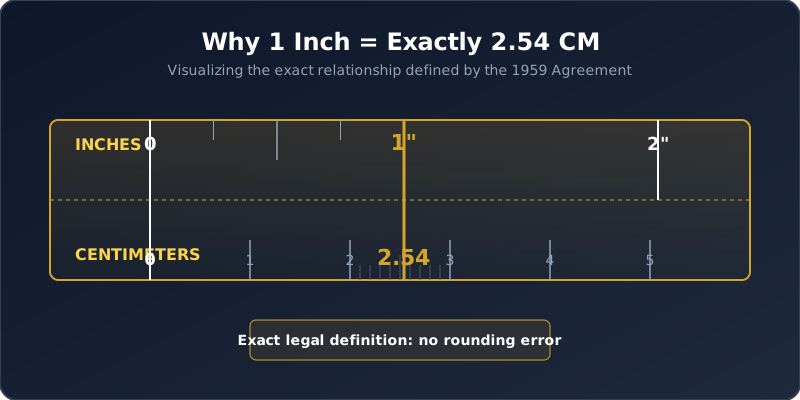
1 inch equals exactly 2.54 cm because it is a defined relationship, not a measured one. The value is exact by international legal agreement, with no rounding or approximation. This means all inch-to-centimeter conversions carry no inherent conversion error, only rounding errors introduced by the number of decimal places you choose to use.
1 foot = 30.48 cm (exact: 12 x 2.54)
1 yard = 91.44 cm (exact: 36 x 2.54)
For a full technical breakdown of this conversion, see our guide on why 1 inch equals exactly 2.54 cm.
How the Inch Is Used Today
Height Measurements
In the United States, human height is measured and reported in feet and inches, never in total inches alone in conversation. A person who is 69 inches tall is described as 5 feet 9 inches (5'9"), not "69 inches tall." The compound format (feet + inches) is unique to the imperial system and has no direct equivalent in metric, where a single centimeter or meter value describes height completely.
Use our inches to cm calculator to convert any height in feet and inches to centimeters instantly, or our cm to feet calculator for the reverse.
Construction and Engineering
US construction uses inches as the primary precision unit, with dimensions expressed in feet and fractional inches on all blueprints, lumber specs, and building codes. Standard lumber dimensions are specified in inches: a 2x4 board is nominally 2 inches by 4 inches (actual dimensions 1.5 x 3.5 inches). Plywood sheets are 4 feet x 8 feet. Standard residential ceiling height is 8 feet. Pipe diameters, screw sizes, and bolt threads all use inch-based specifications.
Precision engineering uses decimal inches to thousandths (0.001 inch = 0.0254 mm). Machining tolerances on aerospace components can be specified to ten-thousandths of an inch (0.0001 inch = 0.00254 mm). Switching US engineering to metric would require re-certifying every machinist, re-writing every build standard, and replacing every inch-calibrated measuring tool simultaneously.
Electronics and Screen Sizes
Television, monitor, and smartphone screen sizes are measured in diagonal inches globally, even in metric countries where inches are never used for anything else. A "65-inch TV" describes a screen with a diagonal measurement of 65 inches (165.1 cm). This convention began in the United States when the consumer electronics industry was developing global standards in the mid-20th century and has never been changed despite widespread metric adoption elsewhere.
Display resolution also uses inches: dots per inch (DPI) and pixels per inch (PPI) are the standard units for screen and print resolution worldwide. A smartphone screen rated at 460 PPI has 460 pixels in every inch of the display, regardless of whether the country of sale uses metric or imperial for other measurements.
Inch vs Centimeter: A Historical Comparison
The inch and the centimeter both emerged from attempts to standardize length measurement, but from completely different traditions. The inch evolved organically from Roman, agricultural, and body-based standards over 2,000 years. The centimeter was invented deliberately in 1795 as part of the French metric system, defined as one-hundredth of a meter, itself defined as one ten-millionth of the distance from the equator to the North Pole.
| Feature | Inch | Centimeter |
|---|---|---|
| Origin | Roman uncia (~43 AD) | French metric system (1795) |
| Original basis | 1/12 of Roman foot; later 3 barleycorns | 1/100 of a meter (terrestrial measurement) |
| Modern definition | 25.4 mm exactly (1959) | 1/100 of a meter (SI base unit) |
| Relationship to meter | 1 inch = 0.0254 m | 1 cm = 0.01 m |
| Countries of primary use | USA, informally in UK and Canada | ~195 countries |
| Global specialty use | Screen sizes, aviation, engineering | Science, medicine, international trade |
Both units are now defined in terms of the meter, which is itself defined in terms of the speed of light. This means the inch ultimately traces back to a physical constant of the universe, a long way from three barleycorns laid end to end.
Interesting Facts About the Inch
Unusual Historical Definitions
- Scotland had its own inch: The Scottish inch (Scots inch) was approximately 25.29 mm, slightly shorter than the English inch. Scotland used this standard until the Acts of Union in 1707 merged Scottish and English measurement standards.
- The thumbnail definition: Some medieval sources defined the inch as the width of the thumb at the nail, a body reference that varied person-to-person but gave an immediate physical intuition for the unit's scale.
- The "inch of candle" was a time unit: In Scotland, a legal proceeding could be timed by burning a candle exactly 1 inch long; when it burned out, the allotted time was up. This "inch of candle" was used in roup (auction) procedures into the 18th century.
- The US survey inch was different until 2023: The US survey inch (1/39.37 meters, approx. 25.4000508 mm) was used for land surveying for over 150 years and was officially retired on January 1, 2023, when NIST deprecated it in favor of the international inch.
- Printers had their own inch: Typography used the pica (1/6 inch) and point (1/72 inch) as sub-divisions of the inch for type size, a system still used in digital typography today. The CSS "pt" unit is still exactly 1/72 inch.
The Inch in Different Countries
While the inch is formally used for everyday measurement only in the United States, it appears informally in everyday life across many metric countries.
In Canada, height is almost always given in feet and inches despite metric being the official system. Residential real estate lists room sizes in feet and inches. Oven and cooking temperatures use Fahrenheit.
In the United Kingdom, people describe their height in feet and inches, buy screen sizes in inches, and think of short distances in inches and feet even though metric is the official standard for almost everything else.
In Australia and New Zealand, older generations still use feet and inches for height and know their weight in stones, while younger generations use metric exclusively. The inch has persisted through cultural transmission in ways that official metrication campaigns could not fully eliminate.
Common Inch Conversions
Inches to CM
| Inches | Centimeters | Common Context |
|---|---|---|
| 1 in | 2.54 cm | Ruler graduation |
| 6 in | 15.24 cm | Standard ruler length |
| 12 in | 30.48 cm | 1 foot |
| 36 in | 91.44 cm | 1 yard |
| 60 in | 152.40 cm | 5 feet (common short height) |
| 72 in | 182.88 cm | 6 feet (common tall height) |
Inches to Feet
Example: 67 inches / 12 = 5 remainder 7, so 5 feet 7 inches (5'7"). Example: 74 inches / 12 = 6 remainder 2, so 6 feet 2 inches (6'2"). See our full guide on how height conversion math works for all 8 height conversion formulas.
Inches to Meters
Example: 69 inches x 0.0254 = 1.7526 meters. Example: 72 inches x 0.0254 = 1.8288 meters (exactly 6 feet). The value 0.0254 is exact (2.54 / 100), so all inch-to-meter conversions are exact by definition, with rounding only introduced by the decimal places you choose to display.
Frequently Asked Questions
Where did the inch originate?
The inch originated from the Roman uncia, meaning one-twelfth of the Roman foot (pes). Roman legions brought the uncia to Britain during the occupation from 43 AD to 410 AD. The Anglo-Saxons adapted it as the "ynce," and it was formally defined in English law by King Edward II in 1324 as 3 barleycorns laid end to end. The modern definition, exactly 2.54 centimeters, was fixed by international agreement in 1959.
Why was the inch based on barleycorns?
Barleycorns were chosen because they were a consistent, widely available natural reference that any merchant or farmer could verify without special equipment. The 1324 statute of Edward II specified 3 dry, round barleycorns from the middle of an ear of barley, laid end to end. A single barleycorn measures approximately 8.47 mm, making 3 barleycorns approximately 25.4 mm, remarkably close to the modern inch. The barleycorn definition also survives in UK shoe sizing today, where each whole shoe size equals 1 barleycorn (1/3 inch).
When was the inch standardized?
The inch was standardized to its current international definition on July 1, 1959, when 6 English-speaking nations signed the International Yard and Pound Agreement. Before that date, the US inch (approx. 25.4000508 mm) and UK inch (approx. 25.3999772 mm) were slightly different. The 1959 agreement set both to exactly 25.4 mm, creating a single global definition. The old US survey inch (25.4000508 mm) was used in land surveying until it was officially retired on January 1, 2023.
Why is an inch exactly 2.54 cm?
One inch equals exactly 2.54 cm because it is a legal definition established by international treaty in 1959, not a measurement or approximation. The value 2.54 was selected because it is the closest round number to both the US inch (25.4000508 mm) and UK inch (25.3999772 mm), with a difference of less than 2 parts per million from either existing standard. Because it is defined rather than measured, inch-to-centimeter conversions carry zero inherent error.
Which countries still use inches today?
The United States uses inches as the primary everyday unit for length, height, construction, and screen sizes. The United Kingdom and Canada use inches informally for human height and some construction measurements alongside metric. Globally, inches appear in consumer electronics (screen diagonal sizes), aviation instrument readings, and certain engineering and manufacturing standards in all countries. The inch has an internationally recognized legal definition (2.54 cm) in every country that has adopted the metric system.
Explore More Measurement and Conversion Guides
Dig deeper into measurement history, unit conversions, and the imperial system.
Why 1 Inch = Exactly 2.54 CM →
The full technical story behind the 1959 international inch definition.
Understanding the Imperial System →
How the full imperial system works, including units, history, and conversion factors.
How Height Standards Evolved →
The history of how human height has been measured and recorded over centuries.
Inches to CM Calculator →
Convert any height in feet and inches to centimeters instantly.