
Ancient Height Measurement Units: How People Measured Height Before Modern Standards

Before rulers, tape measures, and metric standards existed, every ancient civilization solved the same practical problem: how do you communicate a length precisely to someone who is not standing next to you? The solution was universal and intuitive: use the human body itself as the measuring instrument.
From the cubit of ancient Egypt to the Roman foot, from the Greek stadion to the Chinese chi, ancient measurement units were grounded in anatomy, validated by widespread use, and refined by the practical demands of construction, trade, and governance. The inch you use today to record your height descends in a direct line from the Roman uncia, which was itself one-twelfth of a foot measured against a human foot.
This guide covers the major ancient height measurement units used across history: their origins, their values in modern metric equivalents, how they were used in practice, and how they evolved into the feet and inches of the modern imperial system.
Quick Answer: How Height Was Measured in Ancient Times
Ancient civilizations measured height and length using body-based reference units, primarily the cubit, foot, palm, and digit. The 5 most widely used ancient length units were:
| Unit | Body Reference | Approx. Modern Value | Civilizations |
|---|---|---|---|
| Cubit | Elbow to middle fingertip | 44 to 52 cm | Egypt, Mesopotamia, Rome, Greece |
| Foot | Length of adult male foot | 28 to 33 cm | Rome, Greece, medieval Europe |
| Palm | Width of 4 fingers | 7 to 8 cm | Egypt, Rome, Greece |
| Digit | Width of 1 finger | 1.85 to 2 cm | Egypt, Rome, Greece |
| Span | Thumb tip to little finger, spread | 22 to 23 cm | Widespread |
The modern imperial inch descends directly from the Roman uncia (one-twelfth of a Roman foot), and the modern foot descends from the Roman pes. These ancient units shaped every measurement system that followed them.
Why Ancient Civilizations Needed Measurement Units
Construction and Architecture
Large-scale construction was the primary driver of ancient measurement standardization, because a temple, pyramid, or city wall cannot be built without a shared unit that all workers, across all building sites, use consistently. The Great Pyramid of Giza, built around 2560 BCE, was constructed to tolerances of just a few centimeters across a base of 230 meters on each side. That level of precision required a standardized cubit rod that every stonemason and surveyor was working from.
The Egyptians enforced measurement standards by requiring craftsmen to periodically re-calibrate their working cubit rods against a granite master rod kept at the pharaoh's court. Workers whose cubit rods were found to be incorrect could face severe penalties. This is the earliest documented system of standards enforcement in history.
Trade and Commerce
Trade required shared measurement units because a merchant selling 10 cubits of linen to a buyer expected the buyer to know exactly how much fabric they were purchasing, without renegotiation at every transaction. Inconsistent units created opportunities for fraud: a seller could use a short cubit when measuring out goods and a long cubit when measuring in payment.
Ancient law codes recognized this problem explicitly. The Code of Hammurabi (circa 1754 BCE) included regulations on weights and measures, and the Hebrew Bible contains repeated injunctions against using "diverse weights and measures," reflecting the commercial harm caused by inconsistent standards.
Human Height and Body Measurements
Ancient civilizations recorded human height for military, administrative, and medical purposes, and the same body-based units used for construction served equally well for describing a person's stature. Egyptian tomb paintings and administrative records note the heights of rulers and notable individuals in cubits. Roman military records included soldier heights, relevant for equipment fitting and unit assignments.
The average adult male height of approximately 3.5 cubits, or roughly 165 to 170 cm depending on the cubit definition used, appears consistently across multiple ancient cultures, suggesting that despite regional variation in unit sizes, the body-based anchoring of these units kept them in a broadly comparable range across civilizations.
Early Height Measurement Methods
Using Body Parts as Units
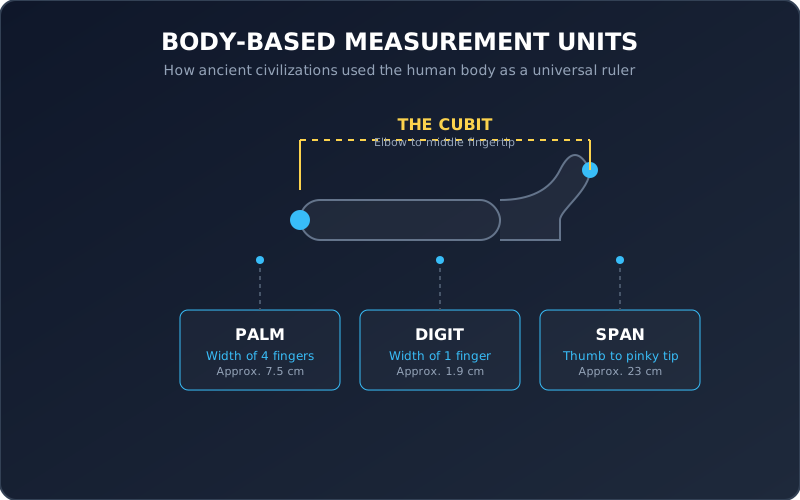
Body-part measurement was practical, immediate, and universal: every person in every culture carried a complete set of measurement instruments at all times. The body-based units used most widely across ancient cultures followed a consistent hierarchical structure, with smaller units nesting cleanly into larger ones:
- Digit (finger width): the smallest common unit, approximately 1.85 to 2 cm, used for fine measurements in carpentry, weaving, and jewelry
- Palm (4 digits): the width of 4 fingers held together, approximately 7 to 8 cm, used for moderate-scale measurements like timber widths and garment dimensions
- Span (3 palms or 12 digits): the distance from thumb tip to little finger fully spread, approximately 22 to 23 cm, used for cloth measurement and personal height estimation
- Cubit (2 spans or 6 palms): the distance from elbow to middle fingertip, approximately 44 to 52 cm, the primary construction and commercial unit across most ancient cultures
- Fathom (4 cubits): the span of both arms fully extended, approximately 175 to 185 cm, used for depth measurement (particularly rope lengths for water depth sounding)
This nested structure, where each unit is a simple multiple of the one below it, reflects practical wisdom rather than arbitrary convention. A craftsman who had memorized this hierarchy could convert between units mentally without any calculation tool.
The Challenges of Non-Standard Measurements
The fundamental problem with body-based measurement is that bodies vary: a tall person's cubit is longer than a short person's, an adult's foot is larger than a child's, and a man's palm is wider than a woman's. Without a standardized reference, the same unit name covered a range of physical lengths depending on whose body was being used as the reference.
Ancient solutions to this problem included: designating a specific individual's body (the pharaoh, the king) as the official reference; creating physical artifacts (rods, bars, marked tiles) that preserved a specific version of the unit; and anchoring units to the body of an "average" adult male, which remained the conventional reference even after physical standards were introduced. The tension between the convenience of body-based measurement and the need for consistency drove the gradual development of standardized measurement artifacts across every advanced civilization.
Ancient Egyptian Measurement Units
The Royal Cubit
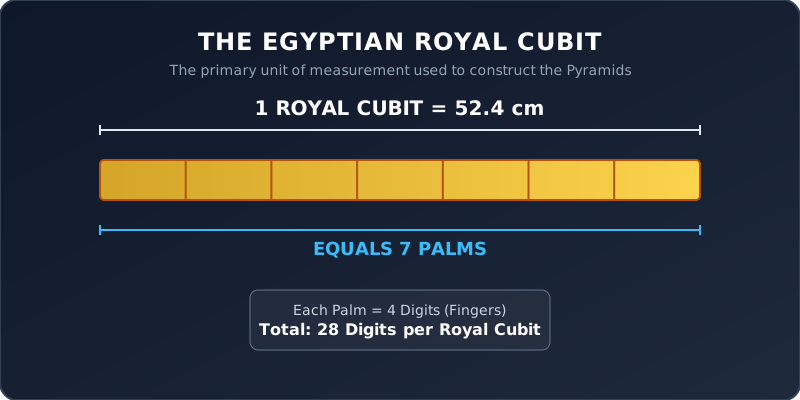
The Egyptian royal cubit (meh niswt) was the most precisely standardized ancient measurement unit, fixed at approximately 52.3 to 52.5 cm and divided into 7 palms of 4 digits each, giving 28 digits per royal cubit. It was longer than the common cubit (approximately 44.4 cm, based on the ordinary forearm) by approximately one palm, reflecting a deliberate engineering choice to create a unit that could be divided into both 7 and 28 equal parts.
The royal cubit appears in Egyptian records from at least 3000 BCE and was used consistently for over 3,000 years of Egyptian civilization. Physical cubit rods have been found in archaeological excavations across Egypt, typically made from granite, basalt, or wood and marked with subdivisions into palms and digits. The most famous surviving example is the cubit rod of Maya, treasurer to Tutankhamun, dating to approximately 1330 BCE.
The Great Pyramid of Giza was designed and built entirely in royal cubits. Its base length is 440 royal cubits on each side (approximately 230.4 meters). Its original height was 280 royal cubits (approximately 146.6 meters). These exact integer-cubit dimensions reflect the Egyptians' ability to work to precision using a standardized unit across a massive, multi-decade construction project.
The Palm and Digit
Below the cubit, Egyptian measurement used the palm (shesep, approximately 7.5 cm) and the digit (djeba, approximately 1.875 cm) as subdivisions for fine work. A royal cubit contained 7 palms. A palm contained 4 digits. This gave the royal cubit a total of 28 digits, enabling precise fractional measurement for detailed work like carving, painting, and jewelry.
Egyptian craftsmen also used smaller subdivisions: the digit was sometimes split into halves, thirds, and quarters for the most detailed work. The grid system used in Egyptian painting, where the human figure was drawn on a grid of 18 to 21 units from foot to crown, used the digit as its module, creating a standardized proportional canon for human representation that persisted across thousands of years of Egyptian art.
Ancient Roman Measurement Units
The Roman Foot (Pes)
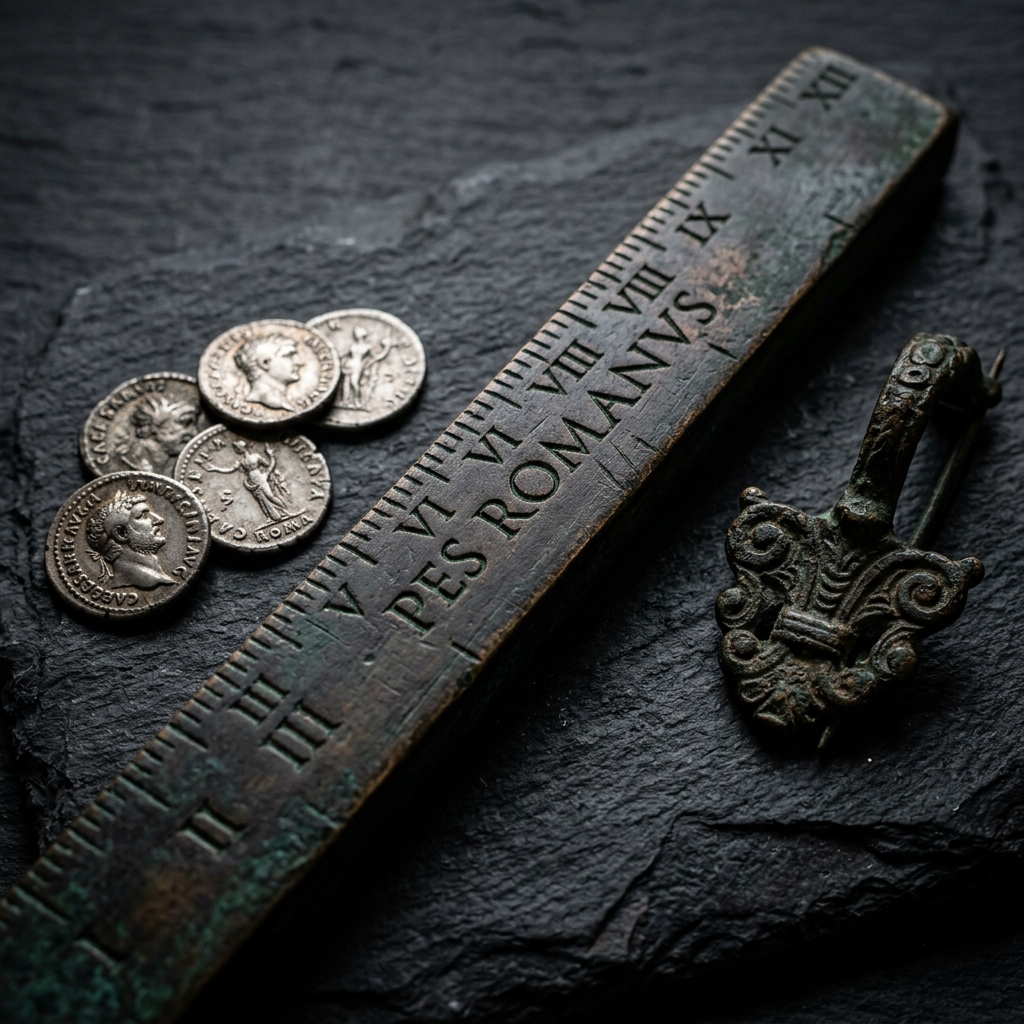
The Roman foot (pes) measured approximately 29.6 cm, divided into 12 unciae (singular: uncia), making each uncia approximately 24.7 mm, the direct ancestor of the modern inch. The Roman foot was itself approximately 4/3 of a Roman palm (palmus), preserving the hierarchical body-based structure used across ancient measurement systems.
Roman engineers used the pes for all construction work throughout the empire. Roman roads were designed in feet and the larger unit of the passus (double step, equal to 5 Roman feet, approximately 1.48 meters). The Roman mile (mille passuum, meaning 1,000 double-steps) was approximately 1,480 meters, shorter than the modern statute mile of 1,609 meters.
Physical Roman foot standards have been found at Pompeii and other archaeological sites, typically marked on bronze or stone and used to calibrate measuring rods. The consistency of the Roman foot across the empire, from Britain to North Africa to the Near East, reflects Rome's systematic approach to administrative standardization.
The Roman Inch (Uncia)
The Roman uncia was exactly 1/12 of the Roman foot, approximately 24.7 mm, and gave us both the word "inch" (through the Old English "ynce") and the word "ounce" (since the same fraction, one-twelfth, applied to both length and weight in Roman measurement).
The uncia was used primarily for fine woodwork, metalwork, and detailed construction dimensions where the pes was too large. Roman architects specified column fluting, capital proportions, and ornamental details in unciae. The 12-division structure of the Roman foot, inherited from this system, is why the modern foot still contains 12 inches rather than 10.
💡 Pro Tip: The Roman uncia (approximately 24.7 mm) and the modern international inch (exactly 25.4 mm) differ by only 0.7 mm, about 2.7%. This remarkable continuity across 2,000 years of measurement history shows how stable body-based units are when anchored to the same anatomical reference, the thumb width at the base of the nail.
Ancient Greek Measurement Units
The Greek Foot
The ancient Greek foot (pous) measured approximately 29.6 to 31.6 cm depending on the city-state and period, closely related to but not identical with the Roman pes. Like the Roman foot, the Greek foot was divided into 16 dactyls (finger widths) or 4 palms, giving it the same hierarchical body-based structure found across Mediterranean measurement systems.
Greek architecture used the foot as the primary module for proportional design. The Parthenon in Athens, completed in 432 BCE, was designed to a foot unit that scholars estimate at approximately 32.68 cm, called the "Attic foot." The building's famous proportional harmony derives partly from the consistent use of this module throughout its design.
The Greek stadion, the unit used for athletic track length, was 600 Greek feet. The variation in stadion length between different Greek cities (from approximately 177 to 192 meters) reflects the variation in local foot definitions. The modern word "stadium" comes directly from this Greek unit.
Regional Variations
Ancient Greece was not a unified state but a collection of independent city-states, each with its own foot standard, creating a patchwork of related but distinct measurement units across the Greek world.
| City-State | Foot Length | Primary Use |
|---|---|---|
| Athens (Attic) | approx. 32.68 cm | Architecture, Parthenon |
| Olympia | approx. 32.05 cm | Olympic stadion measurement |
| Delphi | approx. 29.7 cm | Sanctuary construction |
| Ionian (Asia Minor) | approx. 29.6 cm | Trade, consistent with Roman foot |
These regional variations explain why Greek weights and measures are complex for archaeologists to interpret. A measurement recorded in a Greek text must be understood in the context of the city-state where it was written to be translated accurately into modern values.
Medieval European Height Measurements
The Foot
Medieval Europe inherited the Roman foot through centuries of accumulated custom but standardized it at different values in different regions, with the English foot eventually settling at 30.48 cm, slightly larger than the Roman pes of 29.6 cm. The English foot was used for construction, land measurement, and trade from at least the 10th century onward.
Medieval foot standards were often set by royal decree. One persistent legend holds that the English foot was fixed as the length of the king's foot, making it officially "the king's foot." While this is probably an oversimplification, it reflects the real role that royal authority played in establishing measurement standards before independent standards institutions existed.
The Yard
The yard (3 feet, approximately 91.44 cm) emerged in medieval England as a practical unit for cloth measurement, traditionally defined as the distance from the nose to the tip of the outstretched thumb. The word "yard" comes from the Old English "gerd" or "gyrd," meaning a rod or stick used as a measuring implement, reflecting the physical tool used to apply the unit in trade.
Cloth merchants in medieval England measured fabric by stretching it from their nose to their outstretched hand, a gesture that approximated the yard reliably enough for routine commerce. The yard was formally standardized by the British Weights and Measures Act of 1824, which defined it as the primary imperial length unit from which all others derived.
The Inch and Barleycorn
Medieval England's most famous contribution to measurement history was the 1324 Statute of Edward II, which defined the inch as the length of 3 barleycorns, round and dry, laid end to end. A single barleycorn measured approximately 8.47 mm, making 3 barleycorns approximately 25.4 mm, remarkably close to the modern international inch of exactly 25.4 mm.
The barleycorn definition replaced purely body-based references with an agricultural standard that was more reproducible, since any party to a trade could obtain barleycorns and verify the measurement. This shift from body-based to object-based standards, while still using a natural object rather than a manufactured artifact, was an important step toward modern standardization. The barleycorn lives on today in UK shoe sizing, where each whole shoe size equals 1 barleycorn (1/3 inch). Read the full history in our guide on the history of the inch.
Traditional Measurement Units Around the World
Every major civilization developed its own length units independently, yet the body-based origins produce remarkably similar scales. The cubit-equivalent, the foot-equivalent, and the finger-width equivalent appear across cultures that had no historical contact.
Chinese Chi
The Chinese chi (foot, also romanized as "chih") was the primary length unit in China, varying from approximately 23 cm during the Shang dynasty (1600 to 1046 BCE) to approximately 32 cm during the Tang dynasty (618 to 907 CE). The chi was divided into 10 cun (inches), making Chinese measurement partially decimal long before the metric system was conceived.
The chi was standardized multiple times by different Chinese dynasties, each producing a slightly different value. The Qin dynasty (221 to 206 BCE), which unified China, also standardized the chi as part of its broader administrative unification program, an early example of national measurement standardization driven by political consolidation.
Indian Hasta
Ancient India used the hasta (also called the "cubit" in English translations) as its primary length unit, approximately 45.7 cm, closely matching the standard cubit used across the ancient Near East and Mediterranean world. The term "hasta" means "hand" in Sanskrit, reflecting the body-based origin of the unit.
The Arthashastra, an ancient Indian treatise on statecraft written approximately 300 BCE, includes detailed specifications for measurement standards used in taxation, construction, and trade, demonstrating that measurement standardization was a recognized governmental function in ancient India. The hasta was subdivided into angulas (finger widths), with 24 angulas per hasta, similar to the Egyptian digit system.
Japanese Shaku
The Japanese shaku (foot) was approximately 30.3 cm, close to both the Roman and English foot values, and was derived from the Chinese chi through cultural exchange during Japan's adoption of Chinese administrative practices in the 7th century CE.
The shaku was used in Japanese architecture, carpentry, and fabric measurement for over a millennium. Japanese traditional carpentry still uses a measurement system based on the shaku and its subdivisions (sun = 1/10 shaku, bu = 1/100 shaku), though Japan officially adopted the metric system in 1891 and completed metrication over the following century. The shaku persists as a cultural reference in traditional crafts and architecture restoration.
Arabic Cubit
Islamic civilization used several cubit variants, with the most common being the "hashimi cubit" of approximately 64.84 cm and the "black cubit" of approximately 54 cm, both larger than the Egyptian royal cubit. Arab scholars of the Abbasid period (750 to 1258 CE) documented and compared measurement units across the ancient world as part of their broader scientific synthesis.
The Arabic cubit influenced measurement in regions under Islamic governance from Spain to Central Asia. Al-Biruni, the 11th-century polymath, systematically compared measurement units from multiple cultures and calculated conversion ratios between them, an early exercise in the kind of international measurement harmonization that the 1959 International Yard and Pound Agreement later formalized.
How Ancient Units Influenced Modern Measurements
The Evolution of the Foot
The modern foot (30.48 cm) descends directly from the Roman pes (29.6 cm) through a lineage of Anglo-Saxon, Norman, and medieval English customary practice. The increase from 29.6 cm to 30.48 cm, approximately 3%, accumulated over centuries of local variation as the Roman standard was transmitted through communities that were calibrating by eye and body rather than against a master artifact.
| Era | Foot Unit | Approximate Length |
|---|---|---|
| Ancient Rome | Pes | 29.6 cm |
| Anglo-Saxon England | Fot | approx. 30 cm |
| Medieval England | Foot | approx. 30.3 to 30.5 cm |
| British Imperial (1824) | Imperial foot | 30.479 cm |
| International (1959) | International foot | 30.48 cm (exact) |
The Development of the Inch
The modern inch (2.54 cm) is the Roman uncia (approximately 2.47 cm) scaled up by approximately 3% through the same historical drift that enlarged the Roman foot into the English foot. Because the inch is always defined as 1/12 of the foot, its value tracks the foot's value exactly.
The barleycorn definition of 1324, at approximately 25.4 mm per inch, essentially locked the English inch at the value it already had through centuries of customary use, codifying existing practice rather than imposing a new standard. That the barleycorn definition and the ancient Roman uncia agree to within 0.7 mm is a testament to how stable body-based units are when anchored to the same anatomy.
The Road to Standardization
The path from ancient body-based units to modern defined standards followed a consistent pattern in every civilization: practical use created a unit, trade and construction pressure forced early standardization through physical artifacts, and eventually formal legal or governmental authority fixed the unit's value by law.
The final step, defining imperial units in terms of the metric system, completed this process by grounding ancient body-based intuitions in the meter itself, which is defined in terms of the speed of light. The modern inch at 2.54 cm is both a measurement from 2,000 years of Roman, Anglo-Saxon, and English tradition and a precisely defined fraction of a fundamental constant of physics.
From Ancient Units to the Metric System
Why Standard Measurements Became Necessary
Ancient and medieval measurement systems worked well within their intended scope, which was local trade and construction using familiar units among parties who knew each other. They began to break down as trade networks expanded beyond local communities, as manufacturing required interchangeable parts, and as science required measurements that could be compared across national boundaries.
By the 18th century, the accumulated variations within European measurement systems had become commercially and scientifically untenable. France alone had over 800 named measurement units, with the same name meaning different things in different towns. The industrial revolution, which required precise machining of interchangeable parts, made the situation increasingly costly. The response was the French metric system of 1795, the first measurement system designed from first principles rather than accumulated from body-based tradition.
The Rise of International Standards
The metric system, the 1875 Metre Convention, the 1960 adoption of SI units, and the 1959 International Yard and Pound Agreement all represent stages in the same long process: replacing the accumulated variability of body-based measurement with mathematically defined standards grounded in physical constants.
The ancient Egyptian cubit, defined by the pharaoh's forearm, required periodic re-calibration against a master artifact and could drift if the master artifact was lost. The modern meter, defined as the distance light travels in 1/299,792,458 of a second, requires no master artifact and can be independently verified anywhere in the universe with sufficiently precise instruments. The 5,000-year journey from the pharaoh's forearm to the speed of light is the history of measurement. Read more in our guide on the history of the metric system.
Interesting Facts About Ancient Height Measurements
- The cubit appears in the Bible's dimensions of Noah's Ark: Genesis specifies the Ark as 300 cubits long, 50 cubits wide, and 30 cubits tall. Using the Hebrew cubit of approximately 44.5 cm, this gives dimensions of approximately 133.5 m x 22.3 m x 13.4 m, comparable in length to a modern cargo ship.
- The Egyptian royal cubit was more accurate than most medieval standards: Analysis of surviving cubit rods shows that the royal cubit was standardized to within 0.1 to 0.2% across different rods from different periods, an accuracy that European measurement systems did not consistently achieve until the 19th century.
- The Roman mile was shorter than today's mile: The Roman mille passuum (1,000 double-paces) was approximately 1,480 meters, while the modern statute mile is 1,609.344 meters. The English mile was stretched to 5,280 feet in 1593 to align with the existing furlong system (1 mile = 8 furlongs = 8 x 660 feet = 5,280 feet), making it 9% longer than its Roman ancestor.
- Ancient Indian mathematicians calculated measurement ratios precisely: The Arthashastra gives conversion ratios between different length units to a precision that implies decimal arithmetic, approximately 2,000 years before the decimal system was introduced to Europe from India.
- Vitruvius documented the body-measurement system in detail: The Roman architect Vitruvius, writing around 25 BCE, documented the proportional system relating the digit, palm, foot, cubit, and fathom in his work "De Architectura." His observation that a well-proportioned man's height equals his arm span (the Vitruvian proportion) was illustrated by Leonardo da Vinci in the famous Vitruvian Man drawing around 1490 CE.
- The word "mile" and the word "millennium" share the same Latin root: Both come from the Latin "mille," meaning 1,000. The mile was 1,000 paces (double-steps) and the millennium is 1,000 years. The Roman numbering system made 1,000 a natural unit for both distance and time.
Frequently Asked Questions
How was height measured in ancient times?
In ancient times, height and length were measured using body parts as reference standards, primarily the cubit (elbow to middle fingertip), the foot, the palm (4 finger widths), and the digit (1 finger width). Physical cubit rods and foot standards made from stone, wood, or metal were used to transfer these body-based units into a consistent artifact that craftsmen could copy and carry. For personal height, a person might be described as a certain number of cubits tall, which could then be physically measured with a cubit rod laid against them. Use our height calculator to convert between modern height units.
What is a cubit?
A cubit is an ancient unit of length equal to the distance from the elbow to the tip of the middle finger of an adult male, approximately 44 to 46 cm for the ordinary cubit. The Egyptian royal cubit was longer, approximately 52.3 to 52.5 cm, and was divided into 7 palms of 4 digits each (28 digits total). The cubit is one of the oldest measurement units in recorded history and was used across Egypt, Mesopotamia, ancient Israel, Greece, and Rome. The word "cubit" comes from the Latin "cubitum," meaning elbow.
Did ancient people use feet and inches?
Yes. The Roman pes (foot, approximately 29.6 cm) was divided into 12 unciae (singular uncia), each approximately 24.7 mm, making the Roman uncia the direct ancestor of the modern inch. The word "inch" comes from the Old English "ynce," which derived from the Latin "uncia." The word "ounce" comes from the same Latin root, since uncia meant one-twelfth in both length and weight. The 12-inch foot structure has been continuous from Rome through Anglo-Saxon England through medieval England to the modern imperial system.
Why were body parts used as measurement units?
Body parts were used as measurement units because they were always available, required no manufactured tools, and were intuitively understood by anyone in any culture. Before measuring instruments were manufactured and distributed, every person already possessed a complete set of measurement references: finger, palm, span, forearm, foot. Body-based units also nested naturally into each other (4 digits = 1 palm, 6 palms = 1 cubit), making conversion between scales straightforward. Their main limitation was person-to-person variation, which is why ancient societies quickly moved to creating physical artifacts (cubit rods, foot tiles) to standardize a particular version of each body-based unit.
When did standardized height measurements begin?
Formal measurement standardization began as early as 3000 BCE in ancient Egypt, where the royal cubit was standardized through physical granite reference rods distributed to craftsmen working on royal construction projects. Medieval England's first legal definition of the inch came in 1324 under Edward II. The British imperial system was formally codified in 1824. International standardization was completed in 1959 when the International Yard and Pound Agreement defined 1 yard as exactly 0.9144 meters, fixing the inch at exactly 2.54 cm across 6 English-speaking nations. Learn more in our guide on the 1959 International Yard Agreement.
Explore More Measurement History Guides
Learn more about the history of measurement units and how they became today's standards.
History of the Inch →
From Roman uncia to medieval barleycorn to the modern 2.54 cm definition.
History of the Metric System →
How revolutionary France replaced ancient units with a decimal system for the world.
The 1959 Yard Agreement →
How 6 nations fixed the inch at exactly 2.54 cm by international treaty.
Inches to CM Calculator →
Convert any height in feet and inches to centimeters instantly.