
History of the Metric System: From Revolutionary France to Global Standard

The metric system is the world's dominant measurement framework, used by over 195 countries, yet it was born out of political revolution in 1790s France. Before it existed, Europe had hundreds of conflicting local units for length, weight, and volume. Commerce was chaotic, science was fragmented, and ordinary people were cheated daily by units that meant different things in different towns.
The solution France imposed on itself, and eventually on the world, was radical: discard all inherited units and start over with a system grounded in nature, structured on powers of 10, and applicable to every discipline equally.
This guide covers the complete history of the metric system: why it was created, how it was built, how it spread from Paris to every corner of the globe, how it became SI in 1960, and why a small number of countries, most notably the United States, have never fully adopted it.
Quick Answer: How the Metric System Began
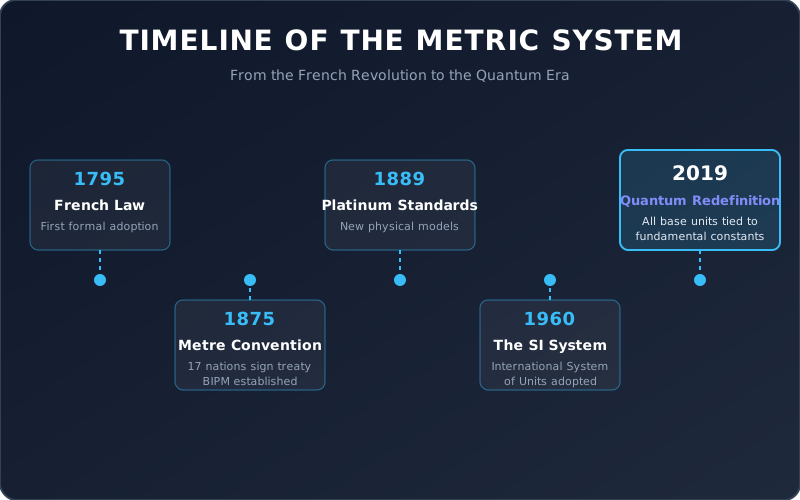
The metric system was created by French scientists in 1795 to replace the hundreds of inconsistent local units used across France. The 3 defining moments in its history are:
| Year | Event | Significance |
|---|---|---|
| 1795 | France adopts the metric system by law | First national metric standard in history |
| 1875 | Metre Convention signed by 17 nations | International body created to maintain standards |
| 1960 | SI units formally adopted at CGPM | Modern metric system fixed with 7 base units |
Today the metric system, in its modern form as the International System of Units (SI), is the official measurement standard in every country on Earth except the United States, Liberia, and Myanmar.
What Is the Metric System?
Definition of the Metric System
The metric system is a decimal-based system of measurement in which all units within a category relate to each other by powers of 10, using a consistent set of prefixes (kilo, centi, milli, etc.) across all unit types. Length uses the meter as its base unit. Mass uses the kilogram. Volume uses the liter. Every prefix means the same thing regardless of what it is attached to: 1 kilometer is 1,000 meters, and 1 kilogram is 1,000 grams.
This structure makes calculations straightforward. To convert 3.75 kilometers to meters, you multiply by 1,000 and get 3,750 meters. To convert 350 centimeters to meters, you divide by 100 and get 3.5 meters. No irregular conversion factors are needed.
Why It Was Created
The metric system was created to solve the measurement chaos that made trade, taxation, and science unreliable across pre-revolutionary France. Before 1795, France alone had over 800 different named units of measurement, with the same unit name meaning different things in different regions. A "pied" (foot) in Paris was 32.48 cm. A "pied" in Lyon was a different length. A merchant traveling between cities needed conversion tables just to buy and sell basic goods.
The French Revolution's guiding principles of reason, equality, and universality made measurement reform inevitable. A system based on natural constants rather than historical accidents or royal decrees was both philosophically consistent with the Revolution's ideals and practically necessary for the new republic to function.
Measurement Before the Metric System
Ancient and Medieval Measurement Systems
Before the metric system, every civilization developed its own measurement units, usually grounded in human body proportions or locally available natural objects. The Egyptians used the cubit (forearm length, approximately 52 cm), the Romans used the pes (foot, approximately 29.6 cm) and the uncia (one-twelfth of a foot), and the Anglo-Saxons used the barleycorn (one-third of an inch) and the yard (arm-stretch from nose to outstretched thumb).
Medieval Europe inherited this patchwork of Roman, Germanic, and regional units and layered additional local definitions on top. The result was a measurement system that was not a system at all, but a collection of local conventions that happened to share some names.
| Civilization | Primary Length Unit | Approximate Modern Value |
|---|---|---|
| Ancient Egypt | Royal cubit | 52.4 cm |
| Ancient Rome | Pes (foot) | 29.6 cm |
| Medieval England | Foot (barleycorn-based) | 30.48 cm |
| Pre-metric France | Pied du Roi (King's foot) | 32.48 cm |
| Ancient China | Chi (foot) | 23 to 35 cm (varied by dynasty) |
Problems With Traditional Units
Traditional measurement systems created 4 practical problems that became increasingly severe as trade and science expanded: inconsistency, complexity, opacity, and injustice.
- Inconsistency: the same unit name meant different quantities in different towns, making inter-regional trade require constant negotiation over what was actually being bought and sold
- Complexity: conversion between units required memorizing dozens of irregular ratios (12 inches per foot, 3 feet per yard, 1,760 yards per mile, 16 ounces per pound), slowing calculation and creating errors
- Opacity: local lords and merchants could exploit measurement variations to underpay for goods bought and overcharge for goods sold, with no universal standard to appeal to
- Scientific fragmentation: scientists in different countries used different units, making collaboration and replication of experiments difficult and prone to translation errors
The Birth of the Metric System
The French Revolution and Measurement Reform
The French National Assembly formally requested a new universal measurement system in May 1790, two years before the Revolution reached its most radical phase. The request came from Talleyrand, the Bishop of Autun, who proposed that France and Britain collaborate on a joint system based on a natural constant. Britain declined. France proceeded alone.
The French Academy of Sciences was assigned to design the system. The committee included some of the greatest scientists in Europe: Lagrange, Laplace, Monge, Condorcet, and Lavoisier (who was later guillotined during the Terror). Their mandate was clear: create a system "for all people, for all time," grounded in nature rather than political authority.
The committee's core decision was to base the fundamental unit of length on the size of the Earth itself, rather than on any human body part or agricultural product. This made the system universal in principle and reproducible by any nation with the instruments to measure the Earth's dimensions.
The First Definition of the Meter
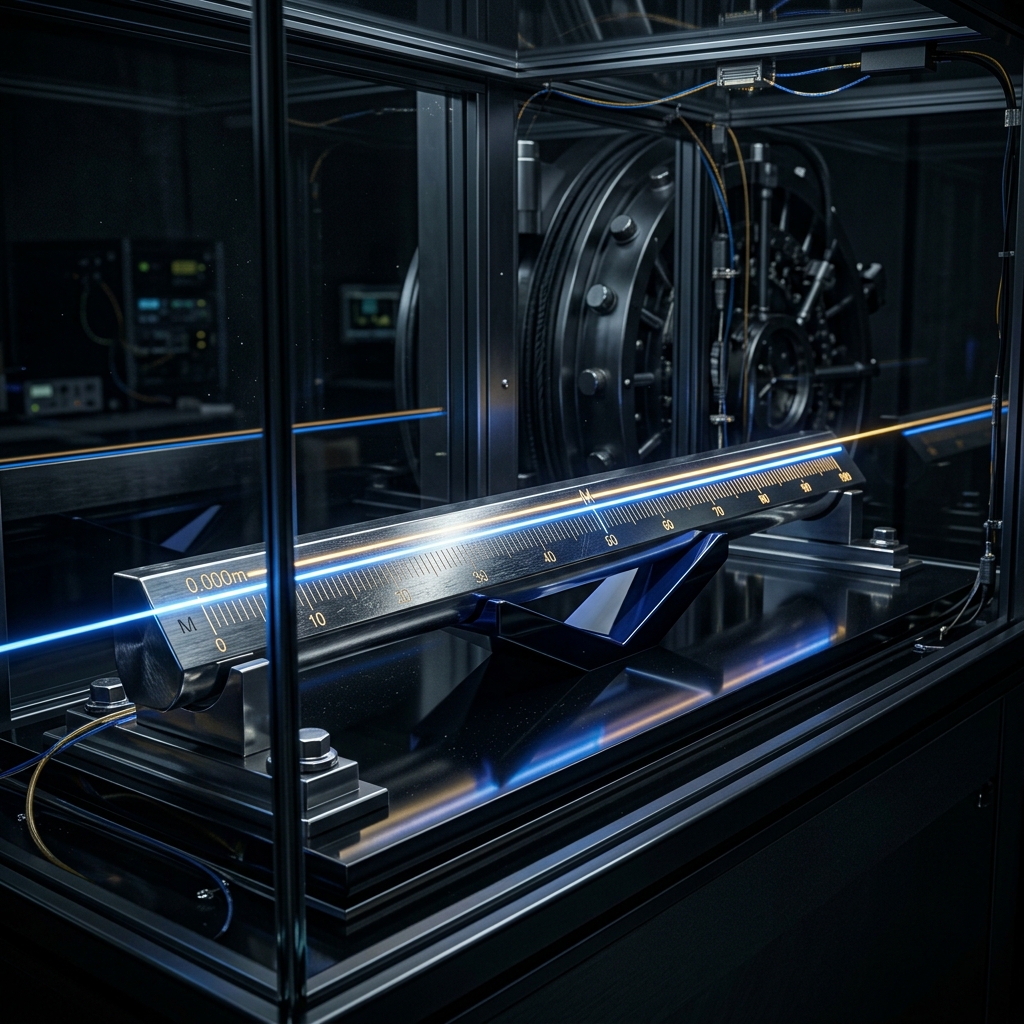
The first meter was defined as one ten-millionth of the distance from the North Pole to the equator along the meridian passing through Paris. To determine this distance precisely, the astronomers Jean-Baptiste Delambre and Pierre Mechain spent 7 years (1792 to 1799) measuring the arc of the meridian from Dunkirk in northern France to Barcelona in Spain. Their measurement, covering about 9.5 degrees of latitude, was then extrapolated to calculate the full quarter-meridian distance.
The resulting value was used to create a physical platinum bar, the "metre des Archives," kept in Paris. This bar served as the international standard for the meter until 1889, when it was replaced by a more precise platinum-iridium alloy bar. The meter is now defined in terms of the speed of light: 1 meter is the distance light travels in 1/299,792,458 of a second in a vacuum.
💡 Pro Tip: The original Earth-based meter definition was slightly off. Mechain made a small error in his meridian measurements, meaning the actual meter (as defined) is about 0.2 mm shorter than one ten-millionth of the actual quarter-meridian. The mistake was discovered but the meter was kept as-is for consistency. The error is smaller than the thickness of 2 sheets of paper.
How the Metric System Was Developed
Establishing Standard Units
The French committee established 3 primary units that formed the foundation of the original metric system, each defined in terms of a natural constant.
| Unit | Measures | Original Definition (1795) |
|---|---|---|
| Meter | Length | 1/10,000,000 of the Paris-to-North-Pole meridian |
| Kilogram | Mass | Mass of 1 liter of water at 4 degrees Celsius |
| Liter | Volume | Volume of a cube 10 cm on each side (1 cubic decimeter) |
These 3 units were deliberately interconnected: the liter was defined in terms of the meter, and the kilogram was defined in terms of the liter. This internal consistency meant the entire system derived from a single physical measurement.
The Decimal-Based Structure
The metric system's defining innovation was applying a consistent set of decimal prefixes to all unit types, making every conversion a matter of moving a decimal point. The original system defined the following prefixes, all still in use today:
| Prefix | Symbol | Multiplier | Example |
|---|---|---|---|
| kilo | k | x 1,000 | 1 kilometer = 1,000 meters |
| hecto | h | x 100 | 1 hectometer = 100 meters |
| deka | da | x 10 | 1 dekameter = 10 meters |
| deci | d | / 10 | 1 decimeter = 0.1 meters |
| centi | c | / 100 | 1 centimeter = 0.01 meters |
| milli | m | / 1,000 | 1 millimeter = 0.001 meters |
Modern SI has expanded this prefix system to cover scales from yocto (10 to the power of -24) to yotta (10 to the power of 24), covering the full range from subatomic particle sizes to cosmological distances using the same simple framework.
The Global Spread of the Metric System
Adoption Across Europe
The metric system spread through Europe primarily through Napoleon's military conquests between 1799 and 1815, as French-occupied territories were required to adopt French administrative standards, including measurement. The Netherlands, Spain, Italy, and parts of Germany all encountered metric units during Napoleonic occupation.
After Napoleon's defeat, many countries initially reverted to traditional units. However, the practical advantages of metric were hard to ignore. Belgium adopted metric permanently in 1820. The Netherlands followed in 1821. By the 1860s, most of Western Europe had adopted metric as their official system, even if traditional units persisted in informal use for decades.
The 1875 Metre Convention, signed in Paris by 17 nations including the United States, established the International Bureau of Weights and Measures (BIPM) to maintain global metric standards. The US signed the treaty but continued to use customary units for domestic purposes.
Expansion to Other Continents
Metric adoption outside Europe accelerated through colonial administration, independence movements, and deliberate modernization programs in the 20th century. Most countries that gained independence from Britain, France, or other European powers adopted metric either during or shortly after independence as part of modernizing their administrative systems.
Key dates for major metrication programs outside Europe:
- India: adopted metric in 1957 to 1962, replacing the complex British imperial and local Indian unit systems
- Australia: converted from 1966 to 1988 through a phased national metrication program covering currency, weights, road signs, and temperatures
- Canada: began metrication in 1970 and completed most official conversion by 1985, though informal imperial use persists
- South Africa: converted from 1971 to 1977 under the Metrication Advisory Board
- New Zealand: completed metrication from 1969 to 1976, one of the fastest national conversions recorded
Countries That Still Use Non-Metric Units
Only 3 countries have not adopted the metric system as their primary official measurement standard: the United States, Liberia, and Myanmar. The United States is by far the most significant holdout. Its continued use of the US customary system (inches, feet, miles, pounds, gallons) for everyday measurements makes it the only major economy operating primarily in non-metric units.
The US came close to metrication twice. The Metric Conversion Act of 1975 established a national Metric Board to oversee voluntary conversion, but Congress defunded the Board in 1982 after minimal progress. The Omnibus Trade and Competitiveness Act of 1988 designated metric as the "preferred system" for federal agencies, but everyday US measurement has not changed substantially. Read more about the relationship between imperial and metric in our guide on understanding the imperial system.
The Creation of the International System of Units (SI)
What Is SI?
SI (Systeme International d'Unites, or the International System of Units) is the modern, formalized version of the metric system, adopted at the 11th General Conference on Weights and Measures (CGPM) in 1960. SI replaced the earlier CGS (centimeter-gram-second) and MKS (meter-kilogram-second) systems, which had been used inconsistently in different scientific disciplines.
SI is maintained by the International Bureau of Weights and Measures (BIPM) in Sevres, France, and is updated periodically as measurement science advances. The most recent major revision occurred in 2019, when the definitions of the kilogram, ampere, kelvin, and mole were changed from physical artifacts and experimental conditions to fixed numerical values of fundamental physical constants.
Key SI Base Units
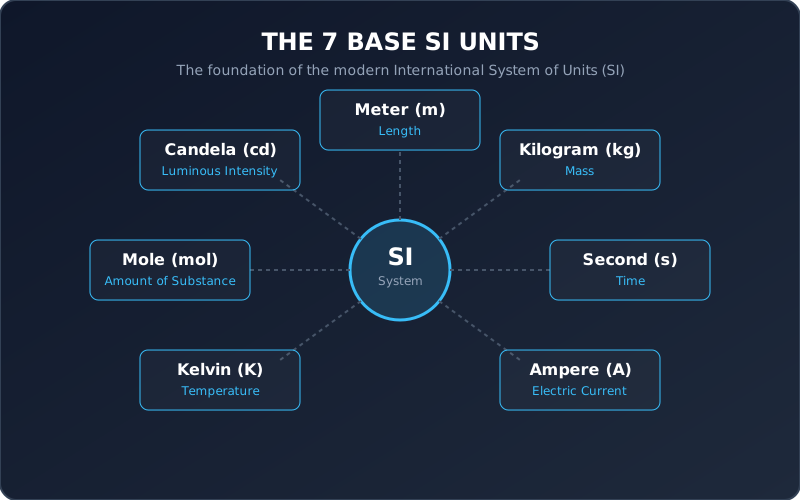
SI defines exactly 7 base units from which all other measurement units in the world are derived.
| Unit | Symbol | Quantity | Current Definition Basis |
|---|---|---|---|
| Meter | m | Length | Speed of light (c) |
| Kilogram | kg | Mass | Planck constant (h) |
| Second | s | Time | Cesium-133 hyperfine transition |
| Ampere | A | Electric current | Elementary charge (e) |
| Kelvin | K | Temperature | Boltzmann constant (k) |
| Mole | mol | Amount of substance | Avogadro constant (N sub A) |
| Candela | cd | Luminous intensity | Luminous efficacy of 540 THz radiation |
Why the Metric System Became Popular
Simplicity and Consistency
The metric system's primary advantage over traditional systems is that every conversion is a matter of multiplying or dividing by 10, 100, or 1,000, with no irregular factors to memorize. Compare metric length conversions (1 km = 1,000 m = 100,000 cm = 1,000,000 mm, all powers of 10) with imperial length conversions (1 mile = 1,760 yards = 5,280 feet = 63,360 inches, all different).
For education, this simplicity is particularly valuable. A student learning metric needs to memorize one set of prefixes (kilo, hecto, deka, deci, centi, milli) and apply them uniformly to length, mass, and volume. A student learning imperial needs to memorize separate conversion tables for length, weight, and volume with no shared structure between them.
Scientific and International Benefits
Science adopted metric almost universally by the early 20th century because SI units integrate directly into mathematical and physical equations without conversion factors. Newton's second law (F = ma) works directly in SI: force in newtons, mass in kilograms, acceleration in meters per second squared. In imperial, a conversion factor of 32.174 must be introduced to make the same equation work in pounds-force, slugs, and feet per second squared.
International trade similarly benefits from metric standardization. A manufacturer exporting products to 50 countries needs only one set of metric dimensions to comply with regulations in all of them. In a world where imperial is used, any product destined for the US market requires separate specification documents, separate labeling, and separate quality-control tooling.
Metric System vs Imperial System
Historical Differences
The metric and imperial systems have fundamentally different origins: metric was designed from first principles in a committee room, while imperial accumulated organically over centuries of Roman, Anglo-Saxon, and medieval English custom.
| Feature | Metric | Imperial |
|---|---|---|
| Origin | France, 1795, by committee | Britain, accumulated over 1,000+ years |
| Design basis | Natural constants (Earth's meridian) | Body parts, agriculture (barleycorn, thumb) |
| Conversion structure | Powers of 10 throughout | Irregular (12, 3, 1,760, 16, etc.) |
| First legal definition | France, Law of 18 Germinal 1795 | Britain, Weights and Measures Act 1824 |
| International standard | Yes, via SI since 1960 | No, each country defines its own variant |
| Countries of primary use | ~195 countries | USA primarily; UK and Canada partially |
Why Both Systems Still Exist
Both systems exist simultaneously in the modern world because converting existing infrastructure, consumer habits, and cultural intuitions is enormously expensive and politically difficult. In the United States, converting road signs alone would cost an estimated 800 million to 1.6 billion dollars. Converting all consumer packaging, construction standards, vehicle speedometers, and appliances would cost tens of billions more.
Cultural inertia also plays a role. A person who grew up knowing that 5'10" is a normal adult height and 70 degrees Fahrenheit is a pleasant temperature has an intuitive grasp of those scales that cannot be transferred instantly to 178 cm and 21 degrees Celsius. Metrication is not just a technical problem, it is a re-education problem for an entire population.
Major Milestones in Metric System History
1790s: Creation of the Metric System
The first version of the metric system was proposed to the French National Assembly in 1790, developed between 1792 and 1799, and formally adopted by French law in 1795. The meter was defined, the kilogram was established, and the first physical standards were created as platinum artifacts. France made metric use compulsory in 1801. By the time Napoleon rose to power, the system was embedded in French administration.
The metric system was initially unpopular with ordinary French citizens, who had used traditional units all their lives. Napoleon actually suspended compulsory metric use in 1812 and allowed a hybrid system called "mesures usuelles" (customary measures) that used metric names but traditional values. Full metric enforcement resumed in France in 1840.
1875: The Metre Convention
The Metre Convention (Convention du Metre) was signed in Paris on May 20, 1875 by representatives of 17 nations, creating an international framework for maintaining and propagating metric standards. The convention established 3 international bodies that still exist: the General Conference on Weights and Measures (CGPM), the International Committee on Weights and Measures (CIPM), and the International Bureau of Weights and Measures (BIPM).
The 1875 convention produced 30 copies of the international prototype meter bar and 40 copies of the international prototype kilogram, made from a platinum-iridium alloy. Each signatory nation received one copy to serve as its national standard. The Metre Convention now has 64 member states, covering more than 98% of world trade and industrial production. May 20 is celebrated annually as World Metrology Day.
1960: Establishment of SI Units
The 11th General Conference on Weights and Measures (CGPM) in 1960 formally adopted the International System of Units (SI), replacing the earlier CGS and MKS systems with a unified 6-base-unit framework. A seventh base unit, the mole, was added in 1971.
SI introduced a standardized notation and a comprehensive set of derived units (newton, joule, watt, pascal, hertz, etc.) that covered every field of science and engineering. The system was designed to be internally consistent, meaning any physical quantity could be expressed in SI units derived directly from the 7 base units without any additional conversion constants. The 2019 revision updated the definitions of 4 base units to rest on fundamental physical constants rather than physical artifacts, making SI more stable and universally reproducible.
How the Metric System Is Used Today
Education
Metric is the standard for all science education globally, including in the United States, where chemistry, physics, and biology courses all use SI units. Students in metric countries learn to measure in centimeters, weigh in kilograms, and record temperatures in Celsius from primary school onward. In the US, students learn metric in science class and customary units in everyday life, maintaining the dual system that defines American measurement.
The simplicity of the metric prefix system makes it particularly well-suited to teaching. A primary school student who understands that "kilo" means 1,000 can immediately apply that to kilometers, kilograms, and kiloliters without learning three separate facts.
Science and Engineering
All scientific publication, pharmaceutical manufacturing, medical practice, and military specification worldwide uses SI units, including in the United States. NASA uses metric for all spacecraft design and mission planning, a policy adopted after the 1999 Mars Climate Orbiter failure, which was caused partly by a failure to convert between metric and imperial units between different engineering teams.
Engineering presents a more complex picture. US aerospace, defense, and automotive industries often use a mix of metric and imperial depending on the customer, the heritage of the component, and the applicable standards body. This dual-system environment creates ongoing translation overhead and is a source of documented errors in manufacturing and quality control.
Everyday Measurements
In metric countries, everyday height measurement uses centimeters (175 cm for an average adult male), weight uses kilograms, road distances use kilometers, and temperatures use Celsius. Grocery items are sold by the gram or kilogram, fuel is sold by the liter, and fabric is sold by the meter.
One area where inches persist globally, even in fully metric countries, is screen sizes. Television, monitor, and smartphone displays are universally described in diagonal inches, a convention established by US consumer electronics manufacturers that has never been superseded. A person in Germany who uses centimeters for everything else will still buy a "65-inch television." Use our inches to cm calculator to convert between the two systems instantly.
Interesting Facts About the Metric System
- France initially resisted its own system: Napoleon suspended compulsory metric use in 1812 and allowed traditional units back, calling the metric system impractical for everyday commerce. Full enforcement resumed in 1840, long after Napoleon's exile.
- The US has been "about to go metric" for 200 years: Thomas Jefferson proposed a decimal measurement system for the US in 1790. The US signed the Metre Convention in 1875, passed the Metric Conversion Act in 1975, and designated metric as "preferred" in 1988. Everyday measurement has barely changed.
- The original kilogram prototype lost mass: The International Prototype Kilogram (IPK), the platinum-iridium cylinder kept in a vault in Sevres, France and used as the global kilogram standard from 1889 to 2019, was found to have lost approximately 50 micrograms (50 millionths of a gram) relative to its official copies over 130 years. This is why the 2019 SI revision redefined the kilogram using the Planck constant instead.
- The metric system has 24 official prefixes: Modern SI recognizes 24 prefixes from quecto (10 to the power of -30) to quetta (10 to the power of 30), the last two added in 2022 to handle the data storage scales needed for modern computing (a quettabyte is 10 to the power of 30 bytes).
- The metric second was not decimalised: The French revolutionary government briefly tried to introduce decimal time, with a day divided into 10 hours of 100 minutes each. The clocks were produced, the calendars were changed, and the system was abandoned within 2 years because it was incompatible with existing astronomical calculations and nobody adopted it.
- Liberia and Myanmar are metric by law, not practice: Both countries that are listed alongside the US as "non-metric" actually have metric as their official legal system. In practice, local traditional units remain dominant. The US is the only large economy where official government agencies actively use non-metric units for everyday civilian purposes.
Frequently Asked Questions
Who invented the metric system?
The metric system was not invented by a single person but was designed by a committee of French scientists appointed by the French National Assembly in 1790. Key figures included the mathematician Joseph-Louis Lagrange, the astronomer Pierre Mechain, and Jean-Baptiste Delambre, who spent 7 years measuring the meridian arc from Dunkirk to Barcelona to define the meter. The French Academy of Sciences oversaw the entire project, which produced the first version of the metric system by 1795.
Why was the metric system created?
The metric system was created to replace the hundreds of inconsistent local measurement units that made trade, taxation, and science unreliable across France and the rest of Europe. Before metrication, the same unit name meant different quantities in different French cities. The French Revolution's ideals of reason and equality made a rational, universal, nature-based measurement system a political as well as a practical priority. The system was designed to be "for all people, for all time."
When did the metric system become popular?
The metric system spread through Europe via Napoleon's conquests in the early 1800s and became the dominant system in most of Western Europe by the 1860s. The 1875 Metre Convention gave metric a formal international institutional structure. Most countries outside Europe completed metrication between 1960 and 1990. By 2025, approximately 195 countries use metric as their primary official measurement system.
What is the difference between the metric system and SI units?
The metric system is the general name for the decimal measurement system originating in France in the 1790s, while SI (Systeme International d'Unites) is the formally standardized modern version adopted in 1960. SI defines exactly 7 base units (meter, kilogram, second, ampere, kelvin, mole, candela) from which all other units are derived. All SI units are metric, but not all metric usage follows SI conventions precisely. In practice, "metric" and "SI" are used interchangeably in everyday contexts.
Which countries do not fully use the metric system?
The United States, Liberia, and Myanmar are the only countries that have not adopted the metric system as their primary official measurement standard. The United States uses the US customary system (inches, feet, miles, pounds, gallons) for everyday measurements, but uses metric in all scientific, medical, military, and pharmaceutical contexts. The United Kingdom officially adopted metric in 1965 but retains imperial units for road distances (miles), draught beer (pints), and informal body weight (stones and pounds).
Explore More Measurement and Conversion Guides
Learn more about measurement history, unit conversions, and the imperial system.
History of the Inch →
How the inch evolved from the Roman uncia to the modern 2.54 cm definition.
Understanding the Imperial System →
How the imperial system works, including units, history, and conversion factors.
Why 1 Inch = Exactly 2.54 CM →
The full story of the 1959 agreement that unified the inch globally.
Inches to CM Calculator →
Convert any height in feet and inches to centimeters instantly.