
Inches vs CM vs Feet: What's the Difference and Which Should You Use?
Picture this. You're filling out a doctor's form online and it asks for your height in centimeters. You only know yours as 5'9". Or maybe you're chatting with a friend overseas about how tall someone is, and they reply with a number that makes no sense to you. If any of that sounds familiar, you've already run into the messy reality of how the world measures height.
Three units do most of the work: inches, centimeters, and feet. Some countries pick one and stick with it. Others switch between all three depending on whether you're at the doctor, at the gym, or watching basketball. The math behind these units looks tricky at first glance, but it actually traces back to a single fixed number that has stayed locked in since 1959.
This guide breaks the whole thing apart. You'll learn what each unit really is, where it gets used, how to switch between them in seconds, and which one fits the situation in front of you. Plus real heights to anchor the numbers, the common pitfalls people fall into, and clear answers to the questions that come up most. By the end, you won't get caught off guard by a height in a different unit again.
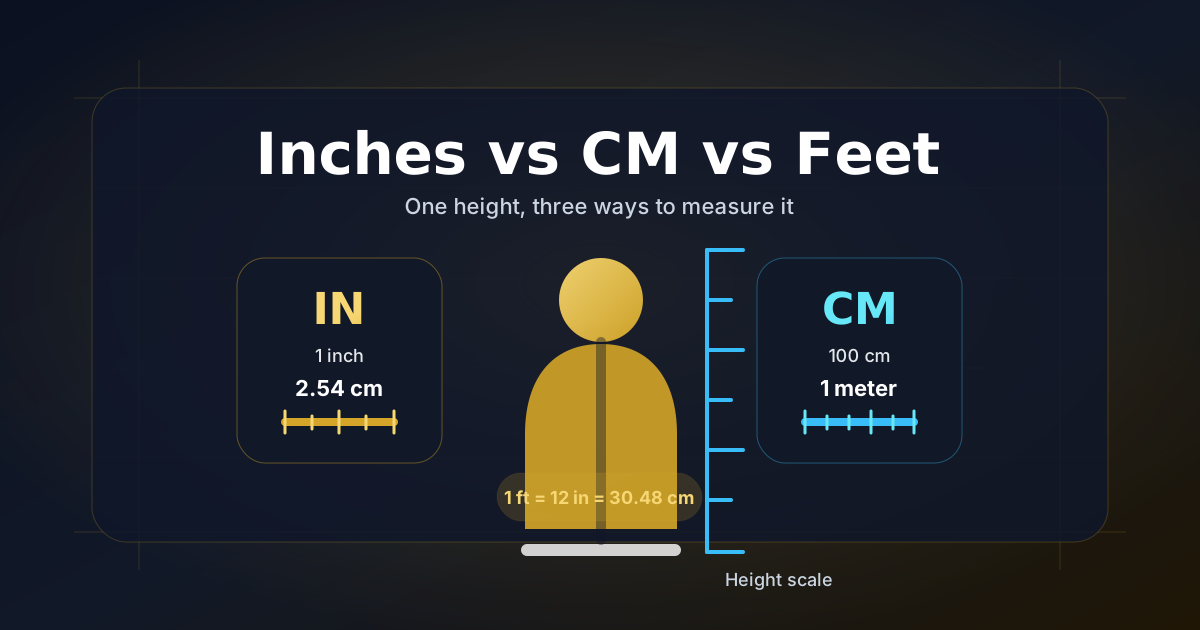
Inches, CM, and Feet Explained
Here's the simplest way to think about height units. Two systems exist in the world. The imperial system, used mainly in the United States, includes inches and feet. The metric system, used almost everywhere else, includes centimeters and meters. That's the full picture in one sentence.
Inches and feet are tied together in a simple way: twelve inches make one foot. So when somebody in the US says "five eleven," they mean five feet plus eleven inches. Centimeters work on a different logic. The metric system runs on tens, with ten millimeters in a centimeter and one hundred centimeters in a meter. No fractions, no awkward conversions. Just shift a decimal point and you're done.
Now here's the part that actually matters. The two systems aren't truly separate, because they share one fixed relationship. One inch equals exactly 2.54 centimeters. That number was locked in by international agreement back in 1959, and it hasn't budged since. Every conversion you'll ever do, anywhere on the planet, traces back to that one ratio. Memorize it and you have a key that opens every door.
A few quick reference numbers worth keeping in your head:
- 1 inch = 2.54 cm
- 1 foot = 12 inches = 30.48 cm
- 1 cm = 0.3937 inches
- 1 meter = 100 cm = 39.37 inches = 3.281 feet
Inches vs CM vs Feet (Quick Comparison)
Before going deeper into each unit, here's the quick visual. Every key feature side by side, so you can spot the patterns before reading the longer explanations.
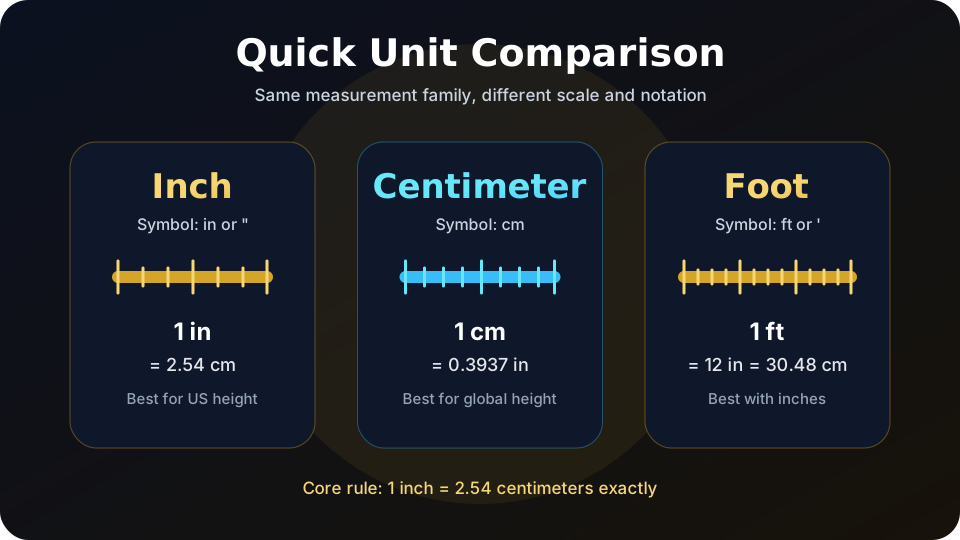
| Feature | Inch | Centimeter | Foot |
|---|---|---|---|
| Symbol | in or " | cm | ft or ' |
| System | Imperial / US | Metric (SI) | Imperial / US |
| Equals in cm | 2.54 cm | 1 cm | 30.48 cm |
| Equals in inches | 1 in | 0.3937 in | 12 in |
| Used for height | Yes (with feet) | Yes | Yes (with inches) |
| Most common in | USA, UK | Most of the world | USA, UK |
| Math base | Base 12 | Base 10 | Base 12 |
What Is an Inch?
An inch is a unit of length in the imperial and US customary systems. By international rule, it equals exactly 2.54 centimeters. The symbol is "in" or a double-prime mark, written as a tall double quote (").
The word itself comes from Latin. Uncia. It meant a twelfth, because the Romans split a foot into twelve parts. That ratio survived nearly two thousand years and still defines the inch today. When you see something measured in inches, you're using a unit that traces all the way back to ancient Rome, just formalized by modern standards. Most people don't think about that history when they buy a 27-inch monitor or read that someone is 70 inches tall, but it's there in every inch you measure.
Where People Use Inches
Inches show up in more places than you'd expect, even in countries that swore off imperial decades ago.
The United States uses inches for almost everything tied to bodies and personal items. Height, waist size, screen diagonals, paper sizes, hand tools, lumber. The UK technically went metric back in the 1960s, but ask any British person how tall they are and you'll get an answer in feet and inches. Canada is similar, mixing metric for distances and weather forecasts with imperial for personal height and home cooking. Liberia and Myanmar are the only other countries that officially use the imperial system, sharing that small global club with the US.
Beyond personal measurements, the inch dominates certain industries everywhere on the planet. Aviation measures altitude in feet, but smaller distances and tolerances often live in inches. Plumbing fittings come in inch sizes (a half-inch pipe is the classic example). Computer monitors, TVs, tablets, and phones are sold by their diagonal inch measurement, even in fully metric countries. Guitar necks, motorcycle wheels, and tire diameters all run on inches. Once you start looking, the inch shows up in places you'd never guess.
How Inches Work in Height
Talk to anyone in the US about height and they'll give you two numbers. A first number, then a smaller number after it. That's feet and inches, and the way it sounds matches how it gets written: 5'10" stands for five feet ten inches.
To get the total in pure inches, multiply the feet by twelve and add the leftover inches. Five feet ten inches works out to (5 × 12) + 10 = 70 inches. A clean six-footer hits 72 inches. Someone who's 6'4" comes in at 76 inches.
5 ft × 12 + 10 in = 70 inches
Why bother converting to total inches at all? Because it's the cleanest unit for math. Adding heights, comparing percentile data, plugging numbers into BMI formulas, all of it works better with one unit instead of two. Pure-inch height is also what most online calculators want, and it's the bridge for converting to anything else, including centimeters.
What Is a Foot?
A foot is twelve inches. Exactly 30.48 centimeters. The symbol is "ft" or the single-prime mark, written as a tall single quote (').
The unit got its name the obvious way. People used to measure things by stepping them off, and a typical adult shoe sat right around the same length most of the time. Different cultures had slightly different feet for centuries, which made trade between regions a headache. Once global commerce really took off, standardization stopped being optional. The modern foot is locked to the inch, which is locked to the centimeter, so it doesn't drift no matter where in the world you measure.
How Feet Are Used
If you're describing anything taller than a child or wider than a doorway in the US, feet usually shows up first.
Adults call out their height in feet and inches: 5'4", 5'10", 6'0". Doors are 6'8" tall by default in American homes. Ceilings come in at 8 feet on the standard build. A king-size bed runs about 6'8" wide. Watch any American sports broadcast and you'll hear feet everywhere. The basketball rim sits at 10 feet. The pitcher's mound is 60 feet 6 inches from home plate. A football field stretches 100 yards, which works out to 300 feet.
Aviation runs on feet too, no matter what country you're in. Pilots talk about cruising at 35,000 feet, descending to 5,000, holding at flight level 280. American architecture works in feet, with floor plans listing rooms as 12 by 14 or 10 by 10. Lot sizes for houses use square feet. Real estate listings? Square feet again. The unit is everywhere in the built environment, even in places that have officially gone metric.
How to Convert Feet and Inches to Centimeters
Here's where most people get stuck, and it's the conversion that comes up most often. Somebody gives you a height in feet and inches, and you need it in centimeters. Maybe for a form. Maybe for a friend who lives abroad. Maybe just out of curiosity.
The formula has two parts. Each foot equals 30.48 centimeters, so you multiply the feet count by 30.48. Each leftover inch equals 2.54 cm, so you multiply the inch count by 2.54. Add the two pieces and you have your answer.
cm = (feet × 30.48) + (inches × 2.54)
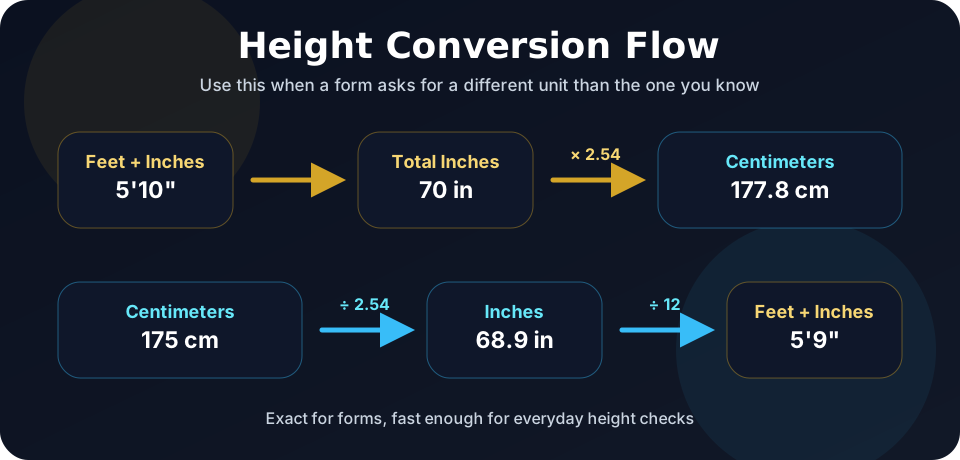
A few worked examples to anchor the math:
- 5'5" works out to (5 × 30.48) + (5 × 2.54) = 152.4 + 12.7 = 165.1 cm
- 5'8" hits (5 × 30.48) + (8 × 2.54) = 152.4 + 20.32 = 172.72 cm
- 5'10" lands at (5 × 30.48) + (10 × 2.54) = 152.4 + 25.4 = 177.8 cm
- 6'0", with no leftover inches, comes out to 6 × 30.48 = 182.88 cm
- 6'2" gets you (6 × 30.48) + (2 × 2.54) = 182.88 + 5.08 = 187.96 cm
If the math feels slow, here's a shortcut: an inch is two and a half cm and change. So a quick mental estimate of 5'10" runs roughly 70 × 2.5 = 175 cm. The real answer (177.8) sits close enough for casual conversations. For exact numbers, the inches-to-cm calculator nails the precise figure in seconds. You can also use the feet-to-inches calculator if you only need the inch step.
Try these calculators
Jump straight to the exact converter you need for this section.
What Is a Centimeter?
A centimeter is a unit of length in the metric system, equal to one hundredth of a meter. Said differently, one centimeter equals ten millimeters, and one hundred centimeters equals one meter. The whole metric system runs on tens, which is the entire point of it.
In inches, one centimeter measures about 0.3937 inches. Roughly four-tenths of an inch. The exact value matters when precision counts, but most people round it to 0.39 or even 0.4 for quick mental math.
The metric system was invented in France in the 1790s, during the years right after the French Revolution. The thinking went something like this. Every region had its own units. Every trade had its own units. Every market had its own units. Buying a sack of grain meant negotiating which "pound" you were using before you could agree on a price. Chaos ruled. The new system fixed everything to base ten so you could scale up or down with simple decimals. By 1799, the metric system was law in France. Other countries adopted it through the 1800s and 1900s. Today the only major holdouts are the US, Liberia, and Myanmar.
Where CM Is Used
Almost everywhere outside the US. Height in any metric country gets reported in centimeters. Doctors, schools, sports federations, immigration forms, dating apps, all of them.
Medical records run on centimeters globally. Even in the US, doctors often record height in cm internally because clinical formulas like BMI, drug dosing, and pediatric growth percentiles work cleanly in metric. Pediatric growth charts almost always show cm on one axis. Clothing sizes in Europe and Asia use centimeters for chest, waist, hips, and inseam length. Shoe sizes in some metric countries cite the foot length in cm directly, with no conversion table needed. Furniture and appliances list their dimensions in cm or millimeters, which is why an Ikea catalog reads like a math homework set.
The one weird exception, even in metric countries, is screen sizes. A TV is sold as a 55-inch model in Berlin and Tokyo, not a 140-cm model. Tradition wins on that one.
How to Convert Centimeters to Inches
Going the other way is even easier than feet-and-inches to cm. One quick division does it.
inches = cm ÷ 2.54
That's the whole formula. If you only need the inch result, you stop right there. If you want feet and inches together, take that inch result and divide by 12. The whole number becomes the feet, and the remainder is the inches.
A few worked examples:
- 165 cm ÷ 2.54 = 64.96 inches. Divide by 12 and you get 5 with 4.96 inches left over, so 165 cm is about 5'5".
- 170 cm ÷ 2.54 = 66.93 inches, which rounds to 5'7".
- 175 cm ÷ 2.54 = 68.90 inches, or 5'9".
- 180 cm ÷ 2.54 = 70.87 inches, or 5'11".
- 185 cm ÷ 2.54 = 72.83 inches, or roughly 6'1".
A faster mental shortcut works for rough estimates. Divide cm by 2.5 instead of 2.54 to get a quick approximation. So 180 / 2.5 = 72 inches, which lands at exactly 6'0". The precise answer is 5'11", but for casual conversations, that estimate gets you in the right neighborhood instantly.
Tools that make this faster
Pick the converter that fits what you have on hand.
What Is a Meter?
A meter is the base unit of length in the International System of Units, the official global measurement standard. One meter equals 100 cm, 39.37 inches, or about 3.281 feet.
The history of the meter is genuinely interesting. When France first defined it in 1793, the goal was a unit based on something universal, not on a king's body part. So the founders declared the meter to be one ten-millionth of the distance from the equator to the North Pole, measured along the meridian through Paris. Surveyors then spent years actually measuring that distance to make a physical platinum bar that became the official standard.
Later definitions got more precise. By 1983, scientists had moved to the most stable reference imaginable: the speed of light. The meter is now defined as the distance light travels through a vacuum in 1/299,792,458 of a second. That sounds extreme, but it makes the meter reproducible anywhere in the universe with the right equipment. No platinum bars required.
Where Meters Are Used
Meters dominate any context where size or distance matters and metric is the rule.
Track and field events run on meters. The 100-meter dash. The 1500-meter run. The marathon at 42,195 meters. Olympic records get logged in meters and centimeters. Pool swimming courses are 50 meters long.
Construction in metric countries works in meters too. Architects draft plans in meters, with rooms listed as 4.5 m by 3.8 m. Floor heights in office buildings come in around 3 m. Bridges, roads, and railway clearances are all metric. Science publications use meters for everything from physics to engineering to biology and chemistry. The kilometer (1,000 meters) handles longer distances, while millimeters cover the tiny ones.
Personal height in meters does come up occasionally. A height of 1.78 m means 178 cm, which works out to 5'10". You'll see this notation on European passports, scientific surveys, and athletic profiles where decimal precision matters.
Key Differences Between Inches, CM, and Feet
The size of each unit is only part of the story. The way they behave in everyday math, on documents, and in spoken conversation makes them feel completely different.
Origin and system. Inches and feet come from imperial roots. Centimeters and meters belong to metric. Two histories, two philosophies. Imperial grew organically from human-scale references like thumbs and feet. Metric was designed from scratch to be logical and decimal.
Math base. Metric runs on base ten. You multiply by 10 to go from cm to mm, divide by 100 to go from cm to m, and never have to think harder than that. Imperial uses base twelve for the inch-to-foot relationship, and base three for foot-to-yard. Mental math gets messy quickly. Quick: how many inches are in 7 feet 3 inches? You're multiplying by 12, then adding. Now try 7.25 meters in centimeters. You just shift the decimal: 725 cm. Done.
Precision feel. One centimeter is finer than one inch. So when you see a height written as 178 cm, that single number captures more granularity than a whole-inch height of 70 inches. For fine measurements, cm avoids the fractions that imperial relies on (think 70 and 3/8 inches written as 70 ⅜").
Notation. Inches and feet combine into a single height with primes: 5'10". Centimeters stand alone: 178 cm. Meters use a decimal: 1.78 m. Three different visual shapes for the same exact height.
Cultural fit. In the US, "five ten" gets understood instantly. Hand somebody "178 cm" and they pause for a second to translate. Flip the audience, and 178 cm is the natural one while 5'10" needs translation. Whichever unit your audience grew up with feels intuitive. The other one feels foreign, even though both name the same height.
Where they overlap. All four (counting meters) are used for human height somewhere in the world. They're equally accurate. None is "more correct" than another. The choice comes down to regional habit and what document you're filling out.
Which Height Unit Should You Use?
The right unit depends on three things: where you are, who's reading, and what document you're filling out. Pick wrong and the form gets rejected, the friend gets confused, or the calculation goes off the rails. Pick right and nobody notices, which is exactly the goal.
Use Feet and Inches When
Stick with feet and inches in these situations:
- You're in the United States, talking to Americans, or filling out anything domestic. Driver's license, ID, passport application, gym membership, doctor's intake form for an American practice. They expect feet and inches, and any other format raises flags.
- You're in the UK or Canada and the conversation is casual. Even though both countries are technically metric, height in everyday speech defaults to feet and inches. Imperial wins for casual height in the Anglosphere.
- You're reading or writing about American sports. NBA player heights, NFL combine results, MMA tale of the tape, boxing weigh-ins. All of them run on feet and inches.
- You're using American or British apps and websites that default to imperial. Some let you toggle, but the defaults stay imperial in those markets.
Use CM When
Switch to centimeters in these cases:
- You're in any metric country, which is most of the planet. Europe, Asia, Latin America, Africa, Oceania. Cm is the default for height almost everywhere outside the US.
- You're submitting medical or visa paperwork internationally. Hospitals, embassies, and immigration offices want cm in nearly every country.
- You're using Olympic, FIFA, or international athletics profiles. Player heights on global rosters use cm. The NBA is the famous exception that stays in feet and inches.
- You're sharing your height on dating apps in metric regions. The expected format on Tinder in Germany, Hinge in Spain, or Bumble in Japan is cm.
- You're reading scientific or academic content. Even casual research papers about average human height tend to use cm.
Use Meters When
Reach for meters in narrower cases:
- You're writing for a scientific publication. Physics, engineering, biology, chemistry. SI units rule, and the meter is SI.
- You're recording athletic results. The 100m, the 1500m, the long jump, the high jump. Anything in formal track and field.
- You're producing architectural drawings or floor plans in a metric country. Rooms in meters, ceiling heights in meters, lot dimensions in meters.
- Precision matters and the height is being recorded with a decimal. A formal European passport might list height as 1.78 m. Survey data on average national heights often gets reported in meters with two decimal places.
How Inches, CM, and Feet Connect
Every conversion you'll ever do comes from one unbreakable rule. One inch equals 2.54 centimeters. From there, every other relationship between any two units is just multiplication or division.
Look at how it cascades. Twelve inches makes a foot. So a foot equals 12 × 2.54 = 30.48 cm. One hundred cm makes a meter. So a meter equals 100 ÷ 2.54 = 39.37 inches, which divides into 39.37 / 12 = 3.28 feet. Going the other way is just inverting. One cm is 1 / 2.54 = 0.3937 inches. One foot is 30.48 / 100 = 0.3048 meters. Every number on the chart below traces back to that single inch-cm relationship.
If you ever forget a conversion factor in the wild, just walk it back to 2.54. The whole network of units rests on that one number, and nothing else really matters.
| From | Inches | CM | Feet | Meters |
|---|---|---|---|---|
| 1 inch | 1 in | 2.54 cm | 0.0833 ft | 0.0254 m |
| 1 cm | 0.394 in | 1 cm | 0.0328 ft | 0.01 m |
| 1 foot | 12 in | 30.48 cm | 1 ft | 0.3048 m |
| 1 meter | 39.37 in | 100 cm | 3.281 ft | 1 m |
Height Conversion Table
Common adult heights expressed in feet and inches, total inches, centimeters, and meters. Bookmark this section. The table covers most adult heights you'll come across, from short to tall.
| Feet & Inches | Total Inches | Centimeters | Meters |
|---|---|---|---|
| 4'10" | 58 in | 147.32 cm | 1.47 m |
| 5'0" | 60 in | 152.40 cm | 1.52 m |
| 5'2" | 62 in | 157.48 cm | 1.57 m |
| 5'4" | 64 in | 162.56 cm | 1.63 m |
| 5'6" | 66 in | 167.64 cm | 1.68 m |
| 5'7" | 67 in | 170.18 cm | 1.70 m |
| 5'8" | 68 in | 172.72 cm | 1.73 m |
| 5'9" | 69 in | 175.26 cm | 1.75 m |
| 5'10" | 70 in | 177.80 cm | 1.78 m |
| 5'11" | 71 in | 180.34 cm | 1.80 m |
| 6'0" | 72 in | 182.88 cm | 1.83 m |
| 6'2" | 74 in | 187.96 cm | 1.88 m |
| 6'4" | 76 in | 193.04 cm | 1.93 m |
| 6'6" | 78 in | 198.12 cm | 1.98 m |
Real Height Examples
Numbers feel abstract until you tie them to people and places you actually know. Here are heights in context, so you can build a mental picture of what each unit really represents.
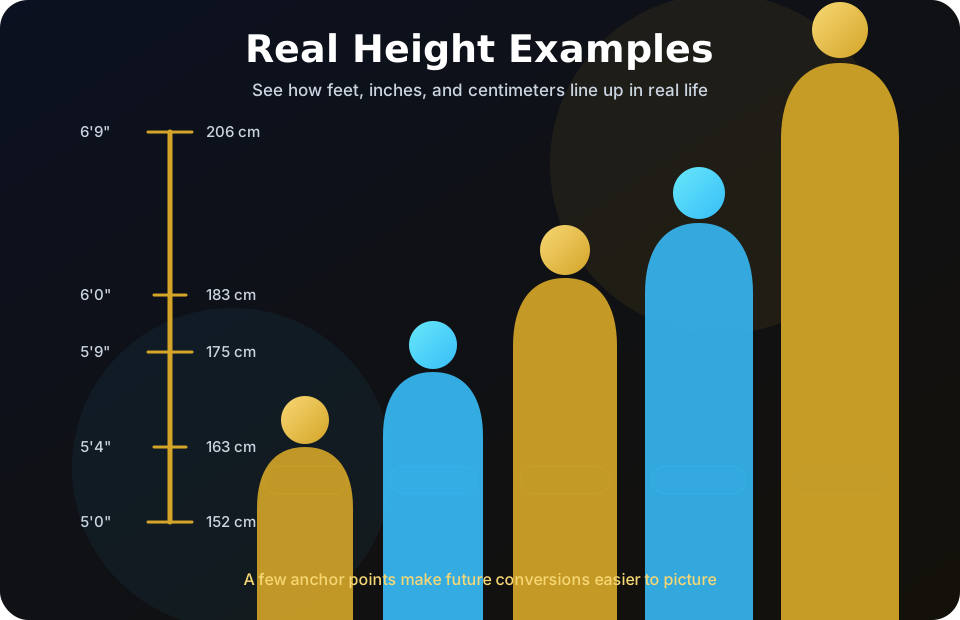
Average heights around the world:
- Average American man: 5'9" or 175 cm
- Average American woman: 5'4" or 162 cm
- Average British man: 5'9.7" or 177 cm
- Average Dutch man (the tallest population in the world): 5'11.9" or 182 cm
- Average Indonesian woman: 5'1" or 155 cm
- Average global adult man: 5'7" or 171 cm
Famous heights:
- LeBron James: 6'9" or 206 cm
- Lionel Messi: 5'7" or 170 cm
- Tom Cruise: 5'7" or 170 cm
- Taylor Swift: 5'10" or 178 cm
- Cristiano Ronaldo: 6'2" or 187 cm
- Robert Wadlow (the tallest person ever recorded): 8'11.1" or 272 cm
Everyday references:
- Standard interior door in the US: 6'8" or 203 cm
- Standard ceiling height in a US home: 8'0" or 244 cm
- Average refrigerator: 5'8" or 173 cm
- Tennis net at the post: 3'6" or 107 cm
- Basketball rim: 10'0" or 305 cm
- Regulation soccer goal height: 8'0" or 244 cm
Use these numbers as anchors. If somebody mentions a 175 cm height, picture an average American guy. If they say 200 cm, they mean someone roughly the size of an NBA rookie. Building these reference points in your head makes any future conversion feel less abstract.
Common Mistakes with Height Units
People mess up height conversions in surprisingly predictable ways. Knowing the traps in advance makes you a lot less likely to fall in.
Mistake one: Mixing up the prime marks. The single prime (') stands for feet. The double prime (") stands for inches. So 5'10" reads as five feet ten inches. Some people accidentally write it backward, like 5"10', which means literally nothing. If you see height notation that doesn't follow the single-then-double pattern, it's wrong.
Mistake two: Using rough estimates as exact values. "An inch is about 2.5 cm." Close enough for a quick guess, but far from accurate when stacked across feet of height. The real number is 2.54, and that 0.04 difference adds up to almost a centimeter at six-foot height. For documents, forms, and any setting where the exact number matters, always use 2.54.
Mistake three: Forgetting to convert before multiplying. If somebody's height is 5 feet, you can't just multiply 5 by 2.54 to get cm. That gives you 12.7 cm, which is the height of a coffee mug. You need to convert feet to inches first (5 × 12 = 60 inches), then multiply by 2.54 to get 152.4 cm. Or skip the middle step entirely and multiply feet by 30.48 directly.
Mistake four: Reading "five-six" as 56 inches. When somebody says "five six," they mean five feet six inches, which works out to (5 × 12) + 6 = 66 inches total. Never 56. The two-digit number people drop is the inches portion, not the total.
Mistake five: Confusing 1.7 m with 1 foot 7 inches. Those look similar on paper but couldn't be more different. 1.7 meters is 170 cm or about 5'7", a normal adult height. 1 foot 7 inches is 19 inches or 48 cm, the height of a toddler. Watch the unit symbol carefully when somebody hands you a number.
Mistake six: Submitting a height in the wrong unit on a form. American forms expect inches or feet. International forms expect cm. Submitting your height in the wrong format gets your application bounced back, and that costs days. Always double-check the unit before filling, especially on visa and medical paperwork.
Mistake seven: Trusting "approximately" conversions for important data. If you're filling out a medical record or a passport application, "around 178 cm" or "roughly 5'10"" doesn't cut it. Use a calculator and write the exact number. The difference of one centimeter can flag inconsistencies between documents later, and that creates problems you don't want.
Inches vs CM vs Feet FAQs
What is bigger, 1 inch or 1 cm?
An inch is bigger. One inch equals exactly 2.54 cm, which means an inch is roughly two and a half times the length of one centimeter. That's why heights expressed in centimeters look like much larger numbers than the same heights in inches.
How many cm is 5 feet 10 inches?
5 feet 10 inches equals 177.8 cm. Here's the math: 5 feet is 5 × 30.48 = 152.4 cm, and 10 inches is 10 × 2.54 = 25.4 cm. Add them together and you get 177.8 cm.
How tall is 6 feet in cm?
6 feet equals 182.88 cm, often rounded to 183 cm in everyday use. The exact calculation is 6 × 30.48 = 182.88. Most casual contexts round to the nearest whole centimeter.
How do I convert cm to feet and inches?
It takes two steps. First, divide the cm value by 2.54 to get total inches. Then divide that inch result by 12. The whole number is feet, and the remainder is inches. For example, 175 cm divided by 2.54 is 68.9 inches. Divide 68.9 by 12 and you get 5 with 8.9 inches left over, so 175 cm is roughly 5 feet 9 inches.
Why don't all countries use the same height unit?
Most countries do use the same unit. Only the United States, Liberia, and Myanmar still officially run on the imperial system. Every other country uses metric. The reason for the holdouts is mostly historical inertia. Switching official systems is expensive, retraining millions of people takes years, and once a country has decades of records in one unit, the case for changing weakens.
Are centimeters more accurate than inches?
Centimeters offer finer increments by default. One cm equals 0.394 inches, which means a cm-based reading is more granular than an inch-based one of the same digit count. For example, a height stated as 178 cm pinpoints a narrower range than the same height stated as 70 inches. That's part of why medical and scientific records prefer cm.
Which is better for height, feet and inches or cm?
Neither is technically better. Both can describe the exact same height with equal accuracy. The right choice depends on your audience. Feet and inches feel intuitive in the US and UK. Centimeters are the global standard everywhere else. Pick whichever your audience and document expect.
Is 5 feet 9 inches a good height?
For an American man, 5 feet 9 inches sits right at the average. For a Dutch man, it's slightly below average. For an Indian man, it's above average. What counts as a good height depends entirely on local norms and what you're trying to do. There isn't one objective answer.
How can I quickly estimate a height in cm if I only know feet and inches?
Use a fast mental shortcut. Multiply total inches by 2.5 instead of the exact 2.54. The error is about 1.5 percent, fine for casual estimates. So 5 feet 10 inches becomes 70 inches × 2.5 = 175 cm. The actual answer is 177.8 cm, but 175 gets you close enough for everyday conversation.
Need an instant conversion?
Skip the math and try the calculator.