
What Is a Centimeter?
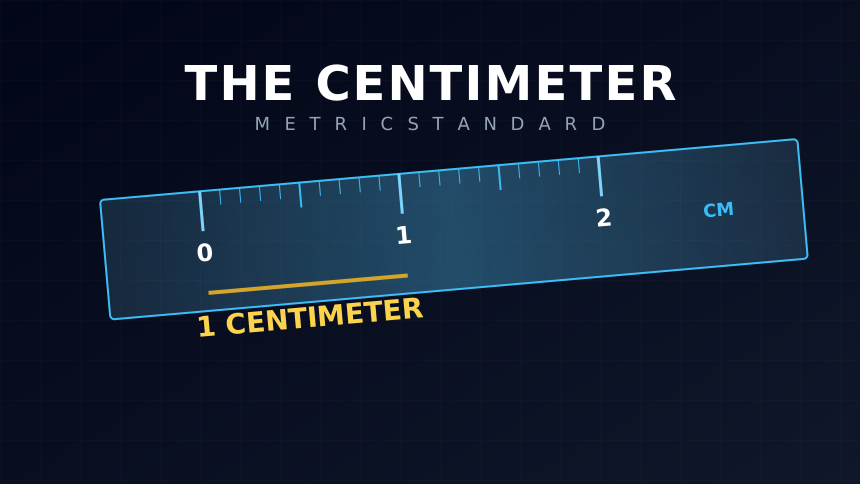
A centimeter is a metric unit of length equal to one hundredth of a meter. One centimeter equals exactly 10 millimeters, 0.01 meters, or about 0.3937 inches.
Centimeters appear in height, clothing sizes, school rulers, medical records, sports profiles, product dimensions, and international forms. Most countries use centimeters for human height because the unit gives a clean whole-number value, such as 170 cm or 180 cm.
This guide explains the centimeter definition, cm meaning, how centimeter measurement works, how long is a centimeter, and how centimeters connect to inches, feet, meters, and millimeters inside the measurement systems used for height.
What Is a Centimeter? Quick Definition
A centimeter is a metric length unit equal to 1/100 of a meter.
The symbol is cm. The word centimeter comes from centi-, meaning one hundredth, and meter, the base unit of length in the International System of Units.
Centimeter Definition and Exact Equivalents
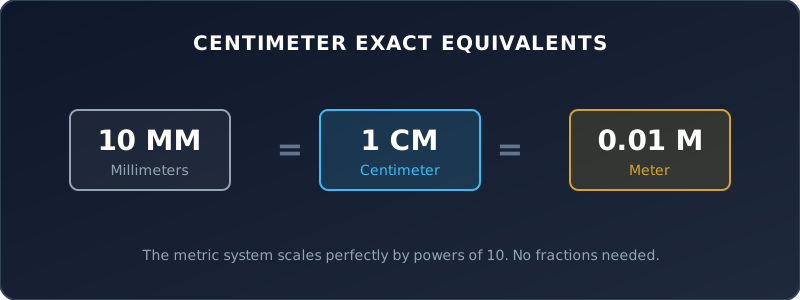
The centimeter has a fixed place in the metric system. It sits between the millimeter and the meter. Ten millimeters make one centimeter, and 100 centimeters make one meter. Because the metric system uses powers of 10, you can move between millimeters, centimeters, and meters by multiplying or dividing by 10 or 100.
| Unit | Equivalent | Use |
|---|---|---|
| 1 centimeter | 10 millimeters | Metric ruler marks |
| 1 centimeter | 0.01 meters | One hundredth of a meter |
| 1 centimeter | 0.3937008 inches | Centimeters to inches |
| 1 centimeter | 0.0328084 feet | Centimeters to decimal feet |
| 100 centimeters | 1 meter | Metric height notation |
The key metric relationship is simple: 1 cm = 10 mm and 100 cm = 1 m. For imperial conversion, use the exact inch relationship: 1 inch = 2.54 cm.
CM Meaning, Symbol, and Correct Writing
CM meaning is straightforward: cm is the standard unit symbol for centimeter. In formal writing, the symbol stays lowercase. Write 1 cm, 12 cm, or 180 cm. Do not add an s after the symbol. Unit symbols stay the same in singular and plural values.
American English usually writes centimeter. British English often writes centimetre. The spelling changes, but the unit and symbol do not. Both words use cm.
Correct: 178 cm
Avoid: 178 cms, 178 CM, 178 c.m.
How Long Is a Centimeter?
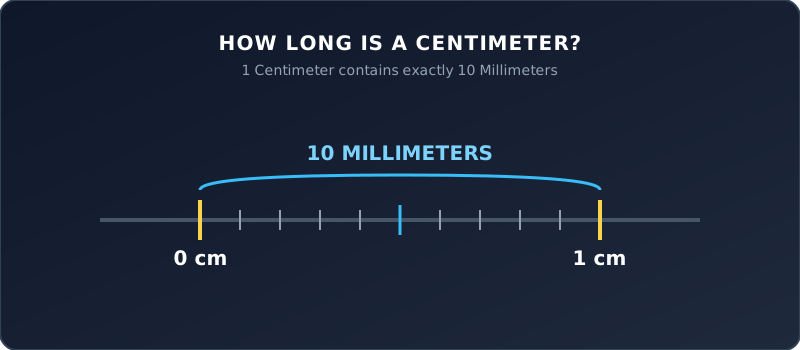
A centimeter is 10 millimeters long. On a metric ruler, the numbered marks usually show centimeters. The smaller marks between those numbers show millimeters. The distance from one numbered mark to the next numbered mark equals one centimeter.
For a rough mental picture, a centimeter is a little less than half an inch. Everyday body comparisons can help you estimate, but use a ruler, tape measure, stadiometer, or calibrated measuring tool when the number matters.
| Mark | Centimeters | What It Means |
|---|---|---|
| 1 mm | 0.1 cm | Smallest marks on many school rulers |
| 5 mm | 0.5 cm | Halfway between numbered centimeter marks |
| 10 mm | 1 cm | One full centimeter |
| 50 mm | 5 cm | Short hand-size reference |
| 100 mm | 10 cm | One decimeter |
Centimeter Measurement in the Metric Unit of Length System
The centimeter belongs to the metric family of length units. Metric units scale by powers of 10, which makes them easier to calculate than many imperial units. You do not need fractions to move from centimeters to meters. You shift two decimal places.
Millimeters, centimeters, and meters
Use millimeters for small details, centimeters for everyday lengths, and meters for larger lengths. A phone width might be measured in centimeters. A screw diameter might use millimeters. A room length might use meters.
Why centimeters work well for height
Adult height usually lands between 140 cm and 210 cm, so centimeters give practical whole numbers. A height like 178 cm is easier to compare, sort, and enter into a database than 5 feet 10.1 inches. That is why medical records, sports profiles, immigration forms, and international charts often use centimeters.
How Centimeters Convert to Inches, Feet, and Meters
Centimeter conversion uses a small set of fixed formulas. The formulas below cover the conversions most people need for height, forms, clothing measurements, sports rosters, and product dimensions.
| Conversion | Formula | Example |
|---|---|---|
| Centimeters to millimeters | cm x 10 = mm | 12 cm x 10 = 120 mm |
| Centimeters to meters | cm / 100 = m | 180 cm / 100 = 1.8 m |
| Centimeters to inches | cm / 2.54 = in | 177.8 cm / 2.54 = 70 in |
| Inches to centimeters | in x 2.54 = cm | 70 in x 2.54 = 177.8 cm |
| Centimeters to feet | cm / 30.48 = ft | 182.88 cm / 30.48 = 6 ft |
Example: 180 cm / 2.54 = 70.87 inches. Divide 70.87 by 12 and you get 5 feet with 10.87 inches left over, so 180 cm is about 5 feet 10.9 inches.
For the full step-by-step method, read How to Convert CM to Inches or use the CM to Feet Calculator.
Common Centimeter Measurements and Height Examples
The table below gives common centimeter height values with inch, feet-and-inches, and meter equivalents. These numbers help you translate metric height into the format used in the United States.
| Height | Total Inches | Feet & Inches | Meters |
|---|---|---|---|
| 150 cm | 59.06 in | 4 ft 11.1 in | 1.50 m |
| 160 cm | 62.99 in | 5 ft 3.0 in | 1.60 m |
| 170 cm | 66.93 in | 5 ft 6.9 in | 1.70 m |
| 175 cm | 68.90 in | 5 ft 8.9 in | 1.75 m |
| 180 cm | 70.87 in | 5 ft 10.9 in | 1.80 m |
| 190 cm | 74.80 in | 6 ft 2.8 in | 1.90 m |
| 200 cm | 78.74 in | 6 ft 6.7 in | 2.00 m |
| Example | Centimeters | Equivalent |
|---|---|---|
| A metric ruler section | 1 cm | 10 mm |
| Passport-style height entry | 178 cm | 1.78 m |
| 5 feet 10 inches | 177.8 cm | 70 inches |
| 6 feet | 182.88 cm | 72 inches |
| Standard US interior door height | 203.2 cm | 80 inches |
| Basketball rim height | 304.8 cm | 10 feet |
Centimeter vs Inch, Foot, Meter, and Millimeter
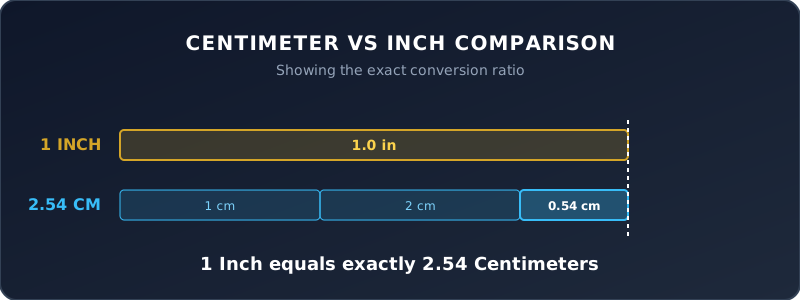
Centimeters fit best when the length is too large for millimeters and too small for meters. In height measurement, centimeters usually give the most practical metric value. Inches and feet still matter when you communicate with a US audience.
| Unit | Symbol | Centimeter Value | Best For |
|---|---|---|---|
| Millimeter | mm | 0.1 cm | Fine marks and small tolerances |
| Centimeter | cm | 1 cm | Height, body measurements, everyday length |
| Meter | m | 100 cm | Rooms, science, formal SI notation |
| Inch | in | 2.54 cm | US height, screens, tools, product sizes |
| Foot | ft | 30.48 cm | US height, buildings, sports, aviation |
Where Centimeters Are Used
Centimeters appear wherever people need a practical metric length. You will see them often in these contexts:
Height and body measurement
Most countries record adult height in centimeters. Clothing size charts also use centimeters for chest, waist, hip, inseam, sleeve, and shoulder measurements. A body measurement listed as 92 cm gives a precise metric value without fractions.
Medical, sports, and official records
Clinics, hospitals, athletics profiles, immigration forms, school records, and research datasets often use centimeters for height. A single centimeter value reduces ambiguity because the reader does not need to parse feet plus inches.
School, science, and product dimensions
Students learn centimeters on metric rulers. Product pages use centimeters for package size, furniture dimensions, clothing measurements, and small household items. Science classes may use centimeters for simple lab measurements before switching to meters or millimeters when scale demands it.
How to Measure in Centimeters Accurately
Start the measurement at the zero mark on the ruler or tape, not at the physical edge of the tool. Some rulers have a small blank margin before zero. If you start at the edge, you can add extra length by mistake.
Keep the tool straight, read the mark at eye level, and include millimeters when the object falls between centimeter marks. For example, an object that reaches two small millimeter marks past 8 cm measures 8.2 cm.
For human height, use a flat wall, hard floor, and a level object placed on top of the head. Mark the wall, then measure from the floor to the mark in centimeters. For more detail, see How to Measure Your Height at Home.
Common Mistakes With Centimeters
Confusing centimeters with millimeters
One centimeter equals 10 millimeters. A value of 180 mm equals 18 cm, not 180 cm. Check the unit before entering a measurement into a form or calculator.
Adding a plural s to cm
Write 180 cm, not 180 cms. Unit symbols stay unchanged regardless of number.
Rounding too early
If you convert 5 feet 10 inches to centimeters, calculate 70 x 2.54 = 177.8 cm first. Then round if your context accepts whole centimeters. Rounding before the final step creates avoidable errors.
Treating centimeters and meters as separate systems
Centimeters and meters belong to the same metric system. A height of 178 cm equals 1.78 m. You only need to move the decimal point two places.
Related Centimeter and Height Resources
Use these supporting resources to move through the measurement-systems silo and related conversion tools.
Supporting guides
Relevant calculators
Frequently Asked Questions
What is a centimeter?
A centimeter is a metric unit of length equal to one hundredth of a meter. One centimeter equals 10 millimeters or about 0.3937 inches.
What does cm mean?
CM means centimeter. The lowercase symbol cm combines the metric prefix centi, meaning one hundredth, with meter, the base unit of length in the International System of Units.
How long is a centimeter?
A centimeter is 10 millimeters long. On a metric ruler, it is the distance between two numbered centimeter marks.
Is a centimeter bigger than an inch?
No. One inch equals exactly 2.54 centimeters, so an inch is about two and a half times longer than a centimeter.
How many centimeters are in a meter?
There are exactly 100 centimeters in one meter. To convert centimeters to meters, divide by 100.
How do you convert centimeters to inches?
Divide centimeters by 2.54. For example, 177.8 cm divided by 2.54 equals 70 inches.
Why is height often measured in centimeters?
Centimeters give a single whole-number height for most adults, such as 170 cm or 180 cm. That makes height easier to record, compare, and convert in metric countries, medicine, sports, and international forms.
Should I write cm or cms?
Write cm. Unit symbols do not take a plural s, so 1 cm and 180 cm both use the same symbol.
What Is a Centimeter?
What Is a Centimeter? It is a metric unit of length equal to one hundredth of a meter, 10 millimeters, or about 0.3937 inches. Its symbol is cm, and it is one of the most practical units for everyday metric measurement.
Remember three anchor facts: 100 centimeters make 1 meter, 1 centimeter equals 10 millimeters, and 1 inch equals exactly 2.54 centimeters. With those relationships, you can measure in centimeters, convert height values, and choose the right unit for any form, chart, or audience.