
How to Format Height on Forms
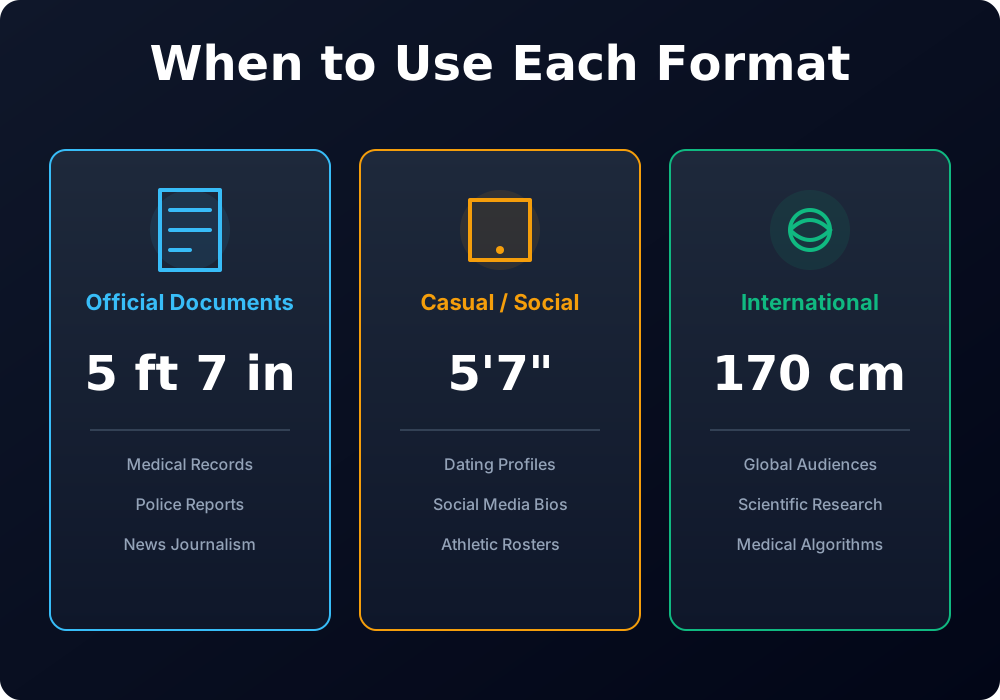
To format height on forms correctly, use the unit system the form expects and enter values in the specific fields provided. The format changes across 5 main form types: passport applications, medical intake forms, driver's license applications, school enrollment forms, and digital health profiles. The wrong format causes rejected submissions, database errors, and mismatched records.
Forms in the United States (US) use feet and inches (ft and in). Forms in the United Kingdom (UK), Europe, and most other countries use centimeters (cm) or meters (m). The format also depends on whether the form provides separate fields for feet and inches or a single text field.
This guide covers the correct height format for each major form type, the right symbols and abbreviations to use, country-specific rules for the US, UK, and international forms, 4 common formatting mistakes that cause form rejections, and how to convert height between centimeters, feet, and inches for any form requirement.
Why Height Format Matters on Forms
Height on official forms is not a casual measurement — it feeds directly into databases, medical record systems, and legal identity documents. Entering height in the wrong format causes 3 types of problems:
- Rejected submissions: Forms with input validation reject entries with unexpected characters. A height written as 5'7" fails validation because the apostrophe and quotation marks trigger security blocks designed to prevent database injection attacks.
- Conversion errors: Entering 5.7 instead of 5 ft 7 in creates a 1.4-inch (3.56 cm) error. The decimal value 5.7 means 5.7 feet (5 feet 8.4 inches), not 5 feet 7 inches.
- Record mismatches: Medical records that store height in the wrong unit affect Body Mass Index (BMI) calculations, medication dosage formulas, and growth percentile charts.
How to Format Height on Passport Application Forms
Passport height formatting depends on your country. There are 3 standard formats used across major passport-issuing countries.
US Passport Height Format
US passport applications from the Department of State require height in feet and inches using 2 separate fields. Enter whole numbers only.
Correct US passport format:
Feet field: 5 | Inches field: 7 (for 5 feet 7 inches = 170.18 cm)
Do not write 5'7" in a single text box. Do not write 5.7. The application form provides dedicated numeric fields to prevent formatting errors. Measure barefoot and round to the nearest whole inch.
UK Passport Height Format
UK passport applications require height in meters and centimeters (cm). His Majesty's Passport Office uses the metric system (International System of Units, or SI) for all government documents.
Correct UK passport format:
Height: 1.70 m or 170 cm (for 5 feet 7 inches)
Convert feet and inches to centimeters by multiplying total inches by 2.54. For 5 ft 7 in: (5 × 12) + 7 = 67 inches × 2.54 = 170.18 cm. Enter 170 cm on the form.
International and European Passport Height Format
Passports from European Union (EU) countries, Canada, Australia, and most other nations use centimeters. Some countries require height in the format 1m70 or 170cm without a space. Always check the specific form instructions for your country.
| Country | Format Required | Example (5 ft 7 in) |
|---|---|---|
| United States | Feet + Inches (separate fields) | 5 ft | 7 in |
| United Kingdom | Centimeters or Meters | 170 cm / 1.70 m |
| Canada | Centimeters (official) or ft/in | 170 cm or 5 ft 7 in |
| Australia | Centimeters | 170 cm |
| Germany / France / EU | Centimeters | 170 cm |
How to Format Height on Medical Forms
Medical forms follow strict data entry standards because height feeds into 3 clinical calculations: BMI, medication dosage (using body surface area formulas), and pediatric growth percentile charts.
US Medical Form Height Format
US medical intake forms, including Electronic Health Record (EHR) systems like Epic and Cerner, record height in feet and inches using separate fields, or as total inches in a single field.
3 accepted US medical formats:
- 5 ft 7 in — preferred on paper intake forms
- 67 in — total inches, used in EHR database fields
- 170 cm — used in research and international clinical settings
Medical notation never uses decimal feet. Writing 5.583 ft on a patient chart is an error. The Centers for Disease Control and Prevention (CDC) pediatric growth charts use centimeters for children under 2 years (recumbent length) and either centimeters or inches for children ages 2 to 20.
International Medical Form Height Format
International medical forms, World Health Organization (WHO) health records, and clinical research papers use centimeters. BMI calculations use height in meters: BMI = weight (kg) / height (m)². For 5 ft 7 in (170.18 cm), the meter value is 1.7018 m.
How to Format Height on Driver's License Applications
Driver's license height formatting uses a compact numeric code in the US and centimeters in most other countries.
US Department of Motor Vehicles Height Format
US Department of Motor Vehicles (DMV) applications record height in feet and inches. The printed license displays height as a 3-digit code. The encoding format has 2 variants across states:
- 507 — 5 feet 7 inches (no separator)
- 5-07 — 5 feet 7 inches (hyphen separator)
The application form itself uses separate numeric fields for feet and inches. Enter whole numbers only, measured barefoot. The DMV does not accept height in centimeters.
How to Format Height on School and Job Application Forms
School Enrollment Forms
School enrollment forms request height for 2 contexts: general health records and physical education programs. US school health records follow the same standard as medical forms. Enter height in feet and inches in separate fields, or as total inches. School health databases in the US use the CDC growth chart system, which stores height in centimeters internally even for US schools.
Job Application Forms
Most job application forms do not include height unless the role has a physical requirement. The 4 job categories that request height on applications are police officer, military, modeling, and professional athletics.
- Police / Military (US): Feet and inches in separate fields. Written as 5 ft 7 in in requirements documentation.
- Military (UK / Europe): Centimeters. Minimum height requirements for most forces are expressed as 157 cm (5 ft 2 in) or 160 cm (5 ft 3 in).
- Modeling: The form accepts feet and inches (5'7") in the US and centimeters (170 cm) in Europe. Modeling agencies enter height as a whole centimeter value in their database systems.
How to Format Height on Digital Forms and Health Apps
Digital forms and mobile health applications use 2 types of height input fields: dropdown selectors and text fields.
Dropdown Selector Forms
Dropdown selectors show preset values for feet (0-8) and inches (0-11) separately. Select the matching value from each dropdown. This format eliminates entry errors because the system controls what values are possible.
Single Text Field Forms
Single text field forms require a specific format. The 3 safest entries for a text field are:
Text field entry rules:
- 5 ft 7 in — letters, no symbols, always accepted
- 170 cm — metric format, accepted on metric-first forms
- 67 — total inches only, accepted on numeric-only fields
- 5'7" — fails validation (apostrophe and quote marks blocked)
- 5.7 — wrong value (equals 5 ft 8.4 in, not 5 ft 7 in)
4 Common Height Formatting Mistakes on Forms
Formatting errors on official forms cause rejection, delays, and data errors. These 4 mistakes appear on forms across all document types.
1. Using Symbols (') and (") in Text Fields
The apostrophe (') and double quote (") characters are blocked by SQL injection protection systems in most web applications. Typing 5'7" into a text input field triggers a validation error on government portals, hospital systems, and job application platforms. Enter 5 ft 7 in or use separate numeric fields.
2. Entering Decimal Height Instead of Feet and Inches
The number 5.7 does not mean 5 feet 7 inches. 5.7 feet equals 5 feet and 8.4 inches (0.7 × 12 = 8.4 inches), which converts to 173.74 cm. The difference from the correct 170.18 cm (5 ft 7 in) is 3.56 cm. This error changes BMI calculations and growth percentile results in medical records.
3. Entering the Wrong Unit System
Entering 170 into a field that expects inches records the person as 170 inches tall (14 feet 2 inches, or 431.8 cm). Entering 67 into a field that expects centimeters records the person as 67 cm tall (2 feet 2.4 inches). Check whether the form field label says inches, centimeters, or feet before entering any number.
4. Rounding Incorrectly
US forms expect height rounded to the nearest whole inch. International forms expect height rounded to the nearest whole centimeter. 5 feet 7.4 inches rounds to 5 feet 7 inches (not 5 feet 7.4). 170.6 cm rounds to 171 cm (not 170). Use whole numbers on all official forms.
Convert Height for Any Form Requirement
Use these 4 conversion formulas to get the right number for any form field.
| You Have | Form Requires | Formula | Example |
|---|---|---|---|
| Feet & Inches | Centimeters | (ft × 12 + in) × 2.54 | 5 ft 7 in = 170 cm |
| Centimeters | Feet & Inches | cm ÷ 2.54 = inches; inches ÷ 12 = ft | 170 cm = 5 ft 6.9 in |
| Feet & Inches | Total Inches | (ft × 12) + in | 5 ft 7 in = 67 in |
| Centimeters | Meters | cm ÷ 100 | 170 cm = 1.70 m |
The conversion constant 1 inch = 2.54 cm is an exact internationally defined standard, not an approximation. Use the full 2.54 value in all calculations to prevent rounding errors across multi-step conversions.
Frequently Asked Questions
How do you write height on a US passport application?
US passport applications require height in 2 separate fields: feet and inches as whole numbers. For 5 feet 7 inches (170.18 cm, or 1.70 m), enter 5 in the feet field and 7 in the inches field. Do not use symbols or decimals.
Should height on medical forms be in inches or centimeters?
US medical forms record height in feet and inches or as total inches (67 in for 5 ft 7 in). International medical forms use centimeters (170 cm). Electronic Health Record (EHR) systems store height as total inches internally and convert for display.
What format does a UK passport use for height?
UK passport applications require height in centimeters or meters. Enter 170 cm or 1.70 m for 5 feet 7 inches. The UK uses the metric system on all official government documents.
Can I write 5'7" on a form?
No, writing 5'7" in a single text field on official forms causes validation errors. Enter height as separate numbers in dedicated feet and inches fields, or write 5 ft 7 in if a single text field is provided.
How is height formatted on a US driver's license?
US driver's licenses display height as a 3-digit code: 507 means 5 feet 7 inches. Some states use 5-07 with a hyphen. The DMV application form uses separate numeric fields for feet and inches.
What height format do job application forms use?
Job application forms for physical-demand roles use feet and inches (5 ft 7 in) in the US and centimeters (170 cm) in Europe. Most job applications do not require height at all.
How do I enter height on a digital form or health app?
Select your feet and inches values from dropdown selectors, or type 5 ft 7 in (or 170 cm) in a single text field. Never type 5'7" since the apostrophe and quote marks fail input validation on most digital platforms.
Related Height Formatting Guides
Use these guides to understand how height notation works across different writing contexts and measurement systems.
5'7" vs 5 ft 7 in →
Learn when to use symbolic notation vs spelled-out abbreviations.
How to Write Height Correctly →
Complete guide to height symbols, abbreviations, and style guide rules.
Height in Different Countries →
See how the US, UK, Europe, and other regions format height.
7 Conversion Mistakes →
The most common errors when converting feet, inches, and centimeters.