
Common Height Conversion Mistakes and How to Avoid Them
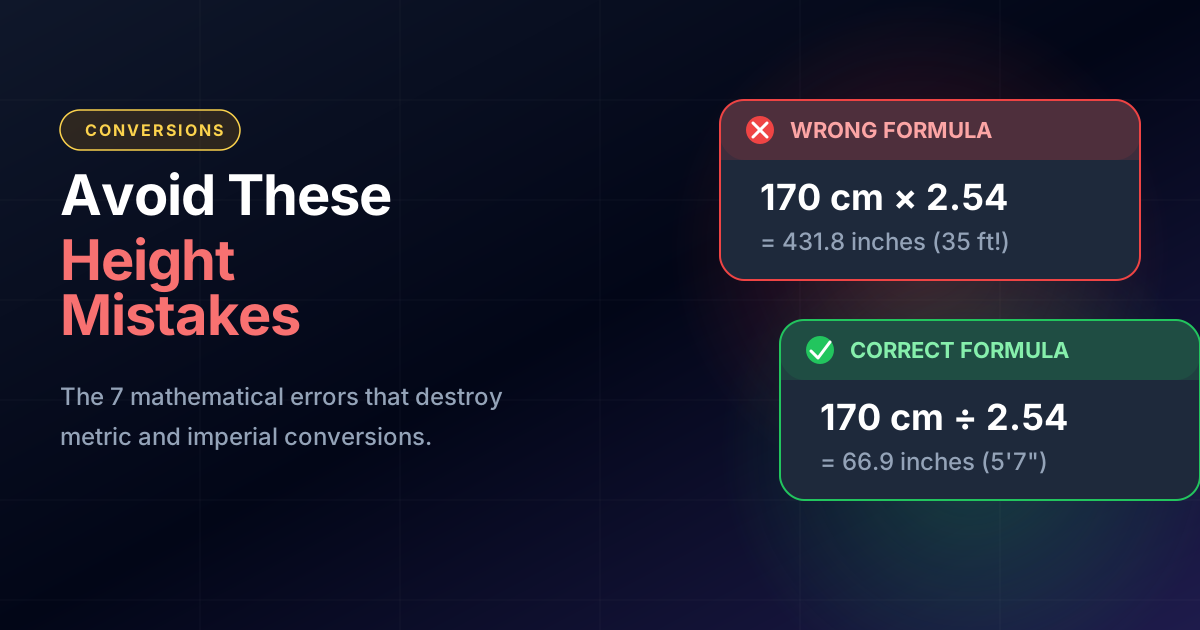
Height conversion mistakes are calculation errors that occur when converting measurements between the metric system (cm) and the imperial system (feet and inches). There are 7 common conversion mistakes that result in inaccurate medical records, flawed building plans, and incorrect personal height profiles. These 7 errors stem from 2 root causes: failing to use the precise 1 inch = 2.54 cm constant and misinterpreting the base-12 imperial system.
These mistakes happen in daily life, sports data entry, and digital software systems where precise measurements are required. This guide explains each of the 7 mistakes, provides 3 real examples of incorrect conversions (such as miscalculating 170 cm or 6 feet), clarifies metric vs imperial notation, and details how to prevent these errors.
Why Height Conversion Mistakes Happen
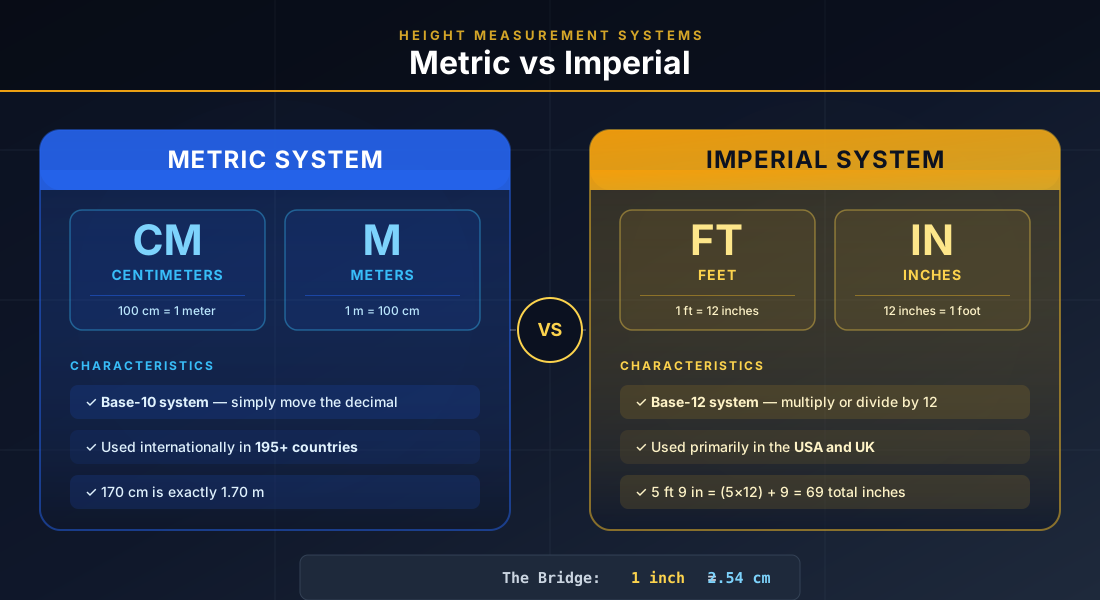
Height conversion mistakes stem from the metric and imperial systems using distinct mathematical bases. The metric system uses a base-10 structure. Every unit operates as a multiple of 10. Moving between centimeters and meters requires shifting the decimal point. 170 cm becomes 1.70 m with no complex multiplication required.
The imperial system relies on a base-12 structure. There are 12 inches in 1 foot, not 10. Moving between feet and inches requires multiplying or dividing by 12. A person trained on metric logic applies base-10 rules to a base-12 system out of habit. That mismatch serves as the root cause of 5 of the 7 most frequent height conversion errors.
The use of estimated constants forms a secondary cause. The strict conversion factor for 1 inch stands at 2.54 cm, defined by international agreement in 1959. Rounding that to 2.5 or 2.6 creates compounded errors of 1.8 cm or more across a series of calculations. That margin matters for medical records, sports databases, and construction plans.
Mixing Up Feet and Inches
Mixing up feet and inches ranks as the most frequent error people make when converting to the imperial system. The metric system describes height with a single unit (cm). Imperial height requires 2 separate units working together: feet and inches. People unfamiliar with this system treat the number pair as a simple decimal, which produces wrong results.
Understanding the Difference Between Feet and Inches
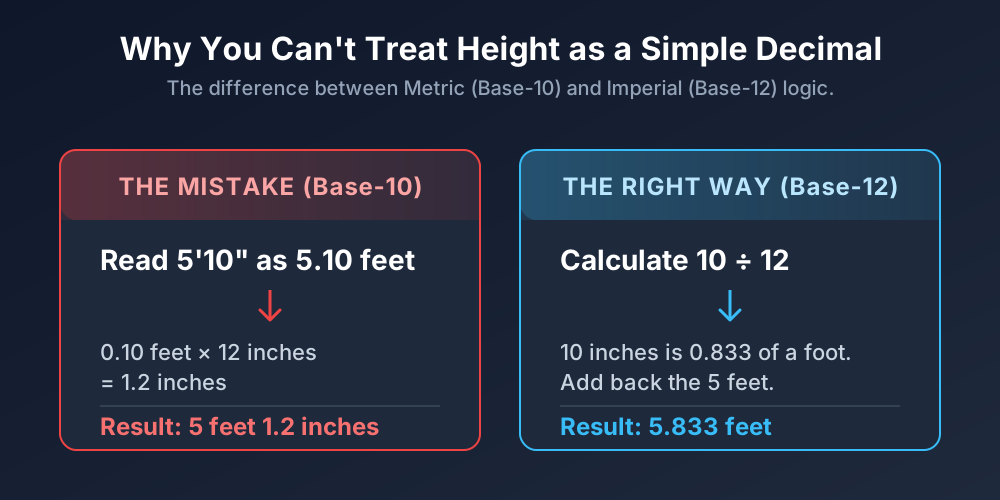
There are 12 inches in 1 foot. Feet serve as the primary, larger unit. Inches act as the secondary unit representing the remaining fraction of a foot. The critical rule states that you cannot treat the inches portion as a decimal fraction of a foot. 5 feet 6 inches does not equal 5.6 feet.
To convert 5 feet 6 inches to a pure decimal, divide the inches by 12 and add the result to the feet: 6 ÷ 12 = 0.5. So 5 feet 6 inches equals 5.5 feet, not 5.6 feet. This distinction alone creates a 3.66 cm error in the final centimeter calculation.
Common Examples of This Mistake
Mistake A: 5 feet 10 inches read as 5.10 feet.
5.10 feet equals 5 feet 1.2 inches (0.10 × 12 = 1.2 in). The proper decimal form of 5 feet 10 inches is 5.833 feet (10 ÷ 12 = 0.833). This produces an 8.8-inch gap and a 22.4 cm error in the final centimeter result.
Mistake B: 6 feet 2 inches read as 6.2 feet.
6.2 feet equals 6 feet 2.4 inches. The proper decimal is 6.167 feet (2 ÷ 12 = 0.167). The resulting centimeter value is off by 1.02 cm when multiplied by the 30.48 cm/foot constant.
Using the Wrong Conversion Formula
There are 7 distinct height conversion formulas, each with a specific direction and constant. Applying the right constant in the wrong direction, or the wrong constant altogether, yields incorrect results. The 2 most common formula errors involve the 2.54 cm/inch constant and the 0.3048 m/foot constant.

CM to Inches Formula Errors
To convert centimeters to inches, you divide by 2.54. The formula requires: inches = cm ÷ 2.54. The most widespread mistake involves multiplying instead of dividing.
| Input | Wrong (× 2.54) | Correct (÷ 2.54) |
|---|---|---|
| 170 cm | 431.8 inches (35 ft tall) | 66.93 inches (5 ft 6.9 in) |
| 180 cm | 457.2 inches (38 ft tall) | 70.87 inches (5 ft 10.9 in) |
| 150 cm | 381 inches (31.75 ft tall) | 59.06 inches (4 ft 11.1 in) |
Feet to CM Formula Errors
To convert feet to centimeters, multiply by 30.48 (since 1 foot = 30.48 cm). Many individuals apply the 2.54 inch multiplier to a feet value.
The Mistake: Multiplying 6 feet by 2.54 gives 15.24 cm. The correct calculation requires 6 × 30.48 = 182.88 cm. The 2.54 constant applies to inches, not to feet.
Forgetting to Convert Feet to Inches First
You must reduce the measurement to a single unit (total inches) when your height is expressed as a combination of feet and inches (such as 5 ft 7 in). Skipping this step stands as the 3rd most widespread conversion error.
The precise process has 3 steps:
- Multiply the feet value by 12 to convert to inches: 5 × 12 = 60 inches.
- Add the remaining inches: 60 + 7 = 67 total inches.
- Multiply total inches by 2.54: 67 × 2.54 = 170.18 cm.
Common Wrong Attempt: Multiplying 5.7 by 30.48 gives 173.73 cm. The correct answer is 170.18 cm. This method produces a 3.55 cm error. It treats 5.7 as a pure decimal (5 feet + 0.7 feet), whereas 7 inches equals 0.583 of a foot.
Confusing Centimeters and Meters
Confusing centimeters (cm) and meters (m) acts as a unit-labeling error, not a formula error. This happens in international data entry forms, medical intake documents, and fitness apps that accept either unit without clear validation.
1 Meter vs 100 Centimeters
There are 100 centimeters in 1 meter. The prefix "centi" means one-hundredth in the International System of Units (SI). 1.70 meters matches 170 centimeters. Multiply by 100 to transition from meters to centimeters (1.70 × 100 = 170 cm). Divide by 100 to move from centimeters to meters (170 ÷ 100 = 1.70 m).
Common Meter-to-Centimeter Errors
There are 3 primary errors when mixing up these two metric units:
- Entering 1.70 into a cm field: Records the person as 1.7 cm tall, less than 1 inch in height.
- Entering 170 into a meters field: Records the person as 170 m tall.
- Converting 1.8 m to feet using the cm formula: Dividing 1.8 by 2.54 gives 0.71 inches. The correct approach converts 1.8 m to 180 cm first, then divides by 2.54 to get 70.87 inches (5 ft 10.9 in).
Confirm which unit a form expects before entering a height value. Work in centimeters to keep the math straightforward when using the metric system for conversions.
Rounding Numbers Too Early
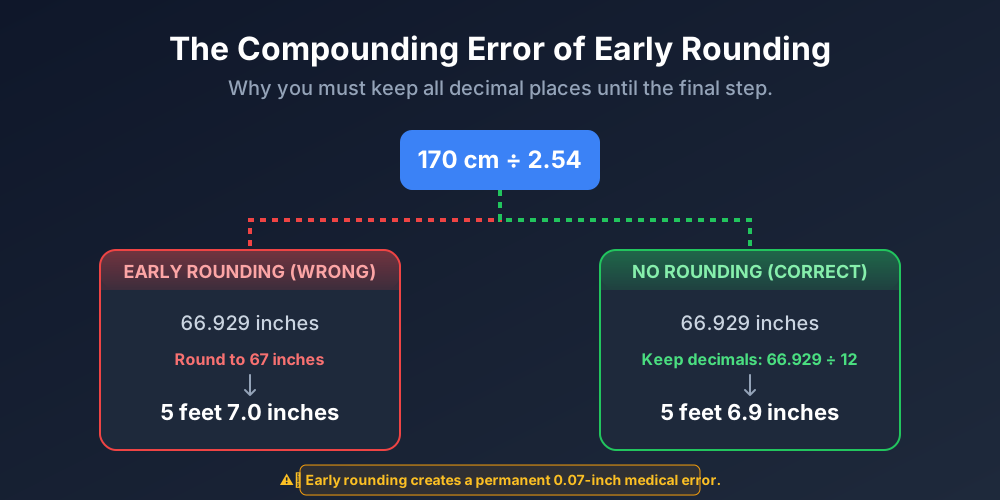
Rounding numbers during intermediate steps ruins precision and compounds errors. You must complete all mathematical operations before rounding your final result.
Here is a direct comparison using 170 cm to feet and inches:
| Step | Early Rounding (Wrong) | No Rounding (Correct) |
|---|---|---|
| 170 ÷ 2.54 | Rounds to 67 in | Keeps 66.929 in |
| Divide by 12 | 67 ÷ 12 = 5.583 ft | 66.929 ÷ 12 = 5.577 ft |
| Final result | 5 ft 7.0 in (off by 0.07 in) | 5 ft 6.93 in (precise) |
A 0.07-inch error affects standardized medical height records, clothing size calculations, and Body Mass Index (BMI) results in clinical contexts.
Misreading Height Notation
The imperial system uses punctuation marks as unit symbols. Misreading these notations causes confusion before any math begins. There are 2 notation formats people mix up.
Understanding 5'8"
The notation 5'8" means 5 feet and 8 inches. The single prime mark (') represents feet. The double prime mark (") represents inches. This height converts to 68 total inches (5 × 12 + 8) and equals 172.72 cm (68 × 2.54). You will see this notation on passports, sports profiles, and health records from the United States, the United Kingdom (UK), and Canada.
Understanding 5.8 Feet
The notation 5.8 feet functions as a pure base-10 decimal. It means 5 full feet plus eight-tenths of one foot. Since 1 foot equals 12 inches, eight-tenths of 12 is 9.6 inches. 5.8 feet equals 5 feet 9.6 inches (176.78 cm). Your cm result becomes 172.72 cm (a 4.06 cm error) if you misread 5.8 feet as 5 feet 8 inches.
| Notation | Correct Reading | In CM |
|---|---|---|
| 5'8" | 5 feet 8 inches | 172.72 cm |
| 5.8 ft | 5 feet 9.6 inches | 176.78 cm |
| 6'0" | 6 feet 0 inches | 182.88 cm |
| 6.0 ft | 6 feet 0 inches | 182.88 cm |
Metric vs Imperial Conversion Mistakes
System-level mismatches cause Metric vs imperial mistakes. They occur when the source data uses one system and the target calculation assumes another.
These errors manifest in 4 situations:
- International sports records: A European athlete's height is 185 cm. A US database imports it as 185 inches, recording them at over 15 feet tall.
- Clothing size conversion: A European size chart lists height in cm. An American retailer reads the value as inches and sizes garments wrong.
- Medical databases: A patient's record stores height in inches. A visiting physician reads the value as centimeters and calculates a wrong Body Mass Index (BMI).
- Building and construction: Plans from a US firm list door heights in feet and inches. A foreign contractor reads them without accounting for the unit system and cuts materials to the wrong length.
The fix in every case remains the same: label every numerical value with its unit (cm, m, in, ft) before sharing or importing data across systems.
Real Examples of Common Height Conversion Errors
Here are 3 real-world examples showing how these mathematical errors play out, including the wrong calculation, the correct calculation, and the size of the resulting error.
Converting 170 CM Wrong
The Mistake: Dividing 170 by 12 instead of 2.54.
Wrong result: 170 ÷ 12 = 14.16 inches. The user concludes they are 14 feet tall.
Correct result: 170 ÷ 2.54 = 66.93 inches = 5 feet 6.93 inches. The divisor 12 functions as the feet-to-inches constant, not the cm-to-inches constant.
Converting 6 Feet Wrong
The Mistake: Multiplying 6 by 10 instead of 12 to get total inches.
Wrong result: 6 × 10 = 60 inches = 152.4 cm. This applies base-10 logic to a base-12 unit.
Correct result: 6 × 12 = 72 inches = 182.88 cm. The error produces a 30.48 cm shortfall.
Converting 72 Inches Wrong
The Mistake: Dividing 72 by 2.5 instead of the exact 2.54 constant.
Wrong result: 72 ÷ 2.5 = 28.8 inches.
Correct result: 72 ÷ 2.54 = 28.346 inches. Rounding 2.54 to 2.5 creates a 0.454-inch error. This introduces a systematic error of 1.15 cm per record across a dataset of 1,000 patient records.
Tips for Accurate Height Conversions
Follow these 5 rules to prevent all 7 common height conversion mistakes:
- Use the strict constant 2.54 for all cm/inch operations. Never estimate with 2.5 or 2.6.
- Convert all mixed feet-and-inches values into total inches before applying any multiplier.
- Keep all decimal places in every intermediate step. Round your final output at the end.
- Attach a unit label (cm, m, in, ft) to every number before you record or share data.
- Sense-check your result. Healthy adult heights fall between 150 cm (4 ft 11 in) and 200 cm (6 ft 6.7 in). Any result outside this range signals an error in your calculation.
How Height Input Errors Impact Digital Platforms
Height conversion mistakes cause form conversion problems on health and fitness websites. Asking users for their height without clear metric and imperial options creates massive friction in conversion. You will lose sign-ups if you run a platform on Shopify or Salesforce.
Experts like Neil Patel and Peep Laja emphasize that poor User experience (UX) leads to a high bounce rate in the field of Conversion Rate Optimization (CRO). It increases user cognitive load when they face confusion over how to enter their height (for example, 5.8 vs 5'8"). Your heatmaps and session recordings will show users abandoning the page at the height input field if you run A/B testing or multivariate testing using tools like Google Optimize, Optimizely, VWO, Hotjar, or Crazy Egg.
To fix conversion issues and stop losing conversions, you must focus on landing page optimization. Prevent common landing page errors such as cluttered landing page layouts, unoptimized form field lengths, and vague call-to-action labels. Boosting your Click-through rate (CTR) requires improving your mobile optimization and bypassing mistakes like overlooking mobile thumb zones, whether you build on Unbounce or HubSpot. Basic E-commerce conversion strategies fail when core data inputs confuse the user. Ensuring fast page speed, clear value proposition hierarchy, and proper social proof placement means little if measurement inputs lead to conversion funnel leaks and checkout page mistakes.
Learning From Mistakes in Everyday Life
People search for lists of 5 common mistakes to avoid, 12 common mistakes, or 8 common mistakes in English on search engines. The reality stands that common mistakes humans make stem from a lack of clear rules, whether the topic involves common translation mistakes, common verbal mistakes, common grammar mistakes in conversation, or even unrelated topics like common kissing mistakes. Common mistakes in language cause mild embarrassment. Measurement errors in medical or engineering contexts bring dangerous real-world consequences.
Frequently Asked Questions
What is the most common height conversion mistake?
The most common height conversion mistake is confusing base-10 decimal notation with base-12 imperial inches. People read 5.8 feet as 5 feet 8 inches. 5.8 feet equals 5 feet 9.6 inches (0.8 × 12 = 9.6 in), a difference of 4.06 cm.
Why do people confuse feet and inches?
People confuse feet and inches when they apply base-10 logic to the imperial base-12 system. 1.70 m = 170 cm acts as a decimal shift. Imperial requires knowing that 1 foot = 12 inches, which does not align with everyday base-10 math.
Should I round conversion results?
No. Do not round during intermediate steps. Complete all calculations first, then round your final result to the nearest tenth (for example: 5 ft 6.9 in or 170.2 cm). Early rounding in multi-step conversions creates compounding errors of up to 0.45 cm per step.
What does 5'8" mean in height?
5'8" means 5 feet and 8 inches. The single quote (') represents feet and the double quote (") represents inches. This equals 68 total inches (5 × 12 + 8) and converts to 172.72 cm.
How can I avoid conversion errors?
You prevent conversion errors by memorizing 2 fixed constants: 1 inch = 2.54 cm (exact, since 1959), and 1 foot = 12 inches (exact). Use these strict values, convert mixed units to a single base unit first, and label your numbers with their units before recording data.
Are height conversions important for standardized tests?
Yes. Mathematical precision holds immense importance in academic testing. Common conversions MCAT topics require students to translate metric values (centimeters and meters) into imperial units (feet and inches) for medical case studies without relying on a calculator.
Conclusion
Common conversion mistakes—such as mixing up feet and inches, rounding numbers too early, and applying the wrong formulas—are preventable. Standardize your approach and memorize the 1 inch = 2.54 cm rule to eliminate these frequent conversion errors and standard funnel failures. Prioritizing mathematical precision helps you bypass the most common conversion pitfalls in everyday life, whether you are building a digital app or checking your personal medical records.
Use Our Height Conversion Calculator
The best way to eliminate all 7 height conversion mistakes involves using a purpose-built tool that applies the correct constants. Our guides below cover the most common conversion directions with step-by-step breakdowns, worked examples, and full reference tables.
All 7 Formulas →
Complete formula cheat sheet for every conversion direction.
CM to Feet Guide →
Step-by-step metric to imperial conversion with examples.
Inches to CM Guide →
Convert imperial inches to metric centimeters with precision.
Feet to Inches Guide →
The exact base-12 calculation with a full reference table.