
Height in Different Countries: Average Heights Around the World
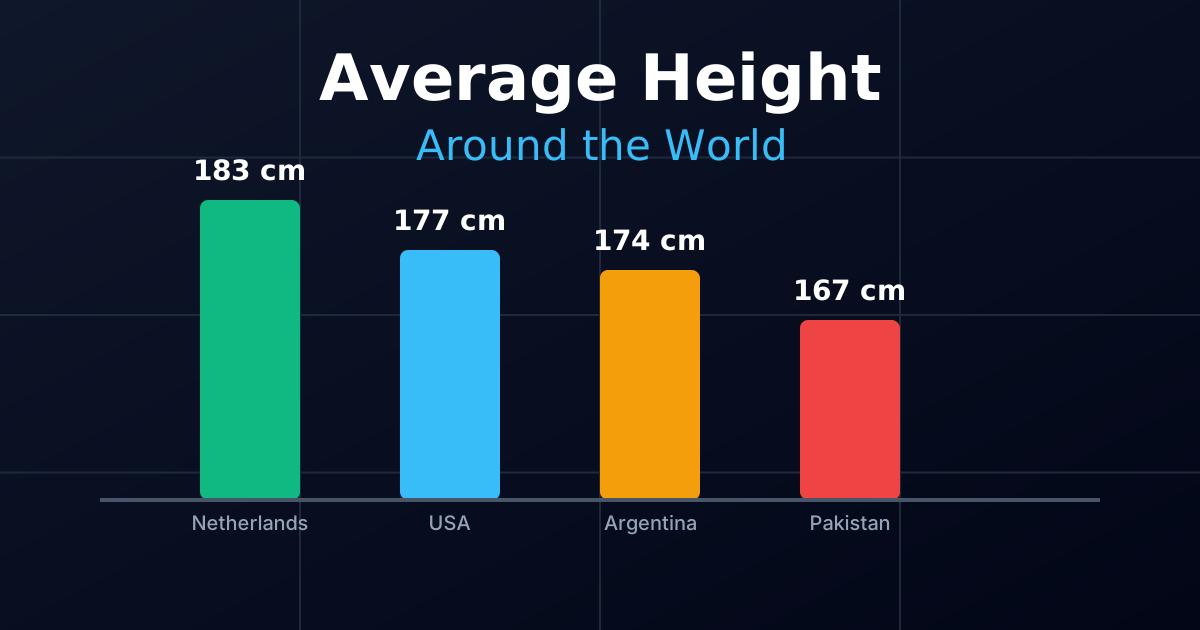
Understanding height in different countries requires analyzing complex biometric data across various populations. Human height reveals critical information regarding a nation's health, economic prosperity, and genetic history.
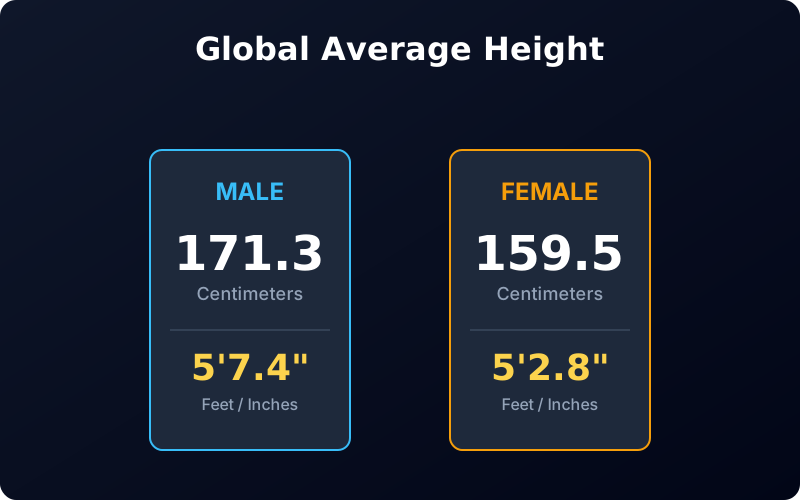
The global average male height rests at 171.28 centimeters (cm), which converts to 5 feet 7.4 inches. The global average female height rests at 159.53 cm, which translates to 5 feet 2.8 inches. These numbers fluctuate drastically depending on geographical borders. Northern European nations dominate the top percentiles, while Southeast Asian nations record the lowest averages.
This definitive guide breaks down country height comparisons, explores the 4 main factors causing global height variance, and provides precise measurements utilizing both the metric system and imperial system to ensure height measurement standard abbreviation compliance.
Quick Overview of Average Heights by Country
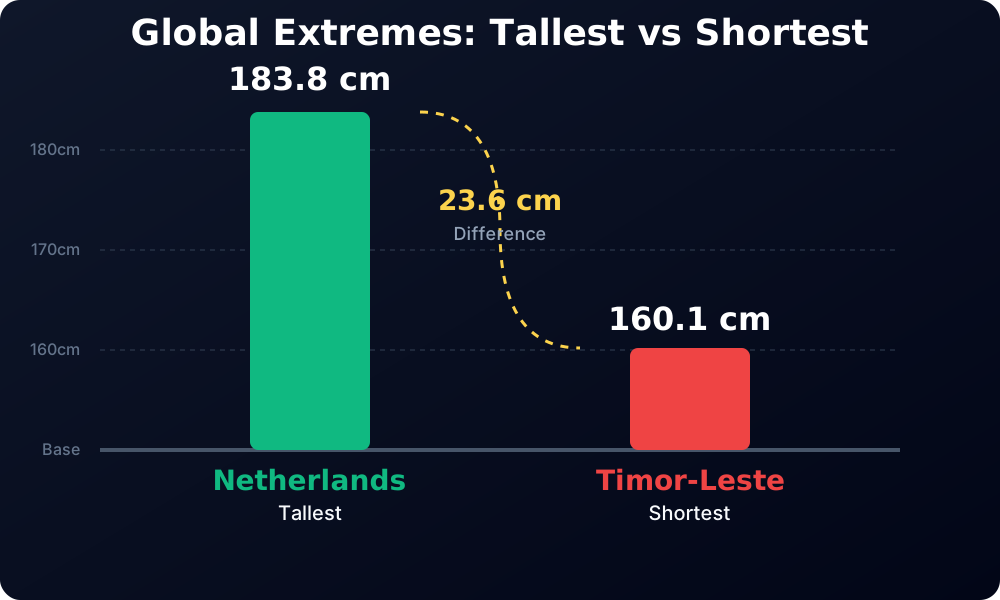
Comparing heights worldwide exposes massive geographic disparities. A man from the Netherlands (183.78 cm or 6 feet 0.3 inches) stands almost a full foot taller than a man from Timor-Leste (160.13 cm or 5 feet 3 inches). These height measurement standard differences force international apparel companies, vehicle manufacturers, and medical professionals to adapt their products based on the destination country.
Data tracking organizations utilize cm as the global baseline. Record cm first, then convert to feet and inches notation. This prevents imperial vs decimal confusion in technical documentation precision.
Why Average Height Varies Between Countries

There are 4 main reasons why human height varies across the globe. These factors dictate the maximum growth potential a child will reach before their growth plates fuse.
Genetics
Genetics determine 80 percent of an individual's final height. Populations with generations of isolated breeding pool specific height-promoting DNA sequences. Northern European populations carry concentrated genetic markers that promote prolonged bone elongation.
Nutrition and Diet
Nutrition provides the biological fuel for genetic potential. High-quality protein, dairy consumption, and access to essential vitamins during childhood spur growth. Nations with diets rich in animal protein and calcium output taller populations. Review your diet, if you want to optimize your growth potential.
Healthcare and Living Conditions
Childhood illnesses stunt growth. Recurrent infections force the body to divert energy away from skeletal development and toward immune response. Countries boasting universal healthcare, clean water, and robust vaccination programs produce taller generations.
Environmental Factors
Climate and altitude impact human growth over long evolutionary timelines. Colder climates favor larger body masses to retain heat. High-altitude environments limit oxygen intake, restricting overall physical size.
Average Male Height by Country
The male height statistics highlight the dominance of European nations in the top rankings. We provide dual measurement formatting to maintain height notation consistency.
Tallest Countries
There are 3 countries that claim the tallest men on Earth.
- Netherlands: 183.78 cm (6 ft 0.3 in)
- Montenegro: 183.30 cm (6 ft 0.1 in)
- Estonia: 182.79 cm (5 ft 11.9 in)
Countries with Average Heights
There are 3 countries that sit perfectly in the global middle.
- Turkey: 176.36 cm (5 ft 9.4 in)
- Argentina: 174.46 cm (5 ft 8.6 in)
- China: 175.66 cm (5 ft 9.1 in)
Shortest Countries
There are 3 countries recording the lowest average male heights.
- Timor-Leste: 160.13 cm (5 ft 3.0 in)
- Yemen: 164.42 cm (5 ft 4.7 in)
- Laos: 162.78 cm (5 ft 4.0 in)
Average Female Height by Country
Female height follows the exact same geographic trends as male height. The gap between men and women remains a constant 12 cm to 14 cm (4.7 to 5.5 inches) across all borders.
Tallest Countries
There are 3 countries producing the tallest women.
- Netherlands: 170.36 cm (5 ft 7.0 in)
- Montenegro: 169.96 cm (5 ft 6.9 in)
- Denmark: 169.47 cm (5 ft 6.7 in)
Countries with Average Heights
There are 3 countries sitting in the global middle for women.
- United Kingdom: 163.90 cm (5 ft 4.5 in)
- South Korea: 163.23 cm (5 ft 4.2 in)
- Brazil: 162.41 cm (5 ft 3.9 in)
Shortest Countries
There are 3 countries recording the lowest average female heights.
- Guatemala: 150.91 cm (4 ft 11.4 in)
- Bangladesh: 152.38 cm (4 ft 11.9 in)
- Nepal: 152.39 cm (4 ft 11.9 in)
Average Height in Popular Countries
People search for specific national averages to compare themselves against major global powers. Proper height format requires dual unit displays.
United States
The average male height in the United States is 176.94 cm (5 ft 9.6 in). The average female height is 163.31 cm (5 ft 4.3 in). The US ranked among the tallest nations in the 19th century but fell behind European countries in modern decades.
United Kingdom
The average British man measures 178.21 cm (5 ft 10.1 in). The average British woman measures 163.90 cm (5 ft 4.5 in).
Canada
The Canadian average male height sits at 178.75 cm (5 ft 10.3 in). The Canadian average female height sits at 164.73 cm (5 ft 4.8 in).
Australia
Australian men stand at an average of 178.77 cm (5 ft 10.3 in). Australian women stand at an average of 164.67 cm (5 ft 4.8 in).
Pakistan
The average height in Pakistan is 167.3 cm (5 ft 5.8 in) for men. The average female height in Pakistan is 153.8 cm (5 ft 0.5 in).
India
Indian men average 166.50 cm (5 ft 5.5 in). Indian women average 155.18 cm (5 ft 1.1 in).
Height Comparison by Region
Analyzing data by continent reveals broader trends in human development.
North America
North America features high averages. The US and Canada pull the numbers up, while Central American nations pull the averages down.
Europe
Europe boasts the highest averages in the world. The Dinaric Alps region and Scandinavia produce the tallest populations on record.
Asia
Asia presents the widest variance. East Asian nations like South Korea experience rapid growth trends. Southeast Asian nations record the lowest global averages.
South America
South America sits firmly in the middle tier. Nations like Argentina and Brazil record moderate growth levels.
Africa
Africa features extreme diversity. The Nilotic peoples of South Sudan stand incredibly tall, while populations in central rainforest regions remain short.
How Height Is Measured Around the World
Recording practices dictate how height data appears in technical documentation. Consistency matters for medical records accurate notation.
Metric System Countries
The metric system rules 95 percent of the globe. Doctors use stadiometers to measure patients in exact cm. This prevents international conversion pitfalls.
Imperial System Countries
The imperial system survives in the US, UK, and Canada. Citizens use feet and inches notation. A 5 foot 7 individual writes their height as 5'7" (symbolic) or 5 ft 7 in (abbreviated). Ensure you never write 5'7 inches, as this creates a redundant terminology error.
Is Height Increasing Globally?
Global heights surged during the 20th century. Improved sanitation, modern agriculture, and antibiotics sparked this massive growth. South Korean women gained an astonishing 20.2 cm (8 inches) over the last 100 years. Growth curves in Western nations plateaued recently. Humans possess a biological ceiling, and developed nations hit that ceiling.
Common Height Conversions for International Comparisons
Translating data requires precise math. Use these standard conversions to process height abbreviation guide data.
CM to Feet & Inches
Divide cm by 2.54 to find total inches. Divide the result by 12 to find feet. 170.18 cm becomes exactly 5 feet 7 inches.
Feet & Inches to CM
Multiply total feet by 12. Add the remaining inches. Multiply that total by 2.54. 5 ft 7 in becomes 67 inches, which converts to 170.18 cm.
Frequently Asked Questions
Which country has the tallest people?
Yes, the Netherlands has the tallest people. The average Dutch man stands at 183.78 cm, which converts to 6 feet 0.3 inches. The average Dutch woman stands at 170.36 cm, which converts to 5 feet 7 inches.
Which country has the shortest average height?
Yes, Timor-Leste has the shortest average height. The average man in Timor-Leste measures 160.13 cm (5 feet 3 inches), while the average woman measures 152.71 cm (5 feet 0.1 inches).
What is the average height in Pakistan?
Yes, the average male height in Pakistan is 167.3 cm (5 feet 5.8 inches). The average female height in Pakistan is 153.8 cm (5 feet 0.5 inches).
Why do average heights differ between countries?
Yes, average heights differ between countries based on 4 primary factors. These factors include genetic inheritance, early childhood nutrition, access to modern healthcare, and local environmental conditions.
Are people getting taller over time?
Yes, people grew taller over the last 150 years. Improved nutrition and disease prevention sparked massive growth spurts across Europe and Asia, though height stagnation now occurs in high-income nations like the United States.
Compare Heights Using Our Height Conversion Tools
Understanding height in different countries demands accurate unit processing. We built strict calculators to eliminate imperial vs decimal confusion.