
5'7" vs 5 ft 7 in: Which Is Correct?
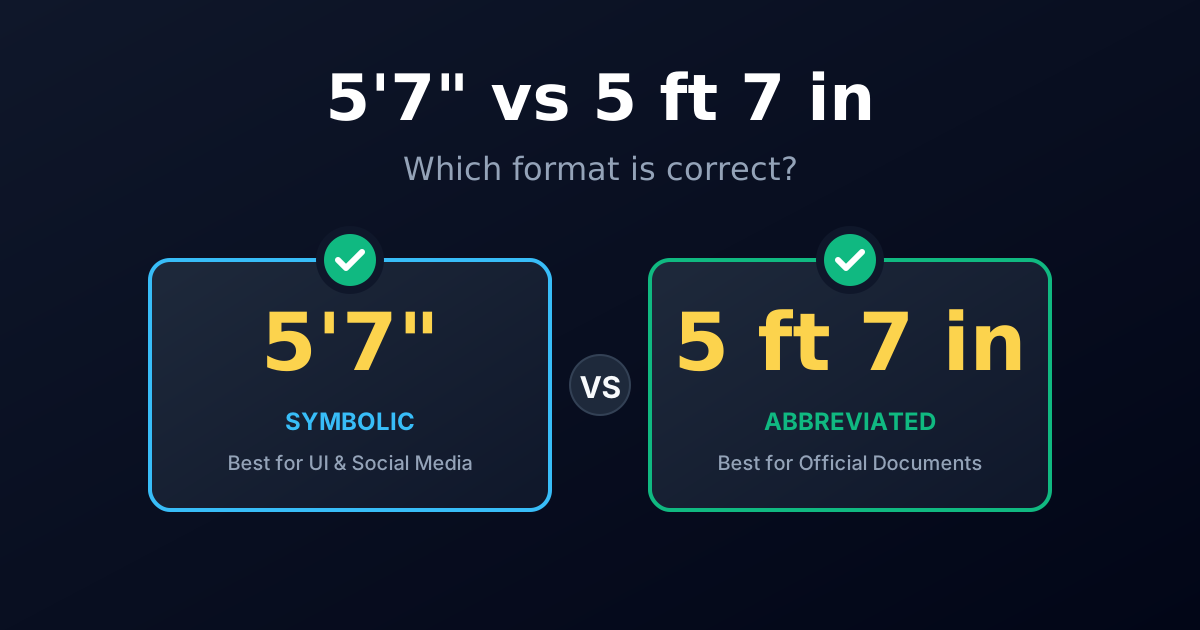
Deciding between 5'7" vs 5 ft 7 in - Which Is Correct? depends on context since both notations are correct representations of the same measurement. The symbolic form uses punctuation markers for brevity, while the abbreviated form uses letters to ensure clarity. Choose the correct height format, if you want to express measurements clearly.
The symbolic notation represents 5 feet and 7 inches (67 inches, 170.18 centimeters, or 1.70 meters) using a single quote for the foot unit and a double quote for the inch unit. The abbreviated notation represents the same value using standard letter designations to express the feet and inches components. Learning the components of height measurement writing assists in expressing height correctly.
Key differences between these formats influence informal communication, formal writing, and digital profile creation. Writers choose the symbolic format for height charts, sports profiles, and everyday messages, whereas they select the abbreviated format for academic papers, technical documentation, and medical records to prevent errors.
Similar formatting choices apply to other heights, including 5'0" vs 5 ft 0 in, 6'2" vs 6 ft 2 in, and 5'11" vs 5 ft 11 in. While imperial systems remain popular in specific countries, global standards require converting height between feet, inches, and centimeters (cm) to satisfy diverse international audiences.
Quick Answer: Both Are Correct
Both formatting styles represent the exact same measurement of 67 inches, which is 170.18 centimeters (cm) or 1.70 meters (m). There are multiple units to express this measurement, including centimeters, meters, and total inches. Choosing between these formats is a stylistic decision based on style guides, database systems, and target readers. One system relies on mathematical symbols, while the other uses letters to prevent misreadings.
Use 5'7", if you write an informal text message, a social media biography, or a sports roster. Punctuation symbols fit short spaces and allow fast scanning. Use 5 ft 7 in, if you fill out official forms, compile medical documents, or publish formal research. Abbreviating units with letters stops digital data processing failures and reduces human parsing confusion.
What Does 5'7" Mean?
To determine what 5'7" means, you must examine the individual punctuation symbols. The expression represents a compound value in the United States (US) customary measurement system. The first number is the feet value, and the second number is the remaining inches value. The combination designates a person's total stature as 5 feet and 7 inches (170.18 cm).
Understanding the Foot (') Symbol
The single apostrophe (') serves as a keyboard substitute for the mathematical prime symbol (′). The prime symbol represents the foot (ft) unit. In history, people used straight hash marks to denote feet in drafting and architecture. Standard web content uses the straight single quote key since standard keyboards lack a dedicated prime key.
Understanding the Inch (") Symbol
The double quote symbol (") serves as a keyboard substitute for the mathematical double prime symbol (″). The double prime represents the inch (in) unit. There are 12 inches in 1 foot. The double quote marks the final unit of the measurement. Dropping this symbol makes the notation incomplete, as it fails to seal the measurement.
What Does 5 ft 7 in Mean?
To explain what 5 ft 7 in means, you must identify the standard abbreviation letters. The abbreviation "ft" represents feet, and the abbreviation "in" represents inches. This alphabetical representation removes all dependency on symbols. It states the measurement units using letters to ensure clear rendering across all screens.
This format provides clarity. It does not suffer from symbol degradation, and it does not trigger script errors in programming languages. Databases read alphabetical notations easily, which prevents coding errors during data migration. Many professional style guides require using letters instead of symbols.
5'7" vs 5 ft 7 in: Key Differences
To understand the differences, you must compare the environments where each format is used. The key differences span visual layout, typographic rules, and data formatting.
| Attribute | 5'7" Notation | 5 ft 7 in Notation |
|---|---|---|
| Punctuation | Uses single and double prime symbols | Uses letters |
| Context | Casual, sports, social media | Official, academic, medical |
| Parser Safety | Low (quotes trigger database errors) | High (letters parse safely) |
| Character Count | 5 characters | 10 characters |
Informal Usage
In casual situations, the symbolic format 5'7" is popular. People use it in text messages, emails, and forum posts. It requires few keystrokes. People often drop the double quote and write 5'7. This shorthand is understood in daily conversation, even though it is incomplete.
Formal and Professional Writing
Professional writers follow style manuals, including the Associated Press (AP) Stylebook, the Chicago Manual of Style (CMOS), the American Psychological Association (APA) style, and the Modern Language Association (MLA) style.
- AP Stylebook: Requires spelling out feet and inches in most text. Use figures and spell out units: "5 feet, 7 inches." Use symbols only for very tight layouts like tables.
- Chicago Manual of Style (CMOS): Prefers spelling out units in normal prose. In technical contexts, it permits abbreviations like 5 ft 7 in.
- APA Style: Requires abbreviations for units of measurement when accompanied by a number, resulting in 5 ft 7 in.
Write measurements as words or standardized abbreviations, if you follow professional style guides.
Digital Forms and Online Profiles
Digital forms on web applications require specific formats. Web systems use validation rules to process input. Typing prime symbols into a text field often triggers errors because the database blocks quote marks to prevent security breaches. Online dating profiles on Tinder or Bumble use 5'7" because it fits narrow mobile layouts.
When Should You Use 5'7"?
To use 5'7" correctly, you must analyze context constraints. Choose the symbolic notation under specific circumstances where space is small.
Height Charts
Physical height charts on clinic walls or classroom doors use 5'7" to save space. The chart displays numbers from top to bottom. Short lines are easy to read on a narrow vertical axis, so symbols work best.
Sports Profiles
Athletic rosters for basketball, football, and soccer display height using symbols. Sports announcers and fans scan statistical lists quickly. Using 5'7" allows columns to remain narrow, which makes data presentation clean.
Everyday Communication
Use 5'7" in text messaging and casual writing. It is quick to type on mobile keyboards. It fits standard messaging limits.
When Should You Use 5 ft 7 in?
To use 5 ft 7 in correctly, you must prioritize reader comprehension and database stability.
Academic Writing
Write 5 ft 7 in or spell out the words in school papers and reports. Academic readers expect formal units. This style fits the strict guidelines of APA and MLA publications.
Technical Documents
Technical writers use 5 ft 7 in to keep data clear. Blueprints, product specifications, and user manuals require precise units. This prevents non-native English speakers from misreading the symbols.
Medical Records
Medical record accuracy is a major concern in hospitals. Electronic Health Records (EHR) use 5 ft 7 in or metric centimeters (cm) to record height. Doctors use height to calculate Body Mass Index (BMI) and determine drug dosages. A formatting mistake can lead to medication errors, which harms patient health.
Common Height Notation Mistakes
Typical formatting errors occur when writing measurements, including using decimals, confusing unit symbols, and omitting units.
Writing 5.7 Instead of 5'7"
Writing 5.7 is a frequent mistake. A decimal point represents a base-10 fraction, but feet and inches operate on a base-12 system. The number 5.7 feet translates to 5 feet and 8.4 inches (173.74 cm). This creates a 3.56 cm error since 5'7" is actually 170.18 cm.
Confusing Feet and Inches Symbols
People sometimes write 5"7'. This places the double quote first and the single quote second. This notation means 5 inches and 7 feet, which describes a giant. Place the single quote after the feet and the double quote after the inches to maintain correct order.
Omitting Units Completely
Writing "5 7" without symbols or abbreviations leads to confusion. A reader cannot tell if the numbers represent feet and inches, meters, or a decimal. Always include symbols or letters to clarify the measurement system.
Other Examples of Correct Height Formatting
To format heights correctly, look at these standard examples.
5'0" vs 5 ft 0 in
The height of 5 feet 0 inches equals exactly 60 inches (152.40 cm or 1.52 m). The symbolic format is 5'0". The abbreviated format is 5 ft 0 in. Write the zero to show that the measurement is exact, rather than leaving it as just 5'.
6'2" vs 6 ft 2 in
The height of 6 feet 2 inches equals exactly 74 inches (187.96 cm or 1.88 m). The symbolic format is 6'2". The abbreviated format is 6 ft 2 in. This height is common on athletic profiles.
5'11" vs 5 ft 11 in
The height of 5 feet 11 inches equals exactly 71 inches (180.34 cm or 1.80 m). The symbolic format is 5'11". The abbreviated format is 5 ft 11 in. This height sits just below the 6-foot mark.
Height Notation Around the World
The imperial system is used in the US, the UK, and Canada. The rest of the world uses the metric system. In European countries, height is written in centimeters (cm) or meters (m). For example, 5'7" is written as 170 cm or 1.70 m.
When writing for global readers, include both systems. Write "5 ft 7 in (170 cm)" to help international audiences understand the measurement. This helps readers who are not familiar with the US customary system.
Frequently Asked Questions
Is 5'7" the same as 5 ft 7 in?
Yes, 5'7" is the same as 5 ft 7 in. Both formats represent 5 feet and 7 inches (67 inches, 170.18 cm, or 1.70 m). The symbolic format is informal, while the letters are formal.
Which format is more commonly used?
The symbolic format 5'7" is more commonly used in casual writing, while the abbreviated format 5 ft 7 in is more common in formal writing. Social profiles and sports rosters use symbols to save space.
Is 5.7 the same as 5'7"?
No, 5.7 is not the same as 5'7". The decimal 5.7 feet represents 5 feet and 8.4 inches. The height 5'7" represents 5 feet and 7 inches. This creates a difference of 1.4 inches (3.56 cm).
How should height be written in official documents?
Height should be written as 5 ft 7 in or spelled out as 5 feet 7 inches in official documents. This prevents data entry errors and ensures readability on official forms.
What do the apostrophe and quotation marks mean?
The apostrophe means feet and the quotation marks mean inches in height notation. These symbols represent the mathematical prime and double prime units.
Convert Height Between Feet, Inches, and CM
To convert height between feet, inches, and centimeters (cm), you must follow simple mathematical steps. The calculation requires converting the feet portion into inches first, adding the remaining inches, and multiplying by the centimeters constant.
- Multiply the feet value by 12. For 5 feet, compute 5 × 12 = 60 inches.
- Add the remaining inches. For 5 feet 7 inches, compute 60 + 7 = 67 total inches.
- Multiply total inches by 2.54. Compute 67 × 2.54 = 170.18 cm.
Use this conversion table to check common heights:
| Feet and Inches | Total Inches | Centimeters (cm) | Meters (m) |
|---|---|---|---|
| 5'0" (5 ft 0 in) | 60 inches | 152.40 cm | 1.52 m |
| 5'5" (5 ft 5 in) | 65 inches | 165.10 cm | 1.65 m |
| 5'7" (5 ft 7 in) | 67 inches | 170.18 cm | 1.70 m |
| 5'10" (5 ft 10 in) | 70 inches | 177.80 cm | 1.78 m |
| 6'0" (6 ft 0 in) | 72 inches | 182.88 cm | 1.83 m |
| 6'2" (6 ft 2 in) | 74 inches | 187.96 cm | 1.88 m |
Choosing the correct height format is important for proper height writing and expressing height correctly. Standardizing your measurements to 5'7" vs 5 ft 7 in - Which Is Correct? helps maintain consistency and ensures readers process your documents without errors.