
Decimal Height vs Fraction Height: What's the Difference?
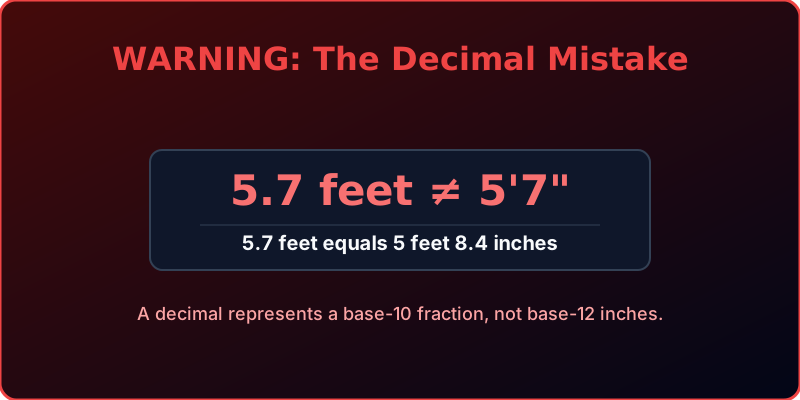
Decimal height and fraction height express the same measurement in 2 different number formats. Fraction height uses feet and whole inches separated as 2 values — for example, 5 feet 7 inches (5'7"). Decimal height expresses that same measurement as a single continuous number in feet — for example, 5.5833 ft. These 2 formats look similar but produce different values when misread.
The difference between decimal height and fraction height matters across 4 main areas: filling out official forms, reading construction blueprints, entering data in digital health systems, and converting height between unit systems. Writing 5.7 instead of 5'7" is one of the most common height notation errors — and it creates a 1.4-inch (3.56 cm) discrepancy that affects medical records, Body Mass Index (BMI) calculations, and database entries.
This guide covers what decimal height and fraction height are, 3 key differences between the 2 formats, 3 common conversion mistakes with exact values, formulas to convert in both directions, and 3 real-world examples with side-by-side comparisons.
Quick Answer: Decimal vs Fraction Height
Decimal height vs fraction height at a glance:
- Fraction height (5'7" or 5 ft 7 in): Feet as a whole number, inches as a whole number. Used in everyday US measurement, medical intake forms, and driver's licenses.
- Decimal height (5.5833 ft): Feet expressed as a decimal. Used in construction software like AutoCAD and Revit, engineering calculations, and carpentry plans.
- 5.7 ft ≠ 5'7": 5.7 decimal feet equals 5 feet 8.4 inches (173.74 cm). 5'7" equals 5 feet 7 inches (170.18 cm).
What Is Decimal Height?
Decimal height is a height measurement expressed as a single decimal number in feet. The integer part represents whole feet, and the decimal part represents the remaining fraction of a foot converted to a decimal value.
Decimal height is the standard format in computer-aided design (CAD) software, building information modeling (BIM) tools like Autodesk Revit, and construction calculation systems. The American National Standards Institute (ANSI) and International Organization for Standardization (ISO) both permit decimal notation for dimensional measurements in technical documentation.
Example of Decimal Height (5.7 ft)
5.7 ft in decimal height means 5 feet plus 0.7 of a foot. To find the inch value: 0.7 × 12 = 8.4 inches. So 5.7 ft = 5 feet 8.4 inches (173.74 cm or 1.7374 m), not 5 feet 7 inches.
Why Decimal Height Is Used
Decimal height is used in 4 main professional contexts:
- CAD and architectural software: AutoCAD, Revit, and SketchUp store all dimensions as decimal values for computational precision.
- Engineering and manufacturing: Decimal notation supports precision tolerances to 3 or more decimal places. A machined part might require a height of 5.625 ft (5 ft 7.5 in).
- Surveying: Total station instruments output decimal feet by default. A surveyed height of 5.583 ft is standard in survey data files.
- Construction calculators: Digital construction calculators accept decimal feet for staircase riser calculations, framing measurements, and roofing layouts.
What Is Fraction Height?
Fraction height is a height measurement expressed as feet and whole inches as 2 separate values. The foot value is a whole number, and the inch value is a whole number from 0 to 11. The term "fraction height" refers to the fact that the inches portion represents a fractional part of a foot (7 inches = 7/12 of a foot).
Fraction height is the standard format for human height measurement in the United States (US), United Kingdom (UK) informal use, and most English-speaking countries. Medical forms, government identity documents, and sports statistics all record height in feet and inches.
Example of Fraction Height (5'7")
5'7" means 5 feet and 7 inches. The total height in inches is (5 × 12) + 7 = 67 inches. In centimeters: 67 × 2.54 = 170.18 cm (1.7018 m). In decimal feet: 5 + (7 ÷ 12) = 5.5833 ft.
Why Fraction Height Is Used
Fraction height (feet and inches) is the everyday standard in the US because the imperial system (United States customary units) divides linear measurement into feet and inches. Tape measures, rulers, and growth charts in the US display markings in feet and whole inches. The format requires no decimal conversion and matches the physical marks on standard measuring tools.
Decimal Height vs Fraction Height: Key Differences
Accuracy and Precision
Decimal height supports unlimited precision. 5.58333... ft can extend to any number of decimal places. Fraction height is precise to the nearest whole inch (1 inch = 2.54 cm). For human height measurement, whole-inch precision is sufficient. For machined parts, architectural dimensions, or woodworking cuts, decimal precision is required.
| Metric | Decimal Height | Fraction Height |
|---|---|---|
| Format example | 5.5833 ft | 5'7" / 5 ft 7 in |
| Precision | Unlimited decimal places | Nearest whole inch (±2.54 cm) |
| Used by | CAD, construction, engineering | Medical forms, sports, everyday use |
| Readable by humans | Requires conversion to interpret | Immediately understood |
| Compatible with software | AutoCAD, Revit, SolidWorks | EHR systems, DMV databases |
Human Readability
Fraction height is readable without calculation. A person told they are 5'7" understands the measurement. A person told they are 5.5833 ft must perform a mental conversion. In health records, patient communication, and identity documents, fraction height (feet and inches) reduces interpretation errors.
Decimal height requires a reference point. The decimal 0.5 in 5.5 ft means 6 inches only if the reader knows that 0.5 × 12 = 6. Without that context, 5.5 ft looks like 5 feet 5 inches to most readers.
Where Each Format Is Used
| Context | Format Used | Example |
|---|---|---|
| US passport / driver's license | Feet + Inches (fraction) | 5 ft 7 in |
| Medical records (US) | Feet + Inches or total inches | 5'7" or 67 in |
| AutoCAD / Revit blueprints | Decimal feet | 5.5833 ft |
| Construction framing plans | Decimal feet or fractional inches | 5.583 ft or 5'-7" |
| Sports statistics | Feet + Inches (fraction) | 5'7" |
| European / UK medical forms | Centimeters / Meters | 170 cm / 1.70 m |
Common Conversion Mistakes
5.7 ft Is NOT 5'7"
Writing 5.7 as a shorthand for 5'7" is the most common height notation error. The 2 values differ by 1.4 inches (3.56 cm):
- 5.7 ft = 5 feet 8.4 inches = 173.74 cm
- 5'7" (5 ft 7 in) = 5 feet 7 inches = 170.18 cm
- Difference: 1.4 inches (3.56 cm)
This error appears in medical records, dating profiles, and sports databases. A BMI calculated from 173.74 cm vs 170.18 cm produces a different result. For a person weighing 70 kg (154.3 lb): BMI at 170.18 cm = 24.2, BMI at 173.74 cm = 23.2. That difference shifts the BMI category boundary for some individuals.
Confusing Decimal Feet With Inches
Readers often misread decimal feet as feet and decimal inches. The decimal 0.75 in 5.75 ft means 9 inches (0.75 × 12 = 9), not 7.5 inches. This confusion produces measurement errors in construction and carpentry, where a 1.5-inch mistake in a door frame or staircase riser has structural consequences.
The correct reading of any decimal foot value: multiply the decimal portion by 12 to get inches. Never read the decimal digits directly as an inch value.
Incorrect Rounding
Converting 5'7" to decimal feet produces 5.58333... ft (repeating). Rounding this to 5.58 ft and then converting back gives 5 feet 6.96 inches — a loss of 0.04 inches (1 mm). For a single height measurement, this is negligible. But in construction calculations with 50 repeated measurements, the cumulative error reaches 2 inches (50.8 mm), which violates building code tolerances.
Round decimal feet to 4 decimal places minimum in technical calculations. Use 5.5833 ft, not 5.58 ft.
How to Convert Between Decimal and Fraction Height
Fraction (Feet + Inches) to Decimal Feet
To convert fraction height to decimal height, divide the inches by 12 and add the result to the whole feet value.
5'7" → 5 + (7 ÷ 12) = 5 + 0.5833 = 5.5833 ft
5'10" → 5 + (10 ÷ 12) = 5 + 0.8333 = 5.8333 ft
6'0" → 6 + (0 ÷ 12) = 6 + 0 = 6.0000 ft
Decimal Feet to Feet and Inches
To convert decimal height back to fraction height, separate the integer part (whole feet) and multiply the decimal part by 12 to get inches. Round to the nearest whole inch for human height use.
Inches = decimal part × 12 (round to nearest whole number)
5.5833 ft → feet = 5, inches = 0.5833 × 12 = 6.9996 ≈ 7 inches → 5'7"
5.8333 ft → feet = 5, inches = 0.8333 × 12 = 9.9996 ≈ 10 inches → 5'10"
5.7000 ft → feet = 5, inches = 0.7000 × 12 = 8.4 ≈ 8 inches → 5'8"
Which Format Should You Use?
Forms and Applications
Use fraction height (feet and inches) on all official forms. US passport applications, Department of Motor Vehicles (DMV) license forms, and medical intake forms require height in feet and whole inches entered as separate numeric values. Enter 5 in the feet field and 7 in the inches field for 5 feet 7 inches. Never enter a decimal value in a form field labeled "feet" unless the form label explicitly says "decimal feet."
Medical and Fitness Use
Medical records in the US use fraction height. Electronic Health Record (EHR) systems like Epic and Cerner store height as total inches internally (67 in for 5'7") and display it as feet and inches. Body Mass Index (BMI) calculators accept height in feet and inches or centimeters. Enter fraction height on all health and fitness platforms unless the app shows a decimal feet field.
International and European medical forms use centimeters. Convert fraction height to centimeters using the formula: total inches × 2.54. For 5'7": 67 in × 2.54 = 170.18 cm.
Everyday Use
Use fraction height in everyday conversation and writing in the US. Write 5'7" in sports profiles, social media bios, and casual measurement references. Use 5 ft 7 in in formal written documents that follow the Associated Press (AP) Stylebook or similar editorial standards. Decimal feet (5.5833 ft) has no everyday use outside of construction and engineering.
Real-World Examples
5'5" vs 5.5 ft
5'5" is 5 feet 5 inches (165.1 cm or 1.651 m). 5.5 ft is 5 feet 6 inches (167.64 cm or 1.6764 m). The difference is 1 inch (2.54 cm). 5.5 ft happens to be a round decimal, so people assume it means 5'5" — but it does not. 5 + (0.5 × 12) = 5 feet 6 inches.
| Notation | Feet + Inches | Centimeters | Total Inches |
|---|---|---|---|
| 5'5" (fraction) | 5 ft 5 in | 165.10 cm | 65 in |
| 5.5 ft (decimal) | 5 ft 6 in | 167.64 cm | 66 in |
5'10" vs 5.83 ft
5'10" is 5 feet 10 inches (177.8 cm or 1.778 m). The correct decimal representation is 5.8333 ft, not 5.83 ft. Rounding to 5.83 ft gives 5 feet 9.96 inches — a 0.04-inch loss. For human height, this is negligible. For a ceiling height in a construction plan, 0.04 inches repeated across framing members accumulates.
| Notation | Exact Value | Centimeters |
|---|---|---|
| 5'10" | 5 ft 10 in exactly | 177.80 cm |
| 5.8333 ft | 5 ft 9.9996 in ≈ 5 ft 10 in | 177.80 cm |
| 5.83 ft | 5 ft 9.96 in (0.04 in error) | 177.70 cm |
6'0" vs 6.0 ft
6'0" and 6.0 ft are the same value. 6 feet 0 inches in decimal feet is exactly 6.0000 ft. This is the one case where the decimal and fraction values match. 6.0 ft = 6 + (0 × 12) = 6 ft 0 in = 182.88 cm (1.8288 m).
Exception: When the inch value is 0, decimal height and fraction height produce identical numbers. 6.0 ft = 6'0" = 182.88 cm. This is the only height where the 2 formats are interchangeable without conversion.
Frequently Asked Questions
Is 5.7 feet the same as 5'7"?
No, 5.7 feet is not the same as 5'7". 5.7 ft equals 5 feet 8.4 inches (173.74 cm) and 5'7" equals 5 feet 7 inches (170.18 cm). The difference is 1.4 inches (3.56 cm).
Why do people confuse decimal and fraction height?
People confuse decimal and fraction height because the numbers look similar. 5.7 resembles 5'7", but the decimal 0.7 represents 0.7 of a foot (8.4 inches), not 7 inches. The decimal system treats height as one continuous value in feet, while fraction notation uses separate feet and inch counts.
Which format is more accurate for height?
Decimal feet are more mathematically precise, supporting any number of decimal places. Fraction height in feet and inches is accurate to the nearest whole inch (±2.54 cm), which is sufficient for human height. For medical records and construction, decimal centimeters (170.18 cm) offer the most practical precision.
Can I convert feet and inches into decimals?
Yes, convert feet and inches to decimal feet by dividing the inches by 12 and adding to the feet value. For 5 feet 7 inches: 7 ÷ 12 = 0.5833, so 5 + 0.5833 = 5.5833 decimal feet. To get total decimal inches: (5 × 12) + 7 = 67 in.
What is the correct way to write height?
The correct way to write height depends on context. Use 5'7" or 5 ft 7 in for US everyday and official use. Use 170 cm or 1.70 m for international and medical contexts. Use decimal feet (5.5833 ft) only in construction, engineering, or CAD software. Never use 5.7 as shorthand for 5'7" — the values are different.
Can height have decimals?
Yes, height can be expressed as a decimal number in feet (5.75 ft) or decimal inches (69.0 in) or decimal centimeters (175.26 cm). Decimal height in feet is standard in CAD software, engineering calculations, and construction databases. Decimal centimeters are the standard in international medical records. Whole-inch fraction height (5'9") is the standard in US everyday and clinical use.
How do I convert decimal height to inches?
To convert decimal feet to total inches, multiply the decimal feet value by 12. For 5.75 ft: 5.75 × 12 = 69 inches. To convert decimal feet to feet and inches, take the integer part as feet and multiply the decimal part by 12 for inches. For 5.75 ft: feet = 5, inches = 0.75 × 12 = 9, so 5 feet 9 inches (5'9" / 175.26 cm / 1.7526 m).
Decimal Height vs Fraction Height: Summary
Decimal height and fraction height describe the same physical measurement in 2 different number formats. Decimal height (5.5833 ft) uses one continuous number in feet. Fraction height (5'7") uses feet and whole inches as 2 separate values. The formats require conversion — they are not interchangeable by reading the digits directly.
Key takeaways on decimal height vs fraction height:
- 5.7 ft ≠ 5'7" — 5.7 ft equals 5 feet 8.4 inches (173.74 cm), not 5 feet 7 inches (170.18 cm).
- To convert fraction to decimal: divide inches by 12 and add to feet. 5'7" → 5 + (7 ÷ 12) = 5.5833 ft.
- To convert decimal to fraction: multiply the decimal part by 12 for inches. 5.5833 ft → 5 feet + (0.5833 × 12) = 5'7".
- Use fraction height on medical forms, government documents, and in everyday US communication.
- Use decimal height in AutoCAD, Revit, SolidWorks, spreadsheets, and construction calculation software.
For any height conversion, use the formulas above or the tools below to get the exact equivalent without rounding errors.
Use Our Height Conversion Tools
Convert between decimal height, fraction height, centimeters, and total inches with the tools below.
How to Format Height on Forms →
Correct height format for passport, medical, DMV, and digital forms.
5'7" vs 5 ft 7 in →
When to use symbolic notation vs spelled-out abbreviations.
How to Write Height Correctly →
Height symbols, abbreviations, and style guide rules explained.
7 Common Conversion Mistakes →
The most frequent errors when converting feet, inches, and centimeters.