

How to Write Height in Feet and Inches (Correct Format with Examples)
Most people write their height wrong — not badly enough to cause problems every time, but wrong enough to create confusion on official forms, medical records, and professional profiles. The gap between 5’7” and 5.7 looks small on paper. Mathematically, they mean two completely different things.
This guide covers every accepted format for writing height in feet and inches, when to use each one, style guide rules, context-specific recommendations, and the mistakes that trip up even fluent English writers.
Quick Answer: The Correct Way to Write Height
The standard format is 5’7” — no spaces, single quote for feet, double quote for inches. This is recognized universally in the US and UK for casual, professional, and most official uses.
Three formats are all correct; context determines which one belongs:
| Format | Example | Best For |
|---|---|---|
| Symbol format | 5’7” | Casual, sports, social media, quick references |
| Abbreviation format | 5 ft 7 in | Technical documents, formal reports, official forms |
| Spelled-out format | five feet seven inches | Formal writing, narrative prose, legal documents |
Understanding the Feet and Inch Symbols
Before formatting anything correctly, you need to understand what the symbols actually mean — and why using the wrong character matters more than most people think.
The Foot Symbol: Single Prime (’)
The single prime mark (’) represents feet. When you write 5’, you are saying “five feet.” The single prime is not the same as a standard apostrophe, though they look nearly identical on most keyboards and screens.
Technically correct: 5′7″ (using true prime symbols: U+2032 and U+2033)
Universally accepted: 5’7” (using apostrophe and quotation mark)
In everyday writing — including professional contexts — using the standard apostrophe (’) and double quotation mark (”) is perfectly acceptable. Only typographically precise publishing requires true prime characters.
The Inch Symbol: Double Prime (”)
The double prime (”) represents inches. Writing 7” means “seven inches.” Together, 5’7” reads as “five feet and seven inches.”
Pro Tip: Many word processors auto-correct straight quotation marks to “curly quotes” — which breaks the height notation. If you type 5’7” in Microsoft Word and the symbols bend inward, turn off autocorrect for smart quotes in document settings before entering measurements.
How to Type Height Symbols on Any Device
| Device | Feet Symbol (‘) | Inches Symbol (“) |
|---|---|---|
| Windows PC | Apostrophe key | Shift + apostrophe key |
| Mac | Apostrophe key | Shift + apostrophe key |
| iPhone | Tap and hold apostrophe, select prime | Tap and hold quote, select double prime |
| Android | Apostrophe key (standard keyboard) | Shift + apostrophe (standard keyboard) |
| True prime (Unicode) | U+2032 via character map | U+2033 via character map |
For most practical purposes, the standard keyboard apostrophe and double quote are the correct characters to use.
The Three Correct Ways to Write Height in Feet and Inches
1. Symbol Format: 5’7”
This is the most recognized and widely used format in English-speaking countries. It is compact, fast to write, and universally understood.
Rules for symbol format:
- Place the single quote immediately after the feet number — no space
- Place the double quote immediately after the inches number — no space
- No space between feet and inches: 5’7” not 5’ 7”
- Zero inches must still be written when present: 6’0” not 6’
Common heights written in symbol format:
| Spelled Out | Symbol Format |
|---|---|
| Five feet zero inches | 5’0” |
| Five feet four inches | 5’4” |
| Five feet seven inches | 5’7” |
| Five feet eleven inches | 5’11” |
| Six feet two inches | 6’2” |
2. Abbreviation Format: 5 ft 7 in
This format uses the standard abbreviations “ft” for feet and “in” for inches. It is preferred in technical writing, official documents, and contexts where symbols may cause confusion.
Rules for abbreviation format:
- Use a space between the number and the abbreviation: 5 ft not 5ft
- Do not add a period after “ft” or “in” in American English: write 5 ft 7 in, not 5 ft. 7 in.
- Both parts are written on the same line without a hyphen
Why this format exists: In some data entry systems, technical databases, and scientific papers, the prime symbol (’) can conflict with programming notation or citation markers. Using “ft” and “in” eliminates any ambiguity.
3. Spelled-Out Format: Five Feet Seven Inches
Formal writing — think legal documents, literary publications, and academic papers — prefers measurements written as words.
Rules for spelled-out format:
- Lowercase for both “feet” and “inches” in standard use
- When used as a standalone noun: He measured five feet seven inches.
- When used as a compound adjective before a noun: hyphenate everything: a five-foot-seven-inch player
- When used after a noun: no hyphenation: a player who is five feet seven inches tall
The hyphenation rule trips up even experienced writers. The difference:
- Correct: She is a five-foot-seven actress.
- Correct: She is five feet seven inches tall.
- Incorrect: She is a five feet seven actress.
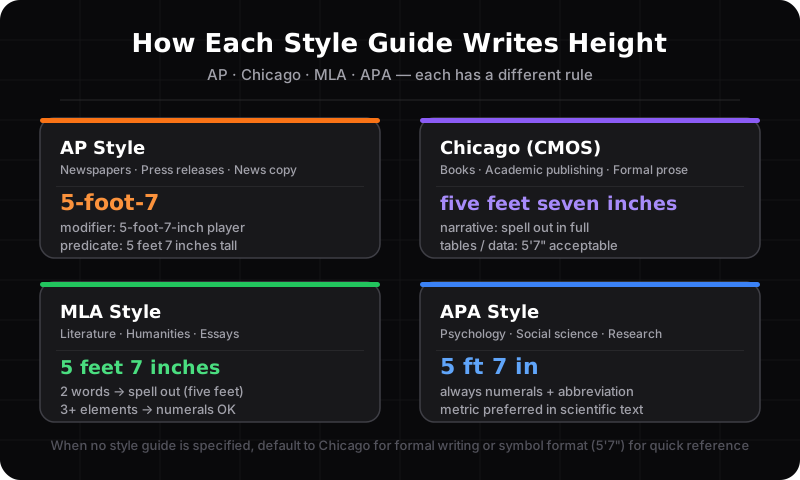
How Style Guides Say to Write Height
Different editorial style guides have specific and sometimes conflicting instructions on height notation.
AP Style (Associated Press)
AP Style is used by most American newspapers, news outlets, and public relations professionals.
AP rule: Use figures and abbreviations for measurements in news copy.
- 5-foot-6 when used as a modifier before a noun
- 5 feet 6 inches tall when used predicatively
- He is 5-6 is acceptable shorthand in sports contexts
AP avoids the prime symbol format in standard editorial copy, though sports departments often use it in statistics tables.
Chicago Manual of Style (CMOS)
Chicago style governs academic publishing, book publishing, and formal prose.
CMOS rule: Spell out measurements in narrative text.
- She stood five feet seven inches tall.
- The patient’s height was recorded as five feet, seven inches.
- Tables and data: use numerals with symbols (5’7”) — acceptable in non-narrative contexts
MLA Style (Modern Language Association)
MLA follows a similar approach to Chicago for literary and humanities writing.
MLA rule: Spell out measurements that can be expressed in two or fewer words; use numerals otherwise.
- five feet (two words — spell out)
- 5 feet 7 inches (three elements — numerals acceptable)
APA Style (American Psychological Association)
APA is used in social science and psychology research.
APA rule: Use numerals for all measurements with standard abbreviations.
- 5 ft 7 in or 5’7” in text
- Metric is preferred in scientific reporting (e.g., 170.18 cm)
Which Style Should You Use?
| Context | Recommended Format |
|---|---|
| News article / press release | AP: 5-foot-7 or 5-foot-7-inch frame |
| Book or academic paper | Chicago/MLA: five feet seven inches |
| Psychology / social science paper | APA: 5 ft 7 in |
| Sports statistics, roster | Symbol: 5’7” |
| Medical record | Abbreviation or total inches: 5 ft 7 in / 67 in |
| Social media / dating app | Symbol: 5’7” |
| Legal contract | Spelled out: five feet seven inches (5’7”) |
How to Write Height on Official Forms
Forms are the most common place height formatting goes wrong. Different institutions use different conventions — and some are strictly specific about what they want.
Medical and Health Forms
US medical forms typically ask for height in one of three ways:
- Separate fields for feet and inches — just enter the raw numbers
- Single field in total inches — convert first (5’7” = 67 inches)
- Metric only — convert to centimeters (5’7” = 170.18 cm) using our CM to Feet Calculator
Most electronic health record (EHR) systems in the US record height in total inches internally, then display it in feet and inches on patient-facing screens. If a form does not specify the unit, default to feet and inches using the abbreviation format (5 ft 7 in) for maximum clarity.
Passport and Government ID Applications
US passport applications (DS-11 form) require height entered in feet and inches in separate boxes. The State Department pre-formats the fields — you enter the number only, no symbols needed.
For UK passports, height is required in meters and centimeters (e.g., 1.70 m or 170 cm). If you only know your height in feet and inches, use our Feet to CM Calculator before filling out the form.
Job Applications and Resumes
Height is almost never required on a standard resume in the US.
When height is legitimately required (modeling, acting, athletics, military, police/fire academies), use:
- Symbol format (5’9”) for quick listings and casting sheets
- Abbreviation format (5 ft 9 in) for formal application documents
School and Sports Forms
Athletic rosters, team programs, and sports databases uniformly use the symbol format without spaces. You will see 6’3” on an NBA roster, a football program, or a high school athletic form — not “six feet three inches.”
International Forms
If you are filling out forms in countries that use the metric system, always convert to centimeters or meters. Writing “5’7"" on a European or Asian form will likely cause confusion or data entry errors.
Quick reference: How to Convert CM to Feet and Inches
How to Write Height in Specific Contexts
How to Write 5’7” Height
5’7” is one of the most searched height formats. Here is how it appears across every context:
| Context | Format | Example |
|---|---|---|
| Sports roster | Symbol | 5’7” |
| News article | AP | 5-foot-7 |
| Formal prose | Spelled out | five feet seven inches |
| Technical document | Abbreviation | 5 ft 7 in |
| International use | Centimeters | 170.18 cm |
| Medical total | Inches | 67 inches |
How to Write Height on a Resume or Bio
For casting profiles, model comp cards, or athletic bios:
- 5’9” — clean symbol format for quick listings
- Height: 5 ft 9 in — for formal document fields
- Not: 5.9 feet — mathematically incorrect
- Not: 69 inches — confusing to readers unfamiliar with the total-inches format
How to Write Height on a Dating App
Symbol format wins here: 5’11”. It is compact, universally recognized, and uses the fewest characters. Most dating apps now have structured height fields that handle formatting automatically. If you are writing it manually in a bio, 5’11” is cleaner than “5 foot 11” or “5ft11.”
How to Write Height in Formal Essays and Academic Papers
Follow your assigned style guide. If no guide is specified, default to Chicago:
- First mention in body text: five feet seven inches (spelled out)
- Subsequent mentions or in tables: 5’7” (symbol format acceptable)
- As a compound adjective: five-foot-seven-inch frame
Height Notation: The Origin of Feet and Inches Symbols
The prime symbols used for feet and inches come from sexagesimal notation — the ancient Babylonian base-60 number system. The Latin phrase pars minuta prima (“first small part”) gave us the single prime mark, used for minutes of arc and later for feet. Pars minuta secunda (“second small part”) gave us the double prime for seconds of arc — and inches.
This is also why a minute of time is marked with a single prime and a second with a double prime. The symbols carry the exact same mathematical lineage across astronomy, geometry, and everyday height measurement.
Height Notation Around the World
The prime symbol format for height is specific to the United States, Canada, and the United Kingdom. Most of the rest of the world records height exclusively in centimeters or meters.
| Region | Standard Format | Example |
|---|---|---|
| United States | Feet and inches (symbol) | 5’7” |
| United Kingdom | Feet and inches (mixed) | 5 ft 7 in or 5’7” |
| Europe | Meters and centimeters | 1.70 m or 170 cm |
| Australia | Centimeters | 170 cm |
| Japan | Centimeters | 170 cm |
| Canada | Both (bilingual use) | 5’7” or 170 cm |
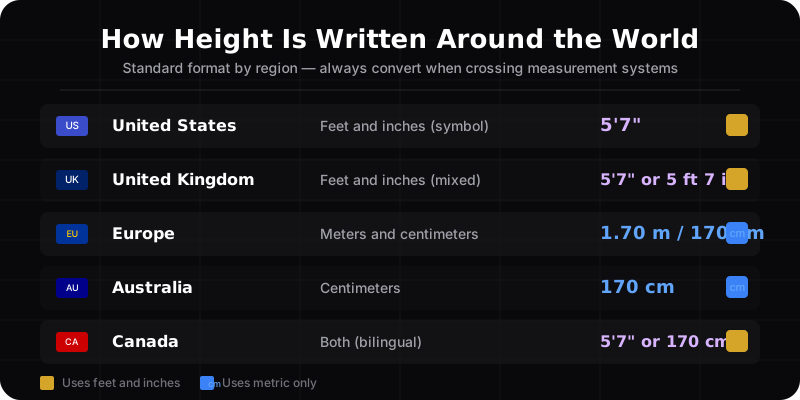
If your content, form, or document crosses borders, always include the metric equivalent. Our Height Conversion Chart covers the most common values side by side.
Common Mistakes When Writing Height
These are the formatting errors that appear most frequently — and the ones most likely to cause real problems on official forms.
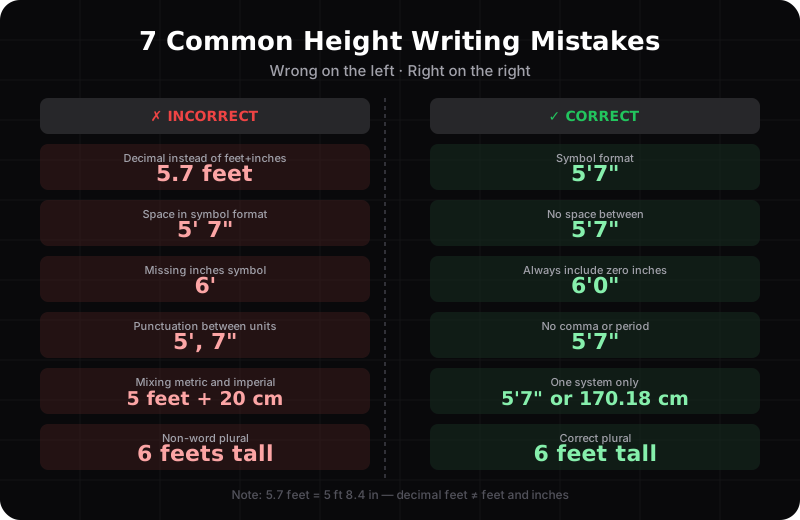
Mistake 1: Using Decimal Feet Instead of Feet and Inches
5.7 feet does not equal 5’7”.
5.7 feet equals 5 feet 8.4 inches — not 5 feet 7 inches. The decimal represents tenths of a foot, not inches.
- Incorrect: 5.7 feet (means 5 ft 8.4 in)
- Incorrect: 5.7’ (same problem)
- Correct: 5’7” (five feet, seven inches)
Only use decimals if your entire measurement is in a single unit: 5.583 feet = 5’7” in decimal feet; 67 inches = 5’7” in total inches.
For more detail, see Decimal Height vs Fraction Height.
Mistake 2: Adding a Space in Symbol Format
- Incorrect: 5’ 7” (space between feet and inches)
- Correct: 5’7” (no spaces)
The space rule applies to abbreviations only: 5 ft 7 in requires spaces.
Mistake 3: Writing Only the Feet Symbol
- Incomplete: 6’ (ambiguous — could mean exactly six feet or an unfinished entry)
- Complete: 6’0” (explicitly states zero inches)
This matters most on medical forms and official records.
Mistake 4: Using Punctuation Between Feet and Inches
- Incorrect: 5’, 7”
- Incorrect: 5’.7”
- Correct: 5’7”
No punctuation separates feet and inches in the symbol format.
Mistake 5: Mixing Measurement Systems
- Incorrect: 5 feet and 20 cm
- Incorrect: 170 cm and 3 inches
Never mix metric and imperial in a single height measurement. Use our Height Conversion Formulas to convert fully to one system.
Mistake 6: Writing “Feets”
- Incorrect: He is 6 feets tall.
- Correct: He is 6 feet tall.
“Feet” is already the plural of “foot.” “Feets” does not exist in standard English.
Mistake 7: “Foot” vs. “Feet” Confusion
- Incorrect (as a predicate): He is 6 foot tall.
- Correct (as a predicate): He is 6 feet tall.
- Correct (as a compound modifier): He has a 6-foot frame.
“Foot” is correct only as part of a compound adjective: a six-foot-tall athlete, a five-foot-seven player.
Height Conversion: Writing Your Height in Other Units
Sometimes you need your height in a different unit — for a passport, an international form, or a fitness calculator.
Converting Feet and Inches to Centimeters
Formula: Total inches x 2.54 = centimeters
Example: 5’7” is (5 x 12 + 7) x 2.54 = 67 x 2.54 = 170.18 cm
Use our CM to Feet Calculator to skip the math entirely.
Converting Feet and Inches to Total Inches
Formula: (feet x 12) + inches = total inches
Example: 5’7” is (5 x 12) + 7 = 67 inches
Learn more: How to Convert Feet to Inches
Converting Centimeters to Feet and Inches
Formula: cm / 2.54 = total inches, then divide by 12 for feet and remainder for inches
Example: 170 cm / 2.54 = 66.93 inches = 5’7” (rounded)
Full process: How to Convert Inches to Feet
Height Unit Quick Reference
| Height (ft/in) | Total Inches | Centimeters | Meters |
|---|---|---|---|
| 5’0” | 60 in | 152.40 cm | 1.524 m |
| 5’4” | 64 in | 162.56 cm | 1.626 m |
| 5’7” | 67 in | 170.18 cm | 1.702 m |
| 5’10” | 70 in | 177.80 cm | 1.778 m |
| 6’0” | 72 in | 182.88 cm | 1.829 m |
| 6’2” | 74 in | 187.96 cm | 1.880 m |
Bookmark our full Height Conversion Chart for the complete reference table.
Height Formatting Cheat Sheet
Symbol Format Rules (5’7”)
- No spaces between numbers and symbols
- Always include zero inches when present: 6’0”
- Single quote = feet, double quote = inches
- No comma or period between feet and inches
Abbreviation Format Rules (5 ft 7 in)
- Space between number and abbreviation
- No period after ft or in in American English
- Both units on same line, no hyphen
Spelled-Out Format Rules (five feet seven inches)
- Lowercase for feet and inches
- Hyphenate when used as compound adjective before a noun
- No hyphen when used predicatively after the noun
What to Avoid
- Decimal notation (5.7 feet) when you mean feet and inches
- Spaces in symbol format (5’ 7”)
- Mixing metric and imperial in a single measurement
- “Feets” — not a word
- Smart/curly quotes breaking symbol format (check word processor autocorrect settings)
Frequently Asked Questions
How do you write height in feet and inches?
The most standard format is 5’7” — a single prime for feet and a double prime for inches, with no spaces. Alternatives include 5 ft 7 in (formal abbreviation) and five feet seven inches (spelled out for literary or legal writing).
Is it 5’7” or 5’7?
Both appear in common usage, but 5’7” is the technically correct and complete format. The closing double quote mark explicitly designates inches. Writing 5’7 leaves the inches unit unmarked and can cause ambiguity on official documents.
How do you write 5-foot-7 vs 5’7”?
These are the same height in two different style conventions:
- 5’7” — symbol format (sports, casual, quick reference)
- 5-foot-7 — AP Style format (news articles, press releases when used as an adjective)
- five feet seven inches — Chicago Style (books, formal prose)
All three are correct. Context and style guide determine which one to use.
How do you write height on a form?
Follow the form’s specific instructions first. If no format is specified, use 5 ft 7 in for maximum clarity in formal contexts, 5’7” for athletic or sports forms, and always convert to local metric standards for international forms.
Should height have a space between feet and inches?
It depends on the format. Symbol format uses no space: write 5’7” not 5’ 7”. Abbreviation format requires spaces between number and unit: 5 ft 7 in. Spelled-out format uses spaces: five feet seven inches.
What is the correct way to write 5 feet 7 inches?
All of these are correct depending on context:
- 5’7” — symbol format
- 5 ft 7 in — abbreviation format
- five feet seven inches — spelled out
- 5-foot-7 — AP Style compound modifier
How do you write height in inches only?
Write the total as a number followed by “inches”: 67 inches (for 5’7”). The formula is (feet x 12) + inches. Use our Height in Inches Calculator to convert any height instantly.
Use Our Free Height Conversion Tools
Still converting between formats or unit systems? Our calculators handle the math so you can focus on the form:
- Height in Inches Calculator — Convert any height between inches, feet, cm, and meters
- Feet to CM Calculator — Instantly get your metric equivalent
- CM to Feet Calculator — Convert metric height to feet and inches
- How to Convert Feet to Inches — Step-by-step guide with examples
- How to Convert Inches to Feet — Convert total inches back to feet format
- Height Conversion Cheat Sheet — Complete reference table
- How to Write Height Correctly — Extended formatting examples and rules
- Height on Forms Guide — Context-specific formatting for official documents
- Common Conversion Mistakes — Avoid the errors that trip up most people