
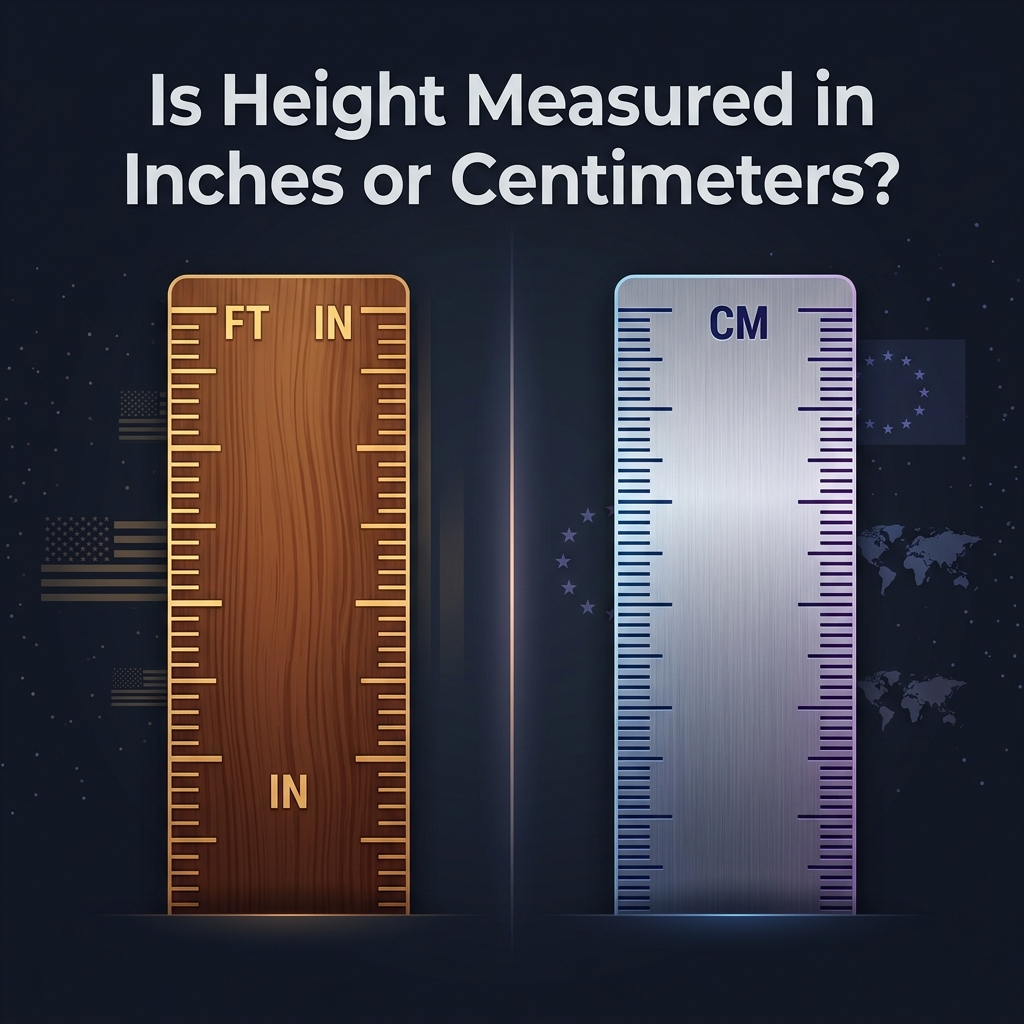
Is Height Measured in Inches or Centimeters? Understanding the Difference
You fill out a form online and it asks for your height. The problem: it wants centimeters, and you only know feet and inches. Or the opposite - a US doctor’s office wants feet and inches, and your passport shows 178 cm. The answer to “is height measured in inches or centimeters?” depends entirely on where you are and what the form expects. This guide explains both systems, which countries use which, how to convert between them, and when to use each.
Quick Answer: Is Height Measured in Inches or Centimeters?
Both units are used worldwide, but not in the same places. The United States, and to a lesser extent the United Kingdom, Canada, and a handful of other countries, commonly express height in feet and inches. The rest of the world - over 170 countries - uses centimeters and meters. There is no single global standard for everyday height reporting. The unit you see depends on the country, the context, and whether the institution uses the imperial or metric system.
Height Measurement Systems Explained
Height measurement falls under two competing systems. Understanding how each works prevents confusion when you switch between them.
Imperial System (Feet and Inches)
The imperial system expresses height using feet and inches. One foot equals 12 inches. One inch equals exactly 2.54 centimeters. A person described as 5’10” stands 5 feet and 10 inches tall - that is 70 total inches, or 177.8 centimeters.
Key imperial units for height:
- Inch (in or ”): The base unit for short lengths. A single inch is 2.54 cm.
- Foot (ft or ’): 12 inches. Used alongside inches for everyday height notation.
The imperial system is not broken - it is simply a different convention. The feet-and-inches format gives most people a fast mental picture of someone’s stature. Hearing “6 feet” is immediately intuitive in the US in a way that “183 cm” is not, and vice versa in Europe.
Metric System (Centimeters and Meters)
The metric system expresses height in centimeters or meters. One meter equals 100 centimeters. A height of 178 cm equals 1.78 meters. Centimeters are the everyday unit; meters appear on official documents and in scientific contexts.
Key metric units for height:
- Centimeter (cm): The primary everyday height unit in metric countries. 178 cm is a typical adult male height.
- Meter (m): Used on formal documents and in medicine. The same person is 1.78 m.
The metric system is decimal-based, which makes unit conversions simple: multiply or divide by 10, 100, or 1,000. That simplicity is why the international scientific and medical community standardized on metric.
Which Countries Use Inches for Height?
Most imperial height usage traces back to British influence and US economic weight. A small group of countries still routinely report height in feet and inches in everyday life.
United States
The US is the clearest example of a country where height is measured in feet and inches. American birth certificates, driver’s licenses, passports, and medical intake forms list height in feet and inches. Clothing tags show waist and inseam in inches. Sports broadcasts use feet and inches for player profiles. Height in cm or inches - for a US audience - almost always defaults to the imperial format.
United Kingdom
The UK is officially metric but culturally bilingual. Official NHS records and government documents use centimeters and meters. However, most British adults still describe their own height in feet and inches in casual conversation. You will hear “I’m five foot nine” far more often than “I’m 175 centimeters” in everyday British speech.
Canada
Canada officially adopted the metric system in the 1970s but has never fully shed imperial height habits. Canadian medical records and government documents use metric. Gyms, fitness apps, and informal conversation often use feet and inches. Many Canadians know their height in both systems and switch depending on who is asking.
Other Countries That Commonly Use Inches
Several other countries show residual imperial height usage, particularly in informal settings:
- Australia and New Zealand - officially metric, but older generations and some sports contexts still reference feet and inches
- Philippines - influenced by US measurement culture; feet and inches appear frequently in everyday use
- India - officially metric, but feet and inches remain common in informal height conversations
- Ireland - similar to the UK; metric on paper, imperial in conversation
Which Countries Use Centimeters for Height?
The majority of the world measures height in centimeters. This is the default in any country that adopted the International System of Units (SI), which is the modern form of the metric system.
Europe
Every EU country uses centimeters and meters for official height. Medical records, identity documents, sports statistics, and building standards all use metric. Countries like Germany, France, Spain, Italy, the Netherlands, and Poland report height exclusively in centimeters in any official context. If a European form asks for height, it expects a value like 175, not 5’9”.
Asia
Asia is overwhelmingly metric for height. China, Japan, South Korea, Vietnam, Thailand, and virtually every other Asian country measure height in centimeters. Healthcare systems, school records, and military conscription forms in these countries all use centimeters. Japanese and Korean height data, for example, is always reported in centimeters in public statistics.
Australia and New Zealand
Both countries are officially metric and use centimeters on all government and medical documents. Height listed on an Australian driver’s license or a New Zealand passport appears in centimeters. The informal feet-and-inches holdover exists among older residents, but centimeters dominate all official usage and most younger generations.
Inches vs Centimeters for Height
Neither unit is objectively superior. Each has real advantages depending on the situation.
Accuracy and Precision
Centimeters are more precise for the same number of digits. Reporting a height as 178 cm gives the same information as 5’10” (which equals 177.8 cm). But if you report in millimeters, you get 1780 mm - far more granular. Clinical settings often measure in millimeters for pediatric growth tracking.
Inches with fractions can also be precise, but fractional notation (5’9¾”) is awkward. Most imperial height reporting rounds to the nearest half-inch or full inch, introducing a small rounding error that centimeters avoid naturally.
Pro Tip: If you are submitting height to a medical record or visa application, always use the exact centimeter value rather than converting from feet and inches and rounding. Start from the centimeter reading if you have it - conversion rounding compounds across unit changes.
Ease of Use
Feet and inches give many people an instant mental image of stature. In countries where the imperial system is native, “six feet tall” is immediately understood. In metric countries, the same intuition applies to centimeters - 180 cm registers at a glance.
Centimeters are easier to work with mathematically. Adding, subtracting, and comparing heights in centimeters involves simple arithmetic. Calculating height differences in feet and inches requires converting to total inches first, then back again.
Everyday Applications
| Situation | Recommended Unit | Reason |
|---|---|---|
| US medical forms | Feet and inches | Standard US clinical format |
| EU/AU/Asian documents | Centimeters | Metric standard |
| Sports statistics (US) | Feet and inches | US broadcasting convention |
| Sports statistics (rest of world) | Centimeters | Metric standard |
| BMI calculation | Meters | Formula uses meters squared |
| Height conversion tools | Either | Tools handle both inputs |
How to Convert Height Between Inches and Centimeters
Conversion between inches and centimeters uses one fixed relationship: 1 inch = 2.54 cm exactly. Every formula below comes from that single fact.
Inches to Centimeters
Formula: inches × 2.54 = centimeters
| Inches | Centimeters |
|---|---|
| 60 in (5’0”) | 152.4 cm |
| 63 in (5’3”) | 160.0 cm |
| 66 in (5’6”) | 167.6 cm |
| 70 in (5’10”) | 177.8 cm |
| 72 in (6’0”) | 182.9 cm |
| 75 in (6’3”) | 190.5 cm |
Use our Inches to CM Calculator to convert any inch value instantly without doing the multiplication.
Centimeters to Inches
Formula: centimeters ÷ 2.54 = inches
| Centimeters | Inches | Feet & Inches |
|---|---|---|
| 150 cm | 59.1 in | 4’11” |
| 160 cm | 63.0 in | 5’3” |
| 170 cm | 66.9 in | 5’7” |
| 175 cm | 68.9 in | 5’9” |
| 180 cm | 70.9 in | 5’11” |
| 190 cm | 74.8 in | 6’3” |
Feet & Inches to Centimeters
When your height is in feet and inches, convert to total inches first, then multiply by 2.54.
Formula: ((feet × 12) + inches) × 2.54 = centimeters
Example: 5’9” → (5 × 12) + 9 = 69 inches → 69 × 2.54 = 175.26 cm
Our Feet to CM Calculator handles this two-step conversion automatically. Enter your height in feet and inches and get the centimeter equivalent in one click.
Never round 2.54 to 2.5. That shortcut introduces a cumulative error of 1.07 cm at 170 cm and grows larger at taller heights. Use the exact factor for any medical form, passport application, or sports profile.
Why Medical Records Use Different Height Units
Healthcare does not follow a single global standard for height units. The unit you see depends on the country, the institution, and the regulatory system that governs that institution.
Hospitals and Clinics
US hospitals record height in feet and inches on patient intake forms, then often convert to centimeters internally for BMI and body surface area calculations (both formulas use metric). The National Institutes of Health (NIH) and CDC publish height data in both units but primarily report statistical data in centimeters.
Hospitals in metric countries record height in centimeters on all forms. NHS hospitals in the UK use centimeters for clinical records even though patients often describe their own height in feet and inches at the reception desk.
Government Documents
Passports reflect the country’s measurement convention. A US passport lists height in feet and inches. A German, French, or Japanese passport lists height in centimeters. Australian passports use centimeters. Canadian passports use centimeters (cm), reflecting the country’s official metric adoption, even if many Canadians still say “five-ten” in conversation.
Driver’s licenses follow the same pattern. A Texas license shows 5’10”; a French permis de conduire shows 178 cm.
Sports and Fitness
American sports - NFL, NBA, MLB, NHL - publish player heights in feet and inches. An NBA player listed at 6’7” stands 200.7 cm. International sports organizations increasingly list heights in both units. FIFA, UEFA, and the IOC primarily use centimeters for official athlete profiles.
Gym and fitness apps allow you to enter height in either unit. Most modern apps convert internally and store the value in centimeters or a neutral decimal format.
Which Height Unit Should You Use?
The practical answer depends on your context, not personal preference.
Personal Use
Use whichever unit you already know and think in. If you grew up in the US and think in feet and inches, that is your native unit. If you grew up in Germany, centimeters are natural. When both are available, choose the one that gives you an accurate mental model of your size relative to others.
Know your height in both systems. This takes 30 seconds: multiply your height in inches by 2.54 to get centimeters, or divide centimeters by 2.54 to get inches. Knowing both numbers prevents errors on forms and eliminates the need to convert on the spot under pressure.
International Travel
Default to centimeters for any international document. Visa applications, international health insurance forms, and global hotel registration systems increasingly expect metric. A centimeter value is universally readable; a feet-and-inches value may confuse a processor who works in metric.
Keep a note of your height in both formats on your phone. Centimeters for international use, feet and inches for US-format forms. This takes 10 seconds to set up and prevents frustration at borders and medical offices abroad.
Online Forms and Applications
Check the unit label first - always. Forms that expect centimeters and receive inches will record a wildly incorrect height. A person who is 5’10” (70 inches) entering “70” into a centimeter field will appear to be 2’4” tall. That error can affect insurance rates, medication dosing recommendations, and fitness tracking calculations.
Look for the unit toggle. Most modern global platforms include a unit switch between imperial and metric. Switch before entering your value, not after.
Common Height Measurement Mistakes
Mixing up units is only one category of height error. These mistakes are more common than most people realize.
Mixing Inches and Centimeters
Entering your height in the wrong unit is the most consequential measurement mistake you can make on a form. A height of 175 interpreted as inches instead of centimeters means a calculated height of 444.5 cm - nearly 15 feet tall. The reverse, entering 5’10” as centimeters, records you as barely over 2 feet tall.
Double-check the expected unit before you type your height. If the form does not clearly label the unit, enter your height in centimeters - it is the more universally expected format outside the US.
Incorrect Height Formatting
The feet-and-inches format has strict notation rules. A single quote means feet; a double quote means inches. The height 5’10” is correct. Writing 5”10’ reverses the symbols and is technically invalid. Writing 5.10 ft means 5.1 feet - that is 5 feet 1.2 inches, not 5 feet 10 inches.
Common notation errors:
| What Was Written | What It Actually Means | Correct Format |
|---|---|---|
| 5.10 ft | 5 feet 1.2 inches | 5’10” or 5 ft 10 in |
| 5”10’ | Symbol reversal - invalid | 5’10” |
| 170 in | 431.8 cm (14+ feet) | 170 cm |
| 5’10 cm | Unit conflict - meaningless | 5’10” or 177.8 cm |
For a full breakdown of formatting rules, see our guide on how to write height in feet and inches.
Conversion Errors
The most common conversion error is using 2.5 instead of 2.54. That rounding shortcut seems harmless at one inch but produces a 4.3 cm error for a person who is 6 feet tall - enough to shift a medical BMI category. Use the full factor or a dedicated conversion tool.
A second common error is forgetting to convert feet to inches first before multiplying by 2.54. Entering 5.10 feet × 2.54 gives 12.95 cm - obviously wrong. The correct process: (5 × 12 + 10) × 2.54 = 70 × 2.54 = 177.8 cm. Our height measurement mistakes guide covers the full list of errors to avoid.
Frequently Asked Questions
Is height measured in inches or centimeters?
Height is measured in both, depending on the country. The United States measures height in feet and inches. Most other countries - including all EU member states, Australia, Japan, and China - measure height in centimeters. There is no single global standard for everyday height reporting.
Why do some countries use inches while others use centimeters?
The division traces back to historical measurement systems. Countries that industrialized under British influence initially adopted imperial measurements, including feet and inches. Most of those countries later switched to metric through official metrication programs. The US is the most notable exception: it never completed metrication, so feet and inches remain the everyday standard for height in American culture and official documents.
Which height unit is more accurate?
Neither is inherently more accurate - accuracy depends on the precision of the measurement instrument, not the unit. A millimeter-precise metric ruler is more accurate than an eighth-inch-precise imperial ruler, but both units can theoretically achieve the same level of precision. For practical everyday height use, both inches and centimeters are accurate enough for any normal purpose.
Can I use both inches and centimeters?
Yes. Knowing your height in both units is practical and avoids errors on international forms. If you know you are 5’10”, that is 177.8 cm. Record both. Most height conversion calculators allow you to enter either value and receive the other instantly.
How do I convert my height from inches to centimeters?
Multiply your total inches by 2.54. If your height is in feet and inches, convert to total inches first: multiply feet by 12, add the remaining inches, then multiply by 2.54. Example: 5’10” = (5 × 12) + 10 = 70 inches × 2.54 = 177.8 cm. Use our Height in Inches to CM Calculator for instant results without manual math.
Convert Your Height Using Our Height Calculators
Know your height in one unit and need the other? Our free converters handle every direction:
- Height in Inches to CM Calculator - Enter inches, get centimeters instantly
- Feet to CM Calculator - Convert feet and inches to centimeters in one step
- CM to Feet Calculator - Convert centimeters back to feet and inches
- Height in Feet to Inches Calculator - Flatten a feet-and-inches height to total inches
- Average Height by Country - See how your height compares globally in both units