
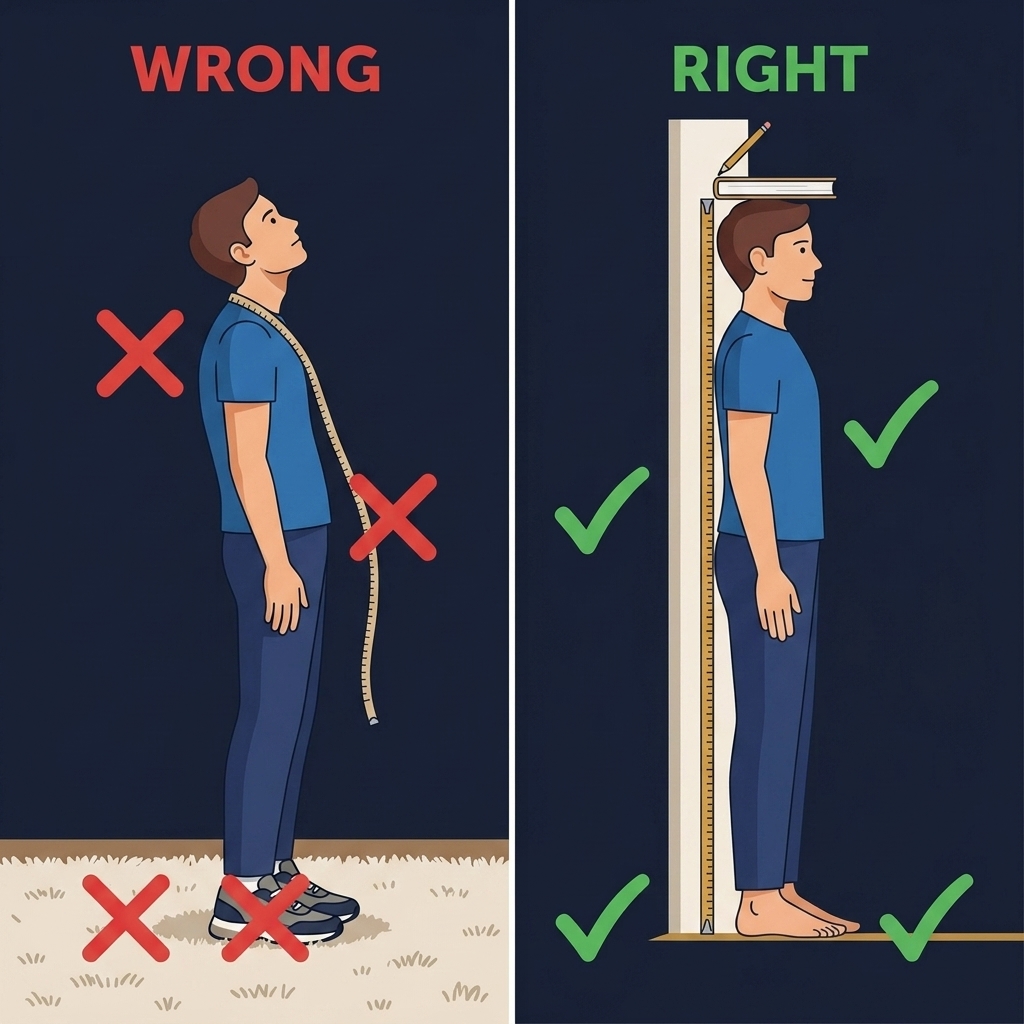
Height Measurement Mistakes You Should Avoid
Your height reading is probably wrong. A single measuring error - wrong shoes, bad posture, soft floor - can add or subtract up to 5 cm (2 inches) from your actual height. That gap distorts your BMI, throws off medical dosage calculations, and makes growth tracking unreliable. Here are the exact height measurement mistakes people make and how to fix each one.
Why Accurate Height Measurement Matters
Before fixing your technique, understand what is at stake. An incorrect height measurement does not just bruise your ego - it creates a cascade of problems.
- BMI miscalculation. Height is squared in the BMI formula. A 2 cm error in height shifts your BMI by 0.5 to 1.0 points, potentially moving you between weight categories.
- Medication dosing. Certain drugs, anesthetics, and chemotherapy agents use body surface area calculations that depend on accurate height. Wrong input means wrong dose.
- Growth tracking failures. For children, a single bad reading can mask delayed growth or trigger unnecessary specialist referrals. The CDC growth charts rely on precise interval measurements.
- Legal and professional requirements. Passports, military enlistment, sports eligibility, and pilot licensing all require verified height. An avoidable measuring error can disqualify you.
The good news: every height measurement mistake on this list is fixable in under 60 seconds.
The 10 Most Common Height Measurement Mistakes
1. Measuring with Shoes On
This is the single most frequent incorrect height measurement people make. Shoes add 1 to 4 cm (0.4 to 1.6 inches) depending on the type:
| Shoe Type | Height Added |
|---|---|
| Dress shoes | 1.5–2.5 cm (0.6–1.0 in) |
| Running shoes | 2.0–3.5 cm (0.8–1.4 in) |
| Boots | 2.5–5.0 cm (1.0–2.0 in) |
| High heels | 5.0–12.0 cm (2.0–4.7 in) |
| Flat sandals | 0.5–1.0 cm (0.2–0.4 in) |
The fix: Remove all footwear. Measure barefoot on a hard floor. Even thin socks under 2 mm are fine - anything thicker adds measurable height.
Every clinical measurement worldwide is performed without shoes. If a doctor measured you in sneakers, that reading is inflated. Learn how medical professionals handle this in our guide on how doctors measure height.
2. Standing on Carpet or Soft Flooring
Carpet compresses unevenly under body weight. Thick pile carpet absorbs 0.5 to 1.5 cm (0.2 to 0.6 inches) from your reading. A rug layered over carpet doubles the compression. Foam exercise mats and bathroom rugs create the same problem.
The fix: Stand on tile, hardwood, laminate, or concrete. If every room in your home has carpet, use the garage floor or a flat porch surface.
Pro Tip: Test your floor with a round pencil. Place it on the surface and let go. If the pencil rolls, the floor slopes, and your reading will be skewed. Find a different spot.
3. Slouching or Over-Straightening
Both extremes produce bad data:
- Slouching removes up to 2 cm (0.8 inches) by curving the upper spine forward and compressing vertebral discs.
- Over-stretching - standing at military “attention” or reaching upward - artificially adds up to 1 cm (0.4 inches) by forcing unnatural spinal extension.
The fix: Stand naturally upright with relaxed shoulders. Press four contact points against the wall: heels, buttocks, shoulder blades, and the back of your head. Not everyone can touch all four due to body shape - press as many as you can without straining. For a full walkthrough of proper stance, see our guide on how to measure your height at home.
4. Tilting Your Head (Ignoring the Frankfurt Plane)
Head position is the most underestimated height measurement mistake. Tilting your head back raises the crown and adds up to 1.5 cm (0.6 inches). Tilting forward drops it by the same amount.
The clinical standard is the Frankfurt Plane - an imaginary horizontal line from the bottom of the eye socket to the top of the ear canal. When this line is level, your chin sits parallel to the floor, and your head is neutral.
The fix: Pick a specific point on the opposite wall at your eye level. Stare at it during the entire measurement. This locks your head into the Frankfurt Plane automatically without overthinking it.
5. Using a Soft or Flexible Headpiece
Resting your hand, a pillow, or a flexible folder on your head creates a false measurement point. Soft objects compress under their own weight and tilt off-center, lowering your wall mark by 0.5 to 1.5 cm (0.2 to 0.6 inches).
The fix: Use a rigid, flat object - a hardcover book, carpenter’s level, or set square. Press one edge firmly against the wall at a 90° angle while the bottom edge rests flat on the crown of your head. The carpenter’s level is the best option because you can visually confirm it sits perfectly horizontal.
6. Using a Fabric Tape Measure
Fabric sewing tapes stretch over time and sag when extended vertically. A stretched fabric tape can read 0.3 to 1 cm (0.1 to 0.4 inches) short of the actual distance.
The fix: Use a metal retractable tape measure with a locking mechanism. Metal tapes stay rigid against the wall and maintain consistent tension. A 25-foot (7.6 m) locking tape costs under $10 at any hardware store.
No tape measure at all? Use our detailed guide on how to measure height at home for 5 alternative methods that still give you a usable reading.
7. Measuring at Inconsistent Times of Day
Your height is not a fixed number. Spinal discs absorb fluid overnight and expand. Gravity compresses them throughout the day. The result: you are 1 to 2 cm (0.4 to 0.8 inches) taller in the morning than in the evening.
| Time of Day | Height Effect | Cause |
|---|---|---|
| Morning (within 1 hour of waking) | Tallest (+1 to 2 cm) | Discs fully hydrated from sleep |
| Midday | Average reading | Partial disc compression |
| Evening | Shortest (−1 to 2 cm) | Full gravitational compression |
The fix: Always measure at the same time of day. Morning measurements (30 to 60 minutes after waking) produce the closest reading to your maximum height. For detailed guidance, read our article on the best time of day to measure height.
8. Not Removing Hair Accessories
Braids piled on top of the head, high ponytails, bows, clips, headbands, and thick hair wraps physically raise the headpiece above the crown. In children, this mistake is especially common and can add 1 to 3 cm (0.4 to 1.2 inches) to the reading.
The fix: Remove all hair accessories before measuring. Undo buns and top-knots. Let hair fall flat against the head. If hair is naturally very voluminous, gently compress it with the rigid headpiece - the headpiece should touch the skull, not the top of the hair.
9. Reading the Tape at an Angle (Parallax Error)
If you crouch to read the tape or look up at it from below, the angle distorts the number. This is called parallax error, and it can shift your reading by 0.3 to 0.5 cm (0.1 to 0.2 inches) in either direction.
The fix: After marking the wall and stepping away, read the measurement at eye level. Position your eyes directly in front of the pencil mark. If the mark is above your comfortable eye line, stand on a stable step stool or ask a taller person to read it.
10. Measuring Against a Wall with Baseboards
Baseboards push your heels 1 to 3 cm (0.4 to 1.2 inches) away from the wall surface. Your body angles forward slightly, compressing your posture and shortening the reading. Some people compensate by leaning back, which tilts the head and introduces even more error.
The fix: Find a section of wall with no baseboards, crown molding, or protruding trim. Interior closet walls and garage walls are usually baseboard-free. Alternatively, if every wall has baseboards, place your heels against the baseboard and accept a minor (~0.5 cm) postural compromise - it is better than angling your body.
The Compounding Problem: How Small Errors Stack Up
Height measurement mistakes rarely occur in isolation. Most people commit 2 to 4 errors simultaneously, and those errors compound:
| Combined Errors | Total Potential Deviation |
|---|---|
| Shoes + carpet | +2.5 to 5.5 cm (1.0 to 2.2 in) |
| Slouching + head tilt down | −2.0 to 3.5 cm (0.8 to 1.4 in) |
| Fabric tape + parallax | −0.6 to 1.5 cm (0.2 to 0.6 in) |
| Shoes + over-stretching + morning reading | +3.0 to 6.0 cm (1.2 to 2.4 in) |
A person wearing running shoes, standing on carpet, and tilting their head back could measure 5 cm (2 inches) taller than their actual height. Someone slouching in the evening with a fabric tape could measure 3 cm (1.2 inches) shorter.
Pro Tip: After fixing your technique, measure yourself 3 times in a row and average the results. If the 3 readings differ by more than 0.5 cm (0.2 inches), at least one measuring error is still present. Go through this checklist again.
Quick-Fix Checklist: Before Every Measurement
Run through this list every time you measure height - yours or someone else’s:
- Barefoot - shoes, thick socks, and slippers removed
- Hard floor - tile, hardwood, or concrete (no carpet, rugs, or mats)
- Flat wall - no baseboards, picture frames, or protruding trim at measurement height
- Hair cleared - accessories removed, buns undone, hair flat against skull
- Four-point contact - heels, buttocks, shoulders, and head touching the wall
- Frankfurt Plane - eyes staring at a fixed point straight ahead, chin parallel to floor
- Rigid headpiece - hardcover book or carpenter’s level, pressed flat at 90° to wall
- Metal tape - retractable, locking, read at eye level
- Three readings - averaged, with all three within 0.5 cm of each other
- Same time of day - ideally 30–60 minutes after waking
Special Cases: Measuring Children and Elderly Adults
Children Under 2
Infants and toddlers are measured lying down (recumbent length). The most common mistake is not fully extending both legs or allowing the child to squirm during measurement. Recumbent length reads approximately 0.7 cm (0.3 inches) longer than standing height for the same child.
For step-by-step technique, see our guide on how to measure a child’s height.
Children Over 2
The biggest child-specific mistake is tiptoe standing. Children instinctively rise on their toes when they sense they are being measured. Watch for it and ask them to keep their feet flat. Remove hair clips, bows, and ponytails - these errors are more common in pediatric measurements than adult ones.
Adults Over 40
Height loss after age 40 is normal - but only at a rate of about 0.5 cm per decade. If you detect more than 2 cm (0.8 inches) of height loss from your peak adult measurement, it may signal osteoporosis or vertebral compression fractures. Accurate, consistent measurements are critical for this age group. Compare your current height to average height data for men or women for context.
How to Convert Your Corrected Height
Once you have a measurement you trust, you may need it in different units for medical forms, passport applications, or fitness tracking.
| From | To | Formula | Example |
|---|---|---|---|
| Inches | Centimeters | inches × 2.54 | 66 in × 2.54 = 167.64 cm |
| Centimeters | Inches | cm ÷ 2.54 | 170 cm ÷ 2.54 = 66.93 in |
| Feet & inches | Total inches | (feet × 12) + inches | 5’6” = (5 × 12) + 6 = 66 in |
Do not round 2.54 to 2.5. That shortcut introduces a cumulative error of over 1 inch at 170 cm. Use the exact conversion factor every time, or check our complete height conversion formulas guide for every unit pair.
Not sure which unit system to use? Our guide on imperial vs. metric explains when each applies and where each is standard.
Frequently Asked Questions
What is the most common height measurement mistake?
Measuring with shoes on is the most common height measurement mistake. Shoes add 1 to 4 cm (0.4 to 1.6 inches) depending on sole thickness. Running shoes typically add 2.5 cm (1 inch). The second most common mistake is measuring on carpet, which compresses under body weight and reduces the reading by 0.5 to 1.5 cm. Always measure barefoot on a hard, flat floor.
How much can height measurement mistakes affect your BMI?
A 2 cm (0.8 inch) height measurement error can shift your BMI by 0.5 to 1.0 points. Since BMI squares the height value, even small measuring errors have outsized effects. For someone on the borderline between normal weight and overweight (BMI 24.5–25.5), a single incorrect height measurement could move them into a different category and change medical recommendations.
Why is my height different every time I measure?
Multiple factors cause height variation between measurements. The biggest natural factor is time of day - you are 1 to 2 cm taller in the morning than the evening due to spinal disc hydration. Other causes include inconsistent posture, different footwear, measuring on different surfaces, and using different tools. Eliminate these variables by following the same procedure at the same time of day, every time.
Can bad posture permanently affect your measured height?
Bad posture during measurement temporarily reduces your reading by up to 2 cm, but it does not change your actual skeletal height. However, chronic poor posture over years can lead to structural changes such as increased thoracic kyphosis (rounded upper back), which does reduce standing height permanently. Regular posture-aware measurement helps you track these changes early.
Should I measure height in the morning or evening?
Morning measurements (30 to 60 minutes after waking) give you the tallest and most reproducible reading because spinal discs are fully hydrated from sleep. Evening measurements are shorter but equally valid - the key is consistency. Pick one time and stick with it for every measurement session. Medical professionals typically measure patients during morning clinic hours.
How do I know if my height measurement is accurate?
Take three measurements in a row using proper technique: barefoot, hard floor, flat wall, rigid headpiece, metal tape, and Frankfurt Plane head position. If all three readings fall within 0.5 cm (0.2 inches) of each other, your measurement is accurate. If they vary more than that, at least one measuring error is present and you should recheck your setup.
Measure Your Height the Right Way
Every height measurement mistake on this list is avoidable. The checklist above takes 60 seconds to run through and eliminates the errors that throw off readings by up to 5 cm.
Ready to get your accurate number and convert it? Use these free tools:
- Height in Inches Calculator - Convert between inches, cm, feet, meters, and more
- Feet to CM Calculator - Convert feet and inches to centimeters
- CM to Feet Calculator - Convert centimeters to feet and inches
- Inches to CM Calculator - Convert total inches to centimeters
- Average Height Data - Compare your corrected measurement to averages by country and gender