
How to Measure Height Accurately at Home
Most people have no idea their height reading is off by up to 2 cm (0.8 inches). That gap throws off your BMI, messes up official documents, and makes it impossible to track real growth over time. The fix takes 3 minutes, 3 household items, and one flat wall. Here is exactly how to measure height at home and get it right every time.
Quick Answer: How to Measure Your Height
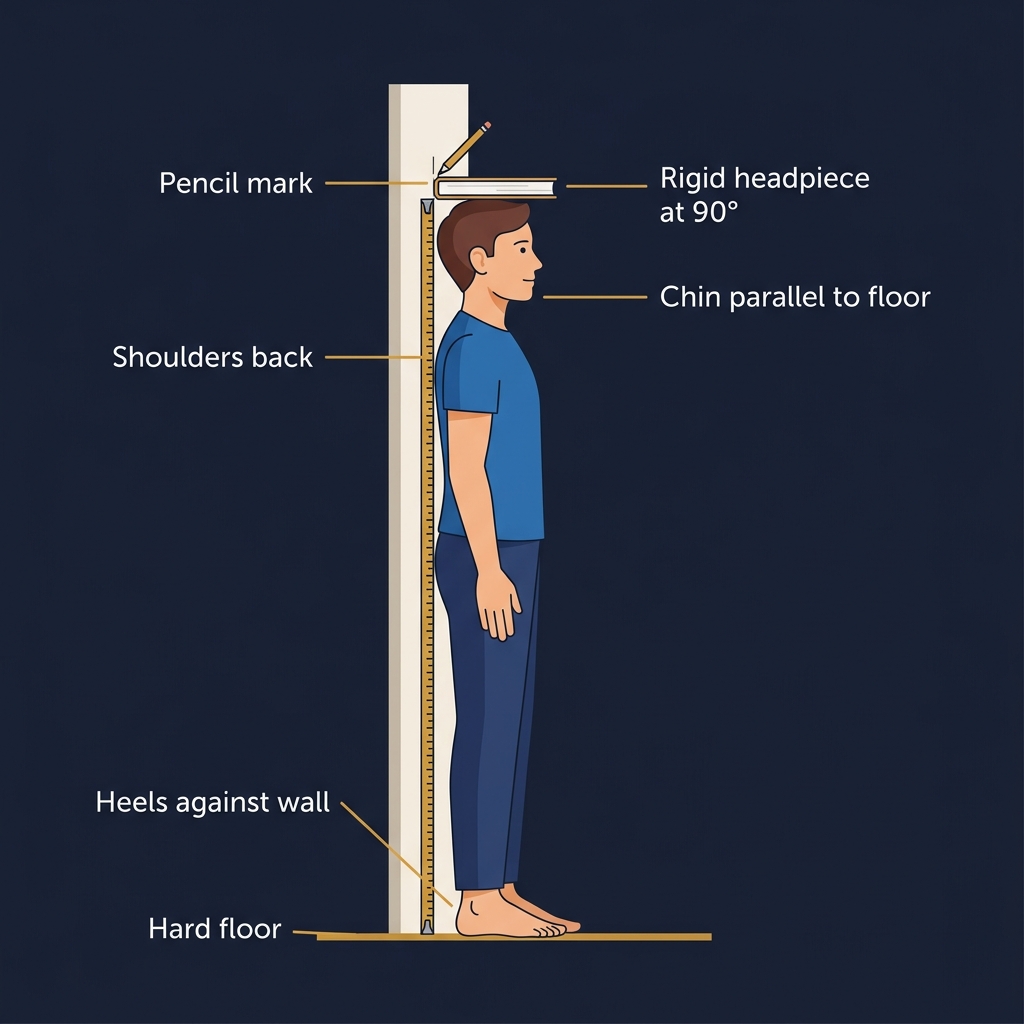
Stand barefoot on a hard floor against a flat wall. Place a rigid flat object (hardcover book or carpenter’s level) on top of your head at 90° to the wall. Mark the wall with a pencil where the bottom edge of the object meets the surface. Step away and measure from the floor to the mark with a metal tape measure.
This method produces readings within 0.5 cm (0.2 inches) of a clinical stadiometer when performed correctly.
What You Need to Measure Height at Home
Three items are all you need for an accurate height measurement. Most households already have them.
| Tool | Purpose | Best Option | Avoid |
|---|---|---|---|
| Tape measure | Measure floor to mark | Metal retractable tape (25 ft / 7.6 m) | Fabric sewing tape (sags and stretches) |
| Flat rigid object | Level headpiece | Carpenter’s level, hardcover book, or set square | Soft objects (pillows, folders, hands) |
| Pencil | Mark the wall | Light pencil mark (erasable) | Marker or pen (permanent) |
A metal tape measure stays rigid against the wall. Fabric tapes droop and produce readings that fall 0.3 to 1 cm (0.1 to 0.4 inches) short of your actual height. Buy a locking retractable tape at any hardware store for under $10.
No tape measure? Use items with known dimensions: US letter paper (11 inches / 27.94 cm long), a US dollar bill (6.14 inches / 15.6 cm long), or a standard credit card (3.37 inches / 8.56 cm long). Stack them from floor to your pencil mark and multiply. Check out our detailed guide on how to measure your height at home for 5 alternative methods.
Step-by-Step: How to Measure Height by Yourself
Follow these 4 steps in order. The entire process takes 2 to 3 minutes.
Step 1: Find the Right Spot
Choose a section of wall that meets 3 criteria:
- Hard floor. Tile, hardwood, laminate, or concrete. Carpet compresses under your weight and steals 0.5 to 1.5 cm (0.2 to 0.6 inches) from the reading.
- Flat, smooth wall. No baseboards, textured stone, or protruding trim. A baseboard pushes your heels away from the wall and angles your body forward.
- Clear vertical space. Remove picture frames, shelves, or anything at head height. You need open wall from floor level to at least 15 cm (6 inches) above your estimated height.
Remove shoes, thick socks, hats, and hair accessories. Shoes add 1 to 4 cm depending on sole thickness. Even running shoes add roughly 2.5 cm (1 inch).
Step 2: Stand with Correct Posture
Press 4 contact points against the wall: heels, buttocks, shoulder blades, and the back of your head. Not everyone can touch all 4 due to body shape — touch as many as you can without straining.
Position your body correctly:
- Feet: Flat on the floor, heels together, toes pointing slightly outward at a 60° angle
- Legs: Straight but not locked, weight distributed evenly
- Shoulders: Relaxed downward, pressed gently against the wall
- Head: Look straight ahead with your chin parallel to the floor
This head position is called the Frankfurt Plane — an imaginary line from the bottom of the eye socket to the top of the ear canal that runs perfectly horizontal. Clinicians use this exact alignment for all standardized height measurements.
Pro Tip: Pick a specific point on the opposite wall at eye level and stare at it while you are being measured. This locks your head in the correct Frankfurt Plane position automatically, without you overthinking it.
Step 3: Mark the Wall
Place a flat, rigid object on top of your head so one edge presses firmly against the wall at a right angle. A carpenter’s level is ideal because you can confirm it sits level. A hardcover book or set square works too.
The bottom edge of the object where it touches the wall is your height point. Make a light pencil mark at that exact spot.
If you are measuring alone, hold the headpiece in place with one hand and mark with the other. Keep your head completely still while marking. Having a helper makes this step significantly easier and more accurate.
Step 4: Measure and Record
Step away from the wall. Place the end of your tape measure flat against the floor at the base of the wall. Extend the tape straight up to the pencil mark. Read the measurement at eye level to avoid parallax error.
Record in your preferred unit:
- Imperial: Read total inches and divide by 12 for feet and remaining inches (e.g., 67 inches = 5’7”)
- Metric: Read centimeters directly (e.g., 170 cm)
- Convert: Inches × 2.54 = centimeters, or centimeters ÷ 2.54 = inches
Measure 3 times and average the results. If your 3 readings vary by more than 0.5 cm (0.2 inches), something is off. Recheck your posture and repeat. Three consistent readings confirm accuracy.
Need to convert your measurement? Use our Height in Inches to CM Calculator or Feet to CM Calculator for instant, exact results.
Why Your Height Changes Throughout the Day
Your height is not a fixed number. You are measurably taller in the morning and shorter by evening. The difference ranges from 1 to 2 cm (0.4 to 0.8 inches) for most adults.
The cause is spinal disc compression. Your spine contains 23 intervertebral discs — gel-filled cushions between each vertebra. While you sleep in a horizontal position, these discs absorb fluid and expand. Throughout the day, gravity compresses them as you stand, sit, and walk, gradually squeezing fluid out.
| Time of Day | Height Effect | Why |
|---|---|---|
| Morning (within 1 hour of waking) | Tallest reading (+1 to 2 cm) | Discs are fully hydrated from sleep |
| Midday | Average reading | Partial disc compression |
| Evening | Shortest reading (-1 to 2 cm) | Full gravitational compression |
For consistent tracking, always measure at the same time of day. Morning measurements (30 to 60 minutes after waking) give the closest reading to your maximum height. Medical professionals typically measure patients during morning clinic hours for this exact reason.
5 Common Mistakes That Ruin Your Height Measurement
Even small errors compound. Here are the mistakes that throw off home measurements the most.
1. Measuring on Carpet
Carpet fibers compress unevenly under your body weight. Thick pile carpet absorbs 1 to 1.5 cm (0.4 to 0.6 inches). Low-pile carpet absorbs 0.5 cm. A rug layered over carpet doubles the compression. Always measure on a hard, flat surface.
2. Slouching or Over-Stretching
Slouching removes up to 2 cm (0.8 inches) from your reading. Stretching upward artificially adds up to 1 cm (0.4 inches). Neither gives your true height. Stand naturally upright with relaxed shoulders — not military “attention” posture.
3. Tilting Your Head
Tilting your head backward raises the crown and adds up to 1.5 cm (0.6 inches). Tilting forward drops it. Keep your chin parallel to the floor (Frankfurt Plane) for a neutral, accurate reading.
4. Using a Soft Headpiece
A pillow, hand, or flexible folder compresses under its own weight. This lowers the mark on the wall and shortens your reading. Use a rigid, flat object — a hardcover book, set square, or carpenter’s level — that holds a true 90° angle against the wall.
5. Measuring at Different Times
Comparing a morning measurement to an evening measurement introduces up to 2 cm of false variation. Pick one consistent time and stick to it for every session.
Pro Tip: To test if your floor is truly level, place a round pencil on the floor. If it rolls, the floor slopes, and your reading will be skewed. Move to a different spot.
How to Measure a Child’s Height at Home
Children require adjusted techniques depending on age.
Children Over Age 2 (Standing Method)
Use the same wall method as adults with 3 important adjustments:
- Watch for tiptoe standing. Children instinctively rise on their toes when they sense they are being measured. Tell them to keep their “pancake feet” flat.
- Remove hair accessories. Ponytails, clips, bows, and braids piled on top of the head add measurable height.
- Measure every 3 to 6 months. The CDC recommends regular interval measurements plotted on growth percentile charts to track development. A child who drops more than 2 percentile lines between measurements should see a pediatrician.
Children Under Age 2 (Lying Down)
Infants and toddlers under 2 should be measured lying flat (recumbent length). Lay the child on a firm surface, hold a flat object against the top of their head, extend both legs, and press another flat object against the soles of their feet. Measure the distance between the two objects.
Recumbent length reads approximately 0.7 cm (0.3 inches) longer than standing height for the same child, which is normal.
When to Measure Your Height (and How Often)
Different life stages call for different measurement schedules:
| Age Group | Recommended Frequency | Primary Reason |
|---|---|---|
| Infants (0–2 years) | Every 1–3 months | Growth chart tracking (WHO standards) |
| Children (2–18 years) | Every 3–6 months | CDC growth percentile monitoring |
| Adults (18–40) | Once per year | Baseline for BMI and medical records |
| Adults (40+) | Once per year | Detecting height loss (osteoporosis indicator) |
Adults over 40 should pay particular attention to height loss. Losing more than 2 cm (0.8 inches) from your peak adult height can signal vertebral compression fractures or osteoporosis and warrants a medical evaluation.
Height Measurement Without a Tape Measure
Stuck without measuring tools? Five methods still give you a usable reading:
- String method: Mark your height on the wall, run a string from floor to mark, cut it, and measure the string against a ruler or known-length object. Accuracy: within 1 cm.
- Printer paper method: US letter paper is 11 inches (27.94 cm) long. Stack sheets end-to-end from floor to your mark. Six sheets cover 66 inches (167.6 cm).
- Doorframe method: Standard US interior doors are 80 inches (203.2 cm). Mark your height on the frame and estimate the difference from the top.
- Dollar bill method: A US dollar bill is 6.14 inches (15.6 cm) long. Lay bills end-to-end from floor to mark and multiply.
- Smartphone app: AR-enabled apps like Apple Measure or Google Measure use camera sensors to estimate height. Accuracy varies from 1 to 3 cm (0.4 to 1.2 inches), making this the least precise method.
The string method gives the best accuracy among these alternatives. Smartphone apps are the least reliable, especially above 170 cm (5’7”) where camera angle distortion increases.
How to Convert Your Height Measurement
Once you have your raw number, you may need it in a different unit for medical forms, passport applications, or fitness calculations.
| From | To | Formula | Example |
|---|---|---|---|
| Inches | Centimeters | inches × 2.54 | 67 in × 2.54 = 170.18 cm |
| Centimeters | Inches | cm ÷ 2.54 | 170 cm ÷ 2.54 = 66.93 in |
| Feet & inches | Total inches | (feet × 12) + inches | 5’7” = (5 × 12) + 7 = 67 in |
| Centimeters | Meters | cm ÷ 100 | 170 cm ÷ 100 = 1.70 m |
Do not round 2.54 to 2.5. That shortcut introduces a cumulative error of 1.07 inches at 170 cm. Use the exact conversion factor, or skip the math entirely with our CM to Feet Calculator or Height in Inches Calculator.
Frequently Asked Questions
How can I measure my height by myself?
Stand barefoot on a hard floor with your back against a smooth wall. Press your heels, buttocks, shoulder blades, and head against the wall. Place a rigid flat object (hardcover book or carpenter’s level) on your head so it touches the wall at 90°. Mark the wall with a pencil at the bottom edge of the object. Step away and measure from the floor to the mark with a metal tape measure. Repeat 3 times and average the results for accuracy.
How accurate are home height measurements?
A properly performed wall-and-book measurement is accurate within 0.5 cm (0.2 inches) of a clinical stadiometer reading. The main error sources are soft flooring (carpet adds up to 1.5 cm), incorrect head position (tilting adds or subtracts up to 1.5 cm), and using a non-rigid headpiece.
Why am I taller in the morning than at night?
Spinal discs absorb fluid and expand while you sleep horizontally. Gravity compresses these discs throughout the day as you stand and sit. The difference between morning and evening height is typically 1 to 2 cm (0.4 to 0.8 inches). For consistent tracking, measure at the same time daily — ideally in the morning.
Can I measure height without a tape measure?
Yes. Use a piece of string to mark your height on the wall, then measure the string against a ruler or any object with a known length. You can also use standard US letter paper (11 inches long), dollar bills (6.14 inches long), or stand next to a doorframe (standard US doors are 80 inches tall) and estimate the difference.
What is the Frankfurt Plane in height measurement?
The Frankfurt Plane (also called the Frankfort Horizontal) is the clinical standard for head positioning during height measurement. It is an imaginary line from the lower border of the eye socket to the upper margin of the ear canal. When this line is horizontal, your chin is parallel to the floor, and your head is in the correct neutral position for an accurate reading.
How often should adults measure their height?
Adults aged 18 to 40 should measure once per year during a routine physical. Adults over 40 should measure annually and track for height loss. Losing more than 2 cm from your peak adult height may indicate osteoporosis or vertebral compression fractures and should be evaluated by a doctor.
Convert Your Height Instantly
Done measuring? Convert your height between any unit system with our free tools:
- Height in Inches Calculator — Full multi-unit converter for inches, cm, feet, meters, and more
- Feet to CM Calculator — Convert feet and inches to centimeters instantly
- CM to Feet Calculator — Convert centimeters back to feet and inches
- Inches to CM Calculator — Convert total inches to centimeters
- Average Height Data — Compare your measurement to average heights by country and gender