
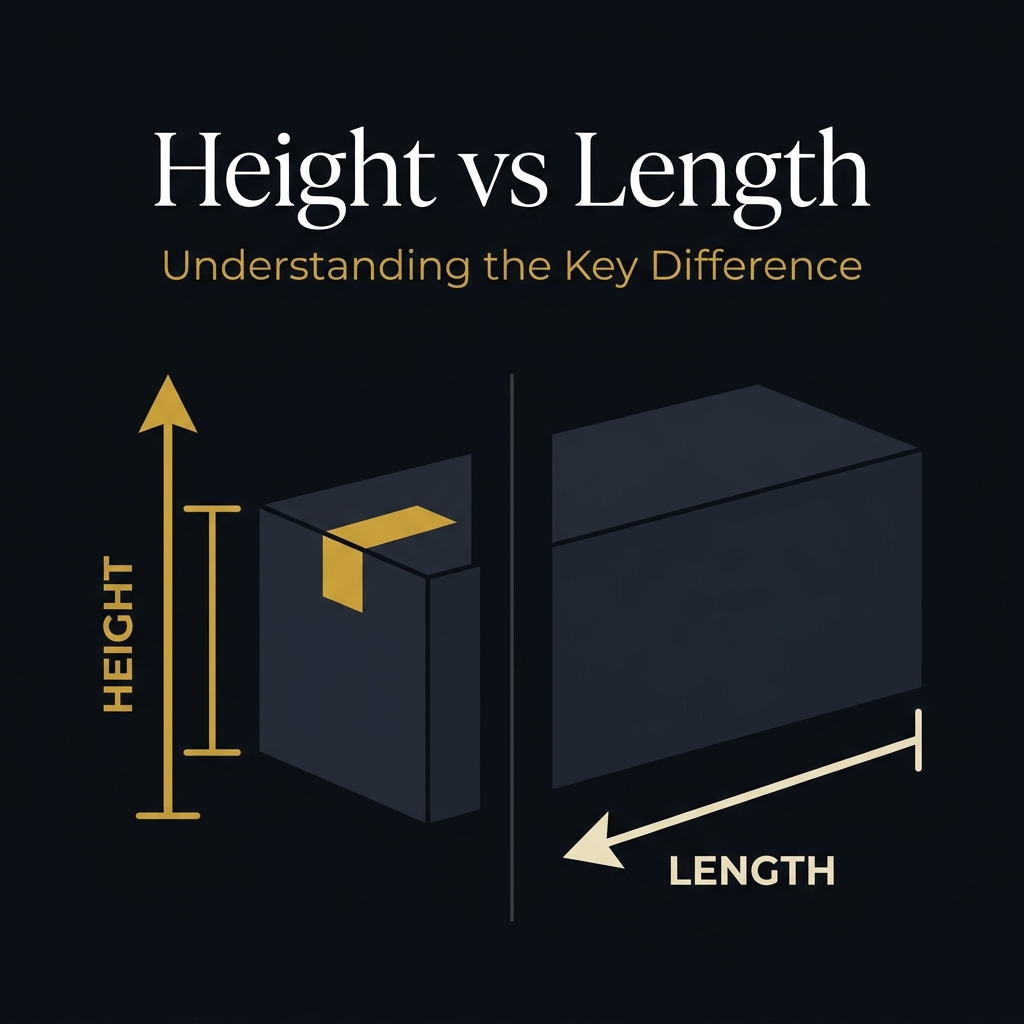
Height vs Length: What’s the Difference?
You’re filling out a form for a shipping label and it asks for “length, width, and height.” You stare at the box. Which side is which? Or maybe you’re measuring a person and someone asks for their “length” instead of their “height.” Is that wrong?
Most people use height and length interchangeably and most of the time, they get away with it. But there are specific situations where mixing them up causes real problems: wrong furniture orders, shipping miscalculations, incorrect medical charts, and failed engineering specs.
Here’s the clear answer: height is the vertical measurement (bottom to top), and length is the horizontal measurement (end to end). But the full story is more nuanced, and knowing when each term applies saves you from costly mistakes.
Quick Answer: Height vs Length at a Glance
| Dimension | Direction | Axis | Measures |
|---|---|---|---|
| Height | Vertical | Y-axis | How tall an object or person is |
| Length | Horizontal | X-axis | How long an object is, end to end |
Both are linear measurements. Both use the same units: inches, centimeters, feet, meters. The difference is purely about orientation.
What Is Height?
Height is the vertical distance from the base of an object to its topmost point.
When you measure how tall a building is, you are measuring its height. When a pediatrician records that a child is 4’2”, they are recording height - the vertical distance from the floor to the crown of the head. When engineers calculate how high water rises in a tank, they track height.
Height always answers the question: “How tall is it?”
In coordinate geometry, height runs along the Y-axis - the vertical axis. It is measured perpendicular to the ground plane.
Common Uses of “Height”
- Human stature: “My height is 5’10”.”
- Buildings and structures: “The Empire State Building stands at 1,454 feet including antenna.”
- Altitude: “The plane cruised at a height of 35,000 feet.”
- Containers and furniture: “The refrigerator height is 69 inches.”
- Geometry: Height of a triangle = perpendicular distance from base to apex.
Pro Tip: In shipping and product specifications, “height” always refers to the vertical dimension - the measurement you see when the object is sitting upright in its normal orientation. This is the number that determines whether something fits under a countertop, through a doorway, or on a shelf.
What Is Length?
Length is the horizontal extent of an object from one end to the other. In most contexts, it specifically refers to the longest horizontal dimension.
When you measure a hallway, a piece of lumber, or a swimming pool, you are measuring length. It answers the question: “How long is it?”
In coordinate geometry, length runs along the X-axis - the horizontal axis.
Common Uses of “Length”
- Objects and surfaces: “The dining table length is 72 inches.”
- Distance: “The length of the trail is 4.2 miles.”
- Fabric and materials: “Cut 36 inches of length from the roll.”
- Body segments: “Arm length: measured from shoulder to wrist.”
- Geometry: Length of a rectangle = the longer of the two base sides.
The Key Difference: Orientation
The simplest way to remember:
- Height = vertical (up and down)
- Length = horizontal (left to right, or front to back)
The same measurement can be called either one depending on how the object is oriented.
Lay a 6-foot person flat on a table. You can now measure their length from head to toe - the same 6 feet that was previously their height when they were standing. The number doesn’t change. The word does.
This is exactly why pediatricians measure infants’ length (lying down) instead of height (standing). Babies cannot stand safely, so their measurement is taken horizontally - making it, by definition, a length measurement, not a height measurement. In fact, recumbent length typically reads about 0.7 cm (0.3 inches) longer than standing height for the same child. Growth charts account for this switch at age 2.
Height vs Length in Product Dimensions
When you buy a piece of furniture or a shipping box, the dimension label order matters.
Standard product dimension notation: Length x Width x Height
| Dimension | What It Measures | Example (Shipping Box) |
|---|---|---|
| Length | Longest horizontal side | 20 inches |
| Width | Shorter horizontal side | 14 inches |
| Height | Vertical distance (base to top) | 10 inches |
Why does this matter?
If you order a wardrobe online listed as “72”L x 24”W x 80”H”, you know:
- The wardrobe occupies 72 inches of wall space (length)
- It sticks out 24 inches from the wall (width)
- It stands 80 inches tall (height)
Confusing height and length here could mean ordering furniture that won’t fit through your door or won’t clear your ceiling.
For shipping carriers like UPS, FedEx, and USPS, dimensional weight pricing depends on correctly identifying L x W x H. Getting the orientation wrong can mean billing errors or rejected packages.
Height vs Length in Human Body Measurement
For people, the standard is almost always height - but there are specific cases where length applies.
| Measurement | Term Used | Why |
|---|---|---|
| Standing adult stature | Height | Vertical, upright position |
| Infant measurement (under 2 years) | Length | Measured horizontally (recumbent) |
| Arm measurement | Arm length | Horizontal limb extent |
| Inseam measurement | Leg length | Limb segment measurement |
| Foot measurement | Foot length | Horizontal extent of the foot |
Notice the pattern: height is used for whole-body vertical measurements. Length is used for limb and body-segment measurements, or any measurement taken in a horizontal position.
This is why clothing sizing uses “inseam length” for pants (the inside leg measurement from crotch to ankle), not “inseam height.”
Pro Tip: When comparing your measurements to average height data, always use standing height (measured vertically, barefoot). If you were recently measured lying down for a medical test, that number may read slightly higher - by up to 0.7 cm - compared to your true standing height.
Height vs Length in Geometry
In mathematics, the two terms have specific definitions depending on the shape.
Rectangles
For a rectangle, length refers to the longer side and width to the shorter side. Both run horizontally. If the rectangle is drawn vertically (like a portrait), the longer vertical side may be called height instead.
Triangles
The height of a triangle is the perpendicular distance from the base to the opposite vertex. It may not correspond to any actual side of the triangle - it’s a calculated internal measurement. The base sides of a triangle are measured by length.
3D Shapes (Rectangular Prisms, Cylinders, etc.)
- Length = longest horizontal dimension
- Width = shorter horizontal dimension (also called depth)
- Height = vertical dimension
Volume formula: V = L x W x H
Because multiplication is commutative, the volume result is identical regardless of which dimension you label as length, width, or height. But when describing a shape to another person or filling a spec sheet, using the correct term prevents confusion.
When the Terms Overlap (And When Context Wins)
Language is flexible. In casual speech, “length” often means “extent in any direction.” You might say “the length of the rope” even if the rope is hanging vertically. That’s fine - everyone knows what you mean.
Where precision matters:
- Medical records: Use height for stature; use length for infants
- Product specs and shipping: Always L x W x H with height vertical
- Architecture and engineering: Height is strictly vertical; use elevation or altitude for measurements above a reference point
- Sports and athletics: Athletes record height (stature), not length; long jump and other events measure distance covered
Height vs Length: Real-World Examples
Example 1: Measuring a Refrigerator
Your new fridge spec sheet reads: 30”W x 32”D x 69”H
- Width: 30 inches (horizontal, side to side)
- Depth: 32 inches (horizontal, front to back - depth is another word for length in this context)
- Height: 69 inches (vertical - this is what determines whether it fits under the overhead cabinets)
If the overhead cabinet clearance is 67 inches, the fridge won’t fit, regardless of the other dimensions.
Example 2: A 6-Year-Old at the Doctor
The pediatric nurse records 3’9” on the growth chart. She marks it as height, not length, because the child is old enough to stand. If the same child were 18 months old and measured lying flat, the same dimension would be recorded as length.
Example 3: Lumber at the Hardware Store
A piece of lumber listed as “2x4x96” means:
- Nominal width: 2 inches (actual: 1.5 inches)
- Nominal depth: 4 inches (actual: 3.5 inches)
- Length: 96 inches = 8 feet - the long horizontal extent
Here, height isn’t used because lumber is specified by its length (along the grain) and its cross-section dimensions.
Height vs Length vs Width vs Depth: All Four Dimensions
Once you understand height vs length, width and depth slot in easily.
| Term | Direction | Describes |
|---|---|---|
| Height | Vertical (Y-axis) | How tall |
| Length | Horizontal (X-axis) | How long (usually longest side) |
| Width | Horizontal (Z-axis or X-axis) | How wide (shorter horizontal side) |
| Depth | Horizontal (front to back) | How far back (often interchangeable with length) |
Width typically refers to the shorter horizontal extent of an object. Depth is often used for the front-to-back dimension - how far an object extends away from you. In practice, depth and length are frequently interchangeable.
How to Measure Height Correctly
When someone asks for your height - or the height of an object - here’s how to measure it accurately:
- Stand barefoot on a hard, level floor - carpet compresses and adds false inches
- Stand against a flat wall - heels, buttocks, shoulder blades, and head touching
- Use the Frankfurt Plane - chin parallel to floor, eyes looking straight ahead
- Place a rigid flat object (hardcover book, set square) on top of your head at 90 degrees to the wall
- Mark the wall with a pencil where the bottom of the object meets it
- Measure from the floor to the mark with a metal tape measure
This gives you your standing height - the standard vertical measurement. For more detail, see our full guide on how to measure height accurately at home.
Need to convert your height to another unit? Use our Height in Inches Calculator for instant conversions between inches, centimeters, feet, and meters.
Frequently Asked Questions
Is height the same as length?
Not exactly. Height and length both measure linear distance, but height specifically refers to the vertical dimension (how tall), while length refers to the horizontal dimension (how long). When an object is turned on its side, what was its height becomes its length, and vice versa.
Which is bigger: height or length?
Neither is inherently bigger. Both simply describe different directions of measurement. A skyscraper has a greater height than its length (footprint). A highway has a greater length than its height. The actual values depend entirely on the object being measured.
Why do doctors say “length” for infants but “height” for adults?
Infants are measured lying flat on their backs (recumbent position) because they cannot stand safely or stay still upright. A horizontal measurement is, by definition, a length measurement. Once a child can stand (typically around age 2), the measurement switches to height. The two readings differ by roughly 0.7 cm (0.3 inches) for the same child.
What is the difference between height and depth?
Height is the vertical measurement. Depth typically refers to the front-to-back horizontal measurement of an object. For example, a desk might be 30 inches tall (height), 60 inches wide (width), and 28 inches deep (depth). In some contexts, depth and length are interchangeable.
How do you write dimensions in order: length, width, or height first?
The standard order for product and shipping dimensions is Length x Width x Height (L x W x H). Length is listed first (longest horizontal side), width second (shorter horizontal side), and height last (vertical measurement). Some manufacturers use different conventions - always check the spec sheet if uncertain.
Does “height” apply to mountains and altitude?
Yes. Altitude and elevation are specialized forms of height measurement applied to geographical features. A mountain’s height is its vertical distance from base (or sea level) to its peak. Sea level is the standard reference point (zero) for elevation measurements globally.
Measure and Convert Your Height Instantly
Now that you know the difference between height and length, use our free tools to work with your measurements:
- Height in Inches Calculator - Convert height between inches, centimeters, feet, and meters
- CM to Feet Calculator - Convert centimeters to feet and inches
- Feet to CM Calculator - Convert feet and inches to centimeters
- Average Height by Country - See how your height compares globally
- Height Measurement Guide - Step-by-step instructions for accurate home measurement
- How to Write Height Correctly - Format your height properly for forms and documents