
Height Charts: Average Height by Age, Gender, and Country
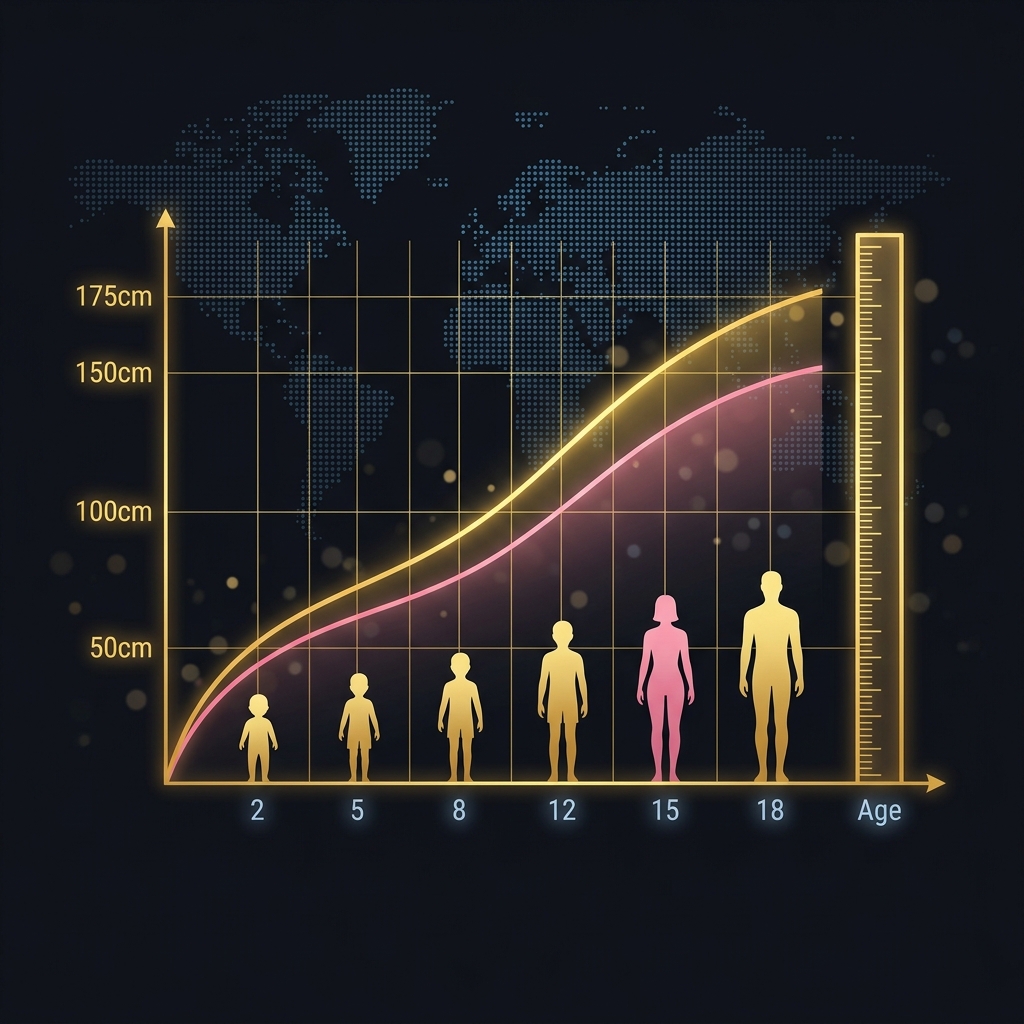
Struggling to figure out exactly what a "normal" height really is? Without a clear visual reference, numbers on a page can feel completely meaningless. Parents often worry if their children are hitting the right milestones, and adults frequently wonder how they stack up against the rest of the world.
This complete guide will break down the science behind height charts. We will teach you exactly how to read percentiles, navigate growth curves, and utilize official data to accurately compare heights across age, gender, and country demographics. You will discover exactly where you, or your child, fall on the global spectrum.
Quick Answer: How to Read a Height Chart
A height chart maps age against stature to generate a "percentile" curve. To read one, simply locate the subject's exact age on the bottom axis, move straight up to find their exact measured height on the vertical axis, and note where those two points intersect on the curved lines.
What Is a Height Chart?
Purpose of Height Charts
Height charts provide a standardized medical baseline. They are not designed to declare a single "perfect" height, but rather to illustrate the natural, healthy spread of human stature across a population, allowing doctors to identify massive deviations from the norm.
How Height Charts Are Used
Pediatricians use them primarily to track consistency. A child does not need to be in the 90th percentile to be healthy. The medical goal is for a child to follow their own established curve consistently without suddenly dropping off or spiking abnormally.
Average Height of Men
View the exact average male height statistics by country, age, and global baselines.
View men's data →Average Height of Women
Explore adult female height data across different nations and understand female growth.
View women's data →Average Height of Boys
Access detailed CDC growth charts and percentiles for boys from birth to age 18.
View boys' charts →Average Height of Girls
Read female growth curves, understand peak height velocity, and view teenage statistics.
View girls' charts →Average Height Chart for Adults
Unlike childhood charts that curve upward as kids age, adult charts represent a flattened, finalized dataset because human growth stops entirely by the early twenties.
Average Height of Men
Adult male charts sit noticeably higher. Because boys experience a much longer and more intense period of bone growth fueled by testosterone, the global adult male average rests around 171 cm (5 feet 7.3 inches).
Average Height of Women
Adult female charts plateau earlier. High estrogen levels during female puberty trigger the growth plates to seal shut much sooner. Therefore, the global adult female average levels off around 159.5 cm (5 feet 2.8 inches).
Height Chart for Boys by Age
Ages 1–5
The steepest curve on the chart. Toddlers grow incredibly fast, gaining roughly 3 to 5 inches per year. Their percentiles can fluctuate wildly as their bodies establish a natural rhythm.
Ages 6–12
The steady climb. The growth curve flattens out into a predictable, diagonal slope. Most boys consistently gain around 2.5 inches per year during this pre-pubescent phase.
Ages 13–18
The final upward spike. As boys hit puberty later than girls, the male growth chart shows a massive upward acceleration between ages 13 and 15, adding 3 to 5 inches per year before aggressively plateauing by age 18.
Height Chart for Girls by Age
Ages 1–5
Mirroring the male chart. Female toddlers grow at a nearly identical, extremely rapid pace during the first five years of life, making early childhood charts almost interchangeable between sexes.
Ages 6–12
The early surge. Girls typically hit puberty around age 10 or 11. During this window, the female growth chart spikes dramatically, causing many girls to temporarily outpace boys of the exact same age.
Ages 13–18
The hard plateau. The female growth chart flattens out completely much earlier. Most girls achieve 99% of their adult height within two years of their first menstrual cycle, typically ceasing all growth by age 15 or 16.
Height Percentile Charts Explained
What Is a Height Percentile?
A percentile is a comparative ranking system. It does not represent inches or centimeters. If a chart places a boy in the 60th percentile, it simply means that if you lined up 100 boys of his exact age, he would be taller than 60 of them, and shorter than 40.
How to Interpret Percentiles
The 50th percentile is the dead-center average. Anything between the 5th and 95th percentiles is generally considered clinically normal. Medical professionals only worry if a child abruptly jumps across multiple percentile lines within a few months, indicating a potential hormone or nutritional issue.
Average Height Chart by Country
Because genetics and environments differ globally, applying a United States height chart to an individual born in South America will result in completely skewed percentiles.
Tallest Countries
The Netherlands dictates the ceiling. Dutch adult male charts peak at a massive 183.8 cm (6 feet 0.4 inches). Other towering nations include Montenegro, Bosnia, and Denmark, due to a unique blend of genetic isolation and heavy dairy consumption.
Shortest Countries
Timor-Leste and Guatemala sit at the bottom. In these nations, the 50th percentile for adult men often sits below 160 cm (5 feet 3 inches), severely depressed by historical poverty and childhood malnutrition rather than purely genetics.
Global Comparisons
Always compare against your own ancestral and regional data. An individual who falls in the 25th percentile on an American CDC chart might easily rank in the 80th percentile on a regional Southeast Asian chart.
Height Chart in CM and Feet & Inches
Metric vs Imperial Measurements
Almost all clinical charts use centimeters. The scientific community strictly utilizes the metric system. Only the United States heavily relies on translating that clinical data into feet and inches for public consumption.
Common Height Conversions
Simple math bridges the gap. To convert a clinical centimeter chart into feet and inches, simply divide the CM value by 2.54. For instance, 170 cm becomes exactly 66.9 inches, or roughly 5 feet 7 inches.
Is Your Height Above or Below Average?
Comparing Your Height to National Averages
In the US, 5'9" is the exact benchmark for men. If you are an American male and you stand precisely 5 feet 9 inches tall without shoes, you are resting squarely on the 50th percentile line for your nation.
Comparing Your Height to Global Averages
Globally, the average human is much shorter. Because highly populated developing nations pull the global mean downward, an American who feels "short" at home is often considered tall when measured against the entire global population.
Factors That Affect Height
Genetics
Your DNA dictates the peak of your curve. Genetics control 80% of final adult stature, essentially determining the absolute maximum height you could possibly reach if given perfect environmental conditions.
Nutrition
Diet determines if you hit that peak. Without high-quality protein, dairy, and essential vitamins during childhood, the body simply will not have the building blocks required to reach its genetic ceiling.
Health and Lifestyle
Chronic illness and sleep deprivation steal height. Fighting off severe infections forces the body to abandon bone growth. Similarly, failing to get deep sleep deprives children of the Human Growth Hormone (HGH) required to maximize bone length.
How to Measure Height Correctly Before Using a Height Chart
Do not guess your height. If you estimate your measurements, applying them to a clinically precise chart will yield completely useless percentiles. You must measure exactly.
Take your shoes and socks off. Stand perfectly straight against a bare wall first thing in the morning (your spine compresses throughout the day). Ensure your heels, buttocks, and upper shoulders maintain contact with the wall. Look straight ahead, rest a flat object on the crown of your head, mark the wall, and measure firmly from the floor up.
Frequently Asked Questions
What is a height chart?
A height chart is a medical graphing tool. It plots age against stature to visualize the average growth trajectory of a specific population, allowing doctors to compare a single individual against millions of peers.
How do I know if my height is average?
You must find your percentile. Measure your true height, find the chart matching your exact age, gender, and nationality, and locate where your height intersects the graph. If you land on the 50th percentile line, you are perfectly average.
What is a height percentile chart?
It is a ranking curve. It ranks individuals from 1 to 100 within a demographic. Being in the 80th percentile means you are taller than 80 percent of the people in that specific testing group.
Are height charts different for boys and girls?
Yes, they are completely separate. Girls mature faster, causing their growth curves to spike and flatten earlier than boys. Combining the genders would completely skew the medical data during the teenage years.
How accurate are height charts?
Mathematically, they are flawless representations of a population. Organizations like the CDC construct them using massive, rigorously vetted datasets. However, they only represent statistical averages, not guaranteed outcomes for individuals.
Explore More Height Statistics and Conversion Tools
Need to quickly swap between metric and imperial to read a global chart? Use our instant calculators.