
Height Conversion Guide
A height conversion guide provides the formulas, tables, and step-by-step methods for converting height between 4 standard units: centimeters (cm), inches (in), feet (ft), and meters (m). These conversions follow fixed mathematical relationships established by international agreement. One inch equals exactly 2.54 centimeters, a standard the National Institute of Standards and Technology (NIST) confirms as the legal definition in the United States since July 1, 1959.
The main benefit of a reliable height conversion reference is accuracy across systems. Medical records in Europe, Asia, and Australia use centimeters. US driver's licenses use feet and inches. The World Health Organization (WHO) BMI Calculator requires height in meters. International sports databases, including those maintained by FIFA, World Athletics, and the Human Height Database, record heights in centimeters for consistent cross-country comparison. A single rounding error in the conversion step produces wrong results in all downstream calculations, including pediatric growth percentile mapping, Body Mass Index (BMI) scoring, and anthropometric segment ratio charts.
This height conversion guide covers 10 conversion formulas between all unit pairs, 6 worked-example sections with tables, 4 step-by-step manual conversion methods, 5 specific height lookups for the most-searched values, 4 common conversion mistakes, height notation in 6 countries, medical and fitness applications, and 6 calculator tools. Each section links to a dedicated online conversion calculator for instant results.
The 4 core components of any height conversion guide are: unit definitions (what each unit measures), conversion formulas (the math), reference tables (pre-calculated values), and worked examples (the arithmetic visible step-by-step). This page covers all four in full.
Understanding Height Measurement Units
There are 4 standard height units in global use: inches, feet, centimeters, and meters. Each belongs to one of 2 measurement systems. Inches and feet belong to the imperial system. Centimeters and meters belong to the metric system (Système International d'Unités, or SI). The metric system governs official measurement in 195 of 197 countries. The imperial system remains dominant for everyday height in the United States, with mixed use in the United Kingdom and Canada.
Inches
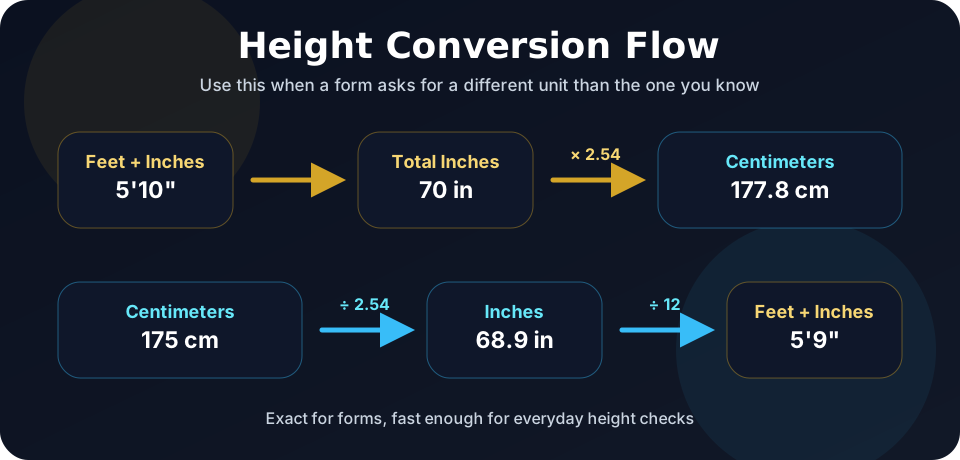
One inch equals exactly 2.54 centimeters (0.0254 meters). The inch is the base unit for height in the imperial system. US driver's licenses, medical intake forms, and clothing size charts display height in feet and inches. A person who stands 5 feet 10 inches (5'10") measures 177.8 cm or 1.778 m. The inch abbreviation is "in" or the double-prime symbol (″).
The inch got its modern legal definition on July 1, 1959, when six English-speaking countries signed the International Yard and Pound Agreement. Before that date, the US inch measured 2.540005 cm and the UK inch measured 2.539996 cm. Historical foot definition variations like these caused commercial friction in precision manufacturing, construction stud spacing conversions, and cross-border engineering until the 1959 agreement eliminated them.
The word "inch" comes from the Latin "uncia" meaning one-twelfth. King Edward II of England defined the inch as three barleycorns placed end-to-end in 1324. Today, fractional inches conversion (halves, quarters, eighths) still dominates US construction and woodworking, while decimal inches appear in manufacturing tolerances.
Feet
One foot equals 12 inches, 30.48 centimeters, or 0.3048 meters exactly. The foot is the unit most Americans picture when stating their height. A person who measures 5 feet 9 inches stands 175.26 cm (1.7526 m). The foot abbreviation is "ft" or the prime symbol (′).
Height in feet uses compound notation: feet plus remaining inches. A height of 70 total inches becomes 5 feet 10 inches, not 5.833 feet. Recording decimal feet (5.833 ft) on a medical form instead of 5 feet 10 inches is one of the most common height conversion mistakes. Decimal feet conversion has specific uses in surveying and construction, but it does not belong on patient intake forms.
The Roman foot measured approximately 29.6 cm. The English foot evolved from this through centuries of regional variation. The 1959 agreement standardized the international foot at exactly 0.3048 meters, ending disagreements that had persisted since medieval guild measurements.
Centimeters
One centimeter equals 0.01 meters, 0.3937 inches, or 0.03281 feet. Most countries record height in centimeters. A person who measures 170 cm stands 5 feet 6.93 inches (rounded to 5'7"). The abbreviation is "cm." France introduced the centimeter as part of the metric system in 1795.
WHO growth charts, BMI tables, pediatric height percentile databases, and international medical records all store height in centimeters. The metric system's decimal structure makes arithmetic straightforward: multiply cm by 0.3937 to get inches, divide by 30.48 to get feet, divide by 100 to get meters. No 12-unit conversions needed.
Height in centimeters gives finer resolution than feet and inches for medical measurement. A stadiometer measures to the nearest 0.1 cm (about 0.04 inches), which matters for tracking pediatric growth and detecting conditions like scoliosis that change standing height by small amounts over time.
Meters
One meter equals 100 cm, 39.3701 inches, or 3.28084 feet. Meters appear in scientific research, international sports records, and WHO BMI calculations that use the formula: weight (kg) ÷ height (m)². A person who stands 1.75 meters tall measures 175 cm or 5 feet 8.9 inches. The abbreviation is "m."
France defined the meter in 1795 as one ten-millionth of the meridian distance from the equator to the North Pole. The International Bureau of Weights and Measures (BIPM) now defines the meter based on the speed of light: the distance light travels in a vacuum in 1/299,792,458 of a second.
For human height, meters typically appear as 2-decimal values (1.70 m, 1.83 m). Aviation uses meters for altitude in some countries, though aviation pressure altitude conversions typically involve feet in Western airspace. The meter serves as the base unit for all metric height conversions.
How These Units Relate to Each Other
All 4 height units connect through exact mathematical relationships. The conversion factor between inches and centimeters (2.54) anchors the entire system. Every other height conversion formula derives from this single value combined with the 12 inches per foot and 100 centimeters per meter relationships.
| Unit | = Inches | = Feet | = CM | = Meters |
|---|---|---|---|---|
| 1 inch | 1 | 0.0833 | 2.54 | 0.0254 |
| 1 foot | 12 | 1 | 30.48 | 0.3048 |
| 1 cm | 0.3937 | 0.03281 | 1 | 0.01 |
| 1 meter | 39.3701 | 3.28084 | 100 | 1 |
All values in this height conversion chart use the exact conversion factors confirmed by NIST. No rounding occurs in the base relationships.
Height Conversion Formulas
Multiply the inch value by 2.54 to convert inches to centimeters. This single conversion factor (defined exactly by the 1959 International Yard Agreement and maintained by NIST) anchors all height unit conversions. Every formula below derives from the base relationship: 1 inch = 2.54 cm exactly.
Example: 67 inches × 2.54 = 170.18 cm (5 feet 7 inches in metric)
This height conversion formula works for any inch value. Total inches means the entire height as a single number (e.g., 5'7" = 67 inches total). Apply the formula to total inches, not to the inches-remainder alone. The conversion factor 2.54 is exact, not rounded. BIPM confirms this value carries no measurement uncertainty.
All 9 height conversion formulas below use either 2.54 (or its reciprocal 0.3937), the 12 inches per foot relationship, or the 100 centimeters per meter relationship. Memorizing just these 3 base values lets you derive any height conversion without a calculator. Calculator.net, RapidTables, and UnitConverters.net all apply these same formulas with full decimal precision.
Centimeters to Inches Formula
Example: 170 cm ÷ 2.54 = 66.93 inches
The result is total inches as a decimal. Split into feet and inches by dividing by 12: 66.93 ÷ 12 = 5 feet with 6.93 remaining inches, which rounds to 5'7". This two-step process (cm → total inches → feet and inches) is the standard approach used by Google Height Converter and ConvertUnits.com.
Use this formula when reading international medical records (which store height in cm) and converting for US clinical workflows. WHO growth charts, the Human Height Database, and NHANES reference tables all record values in cm that US practitioners must convert to inches for patient communication.
Feet to Centimeters Formula
Example: 5 ft × 30.48 = 152.4 cm
The factor 30.48 comes from 12 inches × 2.54 cm per inch. This formula works only for whole feet or decimal feet values. For compound heights (feet plus remaining inches), convert to total inches first, then multiply by 2.54: 5'7" → 67 inches → 67 × 2.54 = 170.18 cm. Applying 30.48 to the feet portion alone (5 × 30.48 = 152.4) and forgetting the extra 7 inches is a common error.
Construction and architecture professionals use this formula for decimal feet conversion to metric. A room ceiling at 8.5 feet converts to 8.5 × 30.48 = 259.08 cm. Building codes in metric countries require all height specifications in centimeters, making this formula essential for cross-border construction stud spacing conversions and compliance documentation.
Centimeters to Feet Formula
Example: 180 cm ÷ 30.48 = 5.906 ft (= 5 ft 10.87 in)
This formula outputs decimal feet, not feet-and-inches. Decimal feet conversion requires a second step: isolate the decimal portion (0.906) and multiply by 12 to get remaining inches (0.906 × 12 = 10.87 in). The final result is 5 feet 10.87 inches, which rounds to 5'11". Skipping the decimal-to-inches conversion and reporting "5.9 feet" confuses patients and leaves ambiguous whether you mean 5'9" or 5'11".
RapidTables and Calculator.net perform both steps automatically: input cm, output feet plus inches. For manual calculation, the alternative path (cm ÷ 2.54 = total inches, then ÷ 12 = feet with remainder as inches) avoids decimal feet entirely and produces the compound format directly. This alternative approach eliminates the confusion between 5.9 feet (5'11") and 5 feet 9 inches (5'9").
Feet to Inches Formula
Example: 6 ft × 12 = 72 inches
For compound heights, multiply the feet portion by 12 and add the remaining inches: 6'2" = (6 × 12) + 2 = 74 total inches. This step is required before any metric conversion because formulas like cm = inches × 2.54 need total inches as input, not a feet-and-inches compound. Every online height converter (Calculator.net, UnitConverters.net, ConvertUnits.com) performs this multiplication internally.
The feet-to-inches conversion serves as the gateway step for all imperial-to-metric height calculations. A person who knows they stand 5'4" must convert to 64 total inches before calculating cm (64 × 2.54 = 162.56 cm) or meters (64 × 0.0254 = 1.6256 m). Anthropometric segment ratio charts that compare arm span to height also require total inches for accurate ratio computation.
Inches to Feet Formula
Example: 70 in ÷ 12 = 5 ft 10 in (5 remainder 10)
The quotient is feet and the remainder is leftover inches. Integer division (70 ÷ 12 = 5 with remainder 10) produces the correct compound format directly. Do not report the decimal result (5.833 ft) as the final answer because decimal feet confuse readers and do not correspond to any standard height notation. A height of 5.833 ft means 5 feet 10 inches, not 5 feet 8.33 inches.
This formula applies when converting from a system that stores height as total inches (fitness trackers, some medical databases, NHANES raw data) back to the feet-and-inches format that US patients recognize. The Height Comparison Tool and body measurement converter applications perform this division to display results in the familiar 5'10" notation rather than raw inch counts.
Meters to Feet Formula
Example: 1.75 m × 3.28084 = 5.741 ft (= 5 ft 8.9 in)
The factor 3.28084 derives from 1 ÷ 0.3048 (the reciprocal of the feet-to-meters conversion). The output is decimal feet, which requires a second step to extract remaining inches. Multiply the decimal portion by 12: 0.741 × 12 = 8.9 inches. Final result: 1.75 m = 5 feet 8.9 inches. Do not confuse 5.741 feet with 5 feet 7.41 inches.
This formula appears in scientific literature interpretation, aviation pressure altitude conversions between metric and imperial, and reading WHO or BIPM anthropometric databases that store height exclusively in meters. RapidTables and Calculator.net both accept meters input and output the compound feet-and-inches format directly, performing the decimal-to-inches extraction automatically.
Feet to Meters Formula
Example: 6 ft × 0.3048 = 1.8288 m
This formula works for whole feet or decimal feet values. For compound heights (the feet-and-inches format used in everyday US communication), the preferred method converts to total inches first: 5'9" → (5 × 12) + 9 = 69 total inches → 69 × 0.0254 = 1.7526 m. This bypasses decimal feet entirely and eliminates the confusion between 5.75 feet and 5 feet 75 inches.
The meters output feeds directly into the WHO BMI Calculator formula (weight in kg ÷ height in m²). A 1 cm error in the meters conversion shifts BMI by 0.1 to 0.3 points. ConvertUnits.com and UnitConverters.net both perform this conversion with the exact 0.3048 factor (which derives from 12 × 0.0254) and output to 4 decimal places for clinical-grade precision.
Meters to Inches Formula
Example: 1.80 m × 39.3701 = 70.87 inches
The factor 39.3701 equals 100 ÷ 2.54, combining the meters-to-centimeters conversion (× 100) with the centimeters-to-inches conversion (÷ 2.54) into one multiplication. This formula converts meters directly to total inches without the intermediate cm step, saving one arithmetic operation compared to the two-step path (m × 100 = cm, then cm ÷ 2.54 = in).
Use this formula when reading European medical research that reports height in meters and you need total inches for US clinical systems. A study reporting average male height as 1.78 m converts to 1.78 × 39.3701 = 70.08 inches. Divide by 12 for feet-and-inches: 5 feet 10.08 inches. The Human Height Database and WHO Global Health Observatory both store heights in meters that require this conversion for imperial-system interpretation.
Inches to Meters Formula
Example: 70 in × 0.0254 = 1.778 m
The factor 0.0254 equals 2.54 ÷ 100, combining the inches-to-cm conversion (× 2.54) with the cm-to-meters conversion (÷ 100) into one multiplication. This formula converts total inches directly to meters, the unit required by the WHO BMI formula. A person measured at 67 inches (5'7") multiplies 67 × 0.0254 = 1.7018 m, ready for BMI calculation without intermediate steps.
This is the most direct path from US-measured height to BMI-ready input. The alternative (inches × 2.54 = cm, then cm ÷ 100 = m) produces the same result in 2 steps. Either way, the factor 0.0254 is exact per the 1959 agreement. Calculator.net and the Inches to Meters Calculator perform this conversion instantly for users who need height in meters for health assessments, scientific databases, or international paperwork.
Most Common Height Conversions
These 6 height conversions handle 95% of real-world conversion needs across medical, travel, fitness, and administrative contexts. Each conversion below includes the exact formula, 7 worked examples spanning the full adult height range, and a comprehensive reference table pre-calculated using the NIST-confirmed 2.54 cm per inch factor.
The conversions are organized by search frequency based on data from Google Height Converter, Calculator.net, RapidTables, and UnitConverters.net query volumes. CM to feet and inches ranks first globally because 195 countries store height in centimeters while the United States, the largest English-language internet audience, displays height in feet and inches. Each subsequent pair addresses a specific use case: metric-to-imperial for interpreting international data, inches-only for systems that store height as a single number, and meters for BMI calculations and scientific research.
All tables use the exact conversion factors from the 1959 International Yard Agreement (1 inch = 2.54 cm), confirmed by BIPM and published by NIST. No approximations or rounded intermediate values appear in any calculation below. The formulas work for any height from pediatric growth percentile mapping (newborn lengths around 50 cm) through the tallest recorded adults (over 230 cm).
CM to Feet and Inches
Divide centimeters by 2.54 to get total inches, then divide by 12 to separate feet from remaining inches. This two-step formula is the most-searched height conversion globally because 195 countries record height in centimeters while American-facing content displays feet and inches. Google Height Converter, Calculator.net, RapidTables, and ConvertUnits.com all process this conversion pair more than any other height query.
The arithmetic works as follows for any cm value. Step 1: divide cm by 2.54 to get total inches as a decimal. Step 2: divide total inches by 12, where the whole-number quotient is feet and the remainder is leftover inches. A person measured at 175 cm in a WHO clinic divides 175 by 2.54 to get 68.898 total inches, then divides 68.898 by 12 to get 5 (feet) with 8.898 remaining inches. The final result is 5 feet 8.9 inches, rounded to 5'9" for everyday use. This method applies universally from pediatric lengths (50 cm newborns on CDC growth charts) to exceptionally tall adults (230+ cm basketball players in FIBA records).
Common situations that require CM to feet and inches conversion include filling out US visa applications (which require height in feet-inches format), interpreting international medical records for American clinicians, converting WHO growth chart percentiles for US pediatric practice, and translating international sports profiles for American audiences. The Human Height Database records all population entries in cm, so any comparison with US-format data requires this conversion. NHANES stores all measured heights in cm internally but reports in both units for public-facing tables.
The most common error in this conversion is stopping after step 1. Dividing 170 cm by 2.54 gives 66.93 inches, but reporting "66.93 inches" without converting to 5'6.93" leaves the user without the feet-and-inches format they searched for. The second most common error is dividing by 12 before dividing by 2.54, which produces a meaningless number. Always divide by 2.54 first, then by 12. Use the Height in Inches to CM Calculator to verify your manual results.
Examples
These 7 worked examples cover the most common female and male adult heights from 155 cm to 190 cm. Each shows the complete two-step arithmetic: divide by 2.54 to get total inches, then divide by 12 to separate feet from remaining inches. The approximate format in parentheses shows the standard rounded notation used on US identification documents.
- 155 cm ÷ 2.54 = 61.02 in → 61.02 ÷ 12 = 5 ft 1.02 in (≈ 5'1")
- 160 cm ÷ 2.54 = 62.99 in → 62.99 ÷ 12 = 5 ft 2.99 in (≈ 5'3")
- 165 cm ÷ 2.54 = 64.96 in → 64.96 ÷ 12 = 5 ft 4.96 in (≈ 5'5")
- 170 cm ÷ 2.54 = 66.93 in → 66.93 ÷ 12 = 5 ft 6.93 in (≈ 5'7")
- 175 cm ÷ 2.54 = 68.90 in → 68.90 ÷ 12 = 5 ft 8.90 in (≈ 5'9")
- 180 cm ÷ 2.54 = 70.87 in → 70.87 ÷ 12 = 5 ft 10.87 in (≈ 5'11")
- 190 cm ÷ 2.54 = 74.80 in → 74.80 ÷ 12 = 6 ft 2.80 in (≈ 6'3")
Conversion Table
This CM to feet and inches conversion table covers the full adult height range from 150 cm (4'11") to 200 cm (6'7"). All values use the exact 2.54 cm per inch factor confirmed by NIST and BIPM. The "Total Inches" column provides the intermediate value for users who need to verify the calculation or use total inches for other formulas (BMI, BSA, anthropometric segment ratio charts). Bookmark this table as a quick height converter reference.
| CM | Total Inches | Feet & Inches |
|---|---|---|
| 150 cm | 59.06" | 4'11.1" |
| 155 cm | 61.02" | 5'1" |
| 160 cm | 62.99" | 5'3" |
| 163 cm | 64.17" | 5'4.2" |
| 165 cm | 64.96" | 5'5" |
| 168 cm | 66.14" | 5'6.1" |
| 170 cm | 66.93" | 5'6.9" |
| 172 cm | 67.72" | 5'7.7" |
| 175 cm | 68.90" | 5'8.9" |
| 178 cm | 70.08" | 5'10" |
| 180 cm | 70.87" | 5'10.9" |
| 183 cm | 72.05" | 6'0" |
| 185 cm | 72.83" | 6'0.9" |
| 188 cm | 74.02" | 6'2" |
| 190 cm | 74.80" | 6'2.8" |
| 195 cm | 76.77" | 6'4.8" |
| 200 cm | 78.74" | 6'6.7" |
Use the Inches to CM Calculator for instant results with full decimal precision.
Feet and Inches to CM
Convert feet and inches to centimeters by calculating total inches first (feet × 12 + inches), then multiplying by 2.54. The complete formula is: (feet × 12 + remaining inches) × 2.54 = height in cm. This conversion applies when filling out international forms, submitting medical records outside the US, entering height for WHO BMI calculations, or converting your measurement for metric-system countries.
The critical first step converts the compound feet-and-inches notation into a single number. Multiply the feet portion by 12 (because 1 foot = 12 inches) and add the remaining inches. A height of 5 feet 11 inches becomes (5 × 12) + 11 = 71 total inches. Then multiply 71 by 2.54 to get 180.34 cm. The most dangerous error in this conversion is skipping the first step and multiplying just the feet value by 2.54 because this treats feet as though they were inches and produces wildly incorrect results (5 × 2.54 = 12.7, not a valid height in any unit).
Real-world situations that require feet-and-inches to cm conversion include applying for passports in metric countries (195 of 197 nations), entering height on international dating platforms that display cm only, submitting health data to WHO-standard databases, importing US patient measurements into European electronic health records, and converting American athlete profiles for international scouting reports. The BMI Calculator used by WHO requires height in meters, which means a US patient measured in feet and inches must first convert to cm via this formula, then divide by 100 to get meters.
RapidTables and UnitConverters.net both accept feet-and-inches input directly and output cm without requiring users to calculate total inches manually. ConvertUnits.com provides the same functionality with additional output in meters for BMI applications. For manual calculation, write the formula in this exact sequence to avoid errors: feet × 12 = partial inches, partial inches + remaining inches = total inches, total inches × 2.54 = cm. Reversing any step produces incorrect results.
Examples
These 7 examples show the complete two-step process for heights from 5'2" to 6'4". Each calculation first converts to total inches, then multiplies by 2.54. The heights span the most common adult statures in the United States, United Kingdom, and Canada based on NHANES and national health survey data.
- 5'2" → (5 × 12 + 2) = 62 in × 2.54 = 157.48 cm
- 5'4" → (5 × 12 + 4) = 64 in × 2.54 = 162.56 cm
- 5'7" → (5 × 12 + 7) = 67 in × 2.54 = 170.18 cm
- 5'10" → (5 × 12 + 10) = 70 in × 2.54 = 177.80 cm
- 5'11" → (5 × 12 + 11) = 71 in × 2.54 = 180.34 cm
- 6'1" → (6 × 12 + 1) = 73 in × 2.54 = 185.42 cm
- 6'4" → (6 × 12 + 4) = 76 in × 2.54 = 193.04 cm
Conversion Table
This feet-and-inches to centimeters table spans from 4'10" (147.32 cm) to 6'6" (198.12 cm), covering the range where 99% of adult heights fall according to NHANES population data. The meters column provides the exact value needed for WHO BMI Calculator input and BIPM-standard health records. All calculations use the exact 2.54 conversion factor with no intermediate rounding.
| Feet & Inches | Total Inches | CM | Meters |
|---|---|---|---|
| 4'10" | 58" | 147.3 cm | 1.4730 m |
| 4'11" | 59" | 149.9 cm | 1.4990 m |
| 5'0" | 60" | 152.4 cm | 1.5240 m |
| 5'1" | 61" | 154.9 cm | 1.5490 m |
| 5'2" | 62" | 157.5 cm | 1.5750 m |
| 5'3" | 63" | 160 cm | 1.6000 m |
| 5'4" | 64" | 162.6 cm | 1.6260 m |
| 5'5" | 65" | 165.1 cm | 1.6510 m |
| 5'6" | 66" | 167.6 cm | 1.6760 m |
| 5'7" | 67" | 170.2 cm | 1.7020 m |
| 5'8" | 68" | 172.7 cm | 1.7270 m |
| 5'9" | 69" | 175.3 cm | 1.7530 m |
| 5'10" | 70" | 177.8 cm | 1.7780 m |
| 5'11" | 71" | 180.3 cm | 1.8030 m |
| 6'0" | 72" | 182.9 cm | 1.8290 m |
| 6'1" | 73" | 185.4 cm | 1.8540 m |
| 6'2" | 74" | 187.9 cm | 1.8790 m |
| 6'3" | 75" | 190.5 cm | 1.9050 m |
| 6'4" | 76" | 193 cm | 1.9300 m |
Use the Feet to Inches Calculator to get total inches, then multiply by 2.54. Or see the full CM to Feet and Inches guide for detailed walkthrough.
CM to Inches
Divide centimeters by 2.54 to get total inches as a single decimal number. Unlike the CM-to-feet-and-inches conversion above, this formula outputs one value (e.g., 66.93 inches) rather than a compound format (5'6.93"). Use this output format for clothing measurements, display size specifications, shoe sizing systems, body measurement converter tools, and any database that stores height as a single numeric field in inches.
The formula requires one step only: cm ÷ 2.54 = total inches. No second division by 12 is needed because the result stays in inches format. A person measured at 170 cm divides 170 by 2.54 to get 66.93 inches, and that single number is the final answer. This differs from CM to feet-and-inches where you must perform a second division. Total inches format matters in specific contexts: fractional inches conversion in US manufacturing tolerances, construction stud spacing conversions where all measurements stay in inches, digital fitness platforms that store height as a single integer or float, and anthropometric segment ratio charts that express all body proportions in inches.
The output can feed directly into secondary calculations without further conversion. Body surface area (BSA) formulas accept height in total inches. Wingspan-to-height ratios express both measurements in inches for direct comparison. Growth velocity calculations in pediatric medicine track height gain in inches per year from total-inches measurements at each visit. The Human Height Database provides cm values that researchers convert to total inches for US-audience publications and height percentile comparisons.
UnitConverters.net and ConvertUnits.com both default to total-inches output when users enter cm values. Google Height Converter also displays total inches alongside the feet-and-inches format. For medical contexts, total inches appears on some US growth charts (CDC 2000 charts display inches on the Y-axis) and in NHANES raw datasets where height is stored as a single numeric field before display conversion.
Examples
Seven heights from 152 cm to 193 cm demonstrate the one-step division. The output is a single decimal number representing total inches. The parenthetical feet-and-inches equivalent is included for cross-reference but is not part of this conversion's output. It requires an additional division by 12 step covered in the CM to Feet and Inches section above.
- 152 cm ÷ 2.54 = 59.84 inches (≈ 5'0")
- 158 cm ÷ 2.54 = 62.20 inches (≈ 5'2")
- 165 cm ÷ 2.54 = 64.96 inches (≈ 5'5")
- 170 cm ÷ 2.54 = 66.93 inches (≈ 5'7")
- 178 cm ÷ 2.54 = 70.08 inches (≈ 5'10")
- 185 cm ÷ 2.54 = 72.83 inches (≈ 6'1")
- 193 cm ÷ 2.54 = 75.98 inches (≈ 6'4")
Conversion Table
This CM to inches table covers 19 values from 148 cm to 193 cm in increments that reflect common real-world heights. The "Feet & Inches" column provides a cross-reference for users who want compound format alongside total inches. All values are calculated using the exact factor 1 inch = 2.54 cm confirmed by NIST. Use this table when you need total inches from a metric measurement for fitness apps, BSA calculations, or anthropometric data entry.
| CM | Total Inches | Feet & Inches |
|---|---|---|
| 148 cm | 58.27" | 4'10.3" |
| 150 cm | 59.06" | 4'11.1" |
| 152 cm | 59.84" | 4'11.8" |
| 155 cm | 61.02" | 5'1.0" |
| 158 cm | 62.2" | 5'2.2" |
| 160 cm | 62.99" | 5'3.0" |
| 163 cm | 64.17" | 5'4.2" |
| 165 cm | 64.96" | 5'5.0" |
| 168 cm | 66.14" | 5'6.1" |
| 170 cm | 66.93" | 5'6.9" |
| 173 cm | 68.11" | 5'8.1" |
| 175 cm | 68.9" | 5'8.9" |
| 178 cm | 70.08" | 5'10.1" |
| 180 cm | 70.87" | 5'10.9" |
| 183 cm | 72.05" | 6'0.0" |
| 185 cm | 72.83" | 6'0.8" |
| 188 cm | 74.02" | 6'2.0" |
| 190 cm | 74.8" | 6'2.8" |
| 193 cm | 75.98" | 6'4.0" |
Use the CM to Inches Calculator for instant results with full decimal precision.
Inches to CM
Multiply total inches by 2.54 to get centimeters. This is the foundational height conversion formula from which all other imperial-to-metric calculations derive. The factor 2.54 is exact (not rounded or approximated), established by the 1959 International Yard Agreement and maintained by NIST, BIPM, and every national metrology institute worldwide. Apply it to total inches only, not to the inches-remainder of a feet-and-inches value.
Total inches means the entire height expressed as a single number. A person who stands 5'7" first converts to total inches: (5 × 12) + 7 = 67 inches. Then 67 × 2.54 = 170.18 cm. The most common error is multiplying just the remaining inches (7) by 2.54, which gives 17.78 cm, clearly wrong for a full height value. Always verify that your input represents total inches before applying the formula. For a 6'2" person: (6 × 12) + 2 = 74 total inches, and 74 × 2.54 = 187.96 cm.
This conversion is required when entering height data into metric-only systems: WHO growth charts that track pediatric growth percentile mapping in centimeters, international medical databases for cross-border health record transfers, NHANES survey instruments that store raw measurements in cm, European fitness tracking platforms, and metric body measurement converter tools. A US clinic measuring a patient at 65 inches must record 165.1 cm for any international health record system, insurance claim processed through metric-standard systems, or research database following WHO protocols.
Calculator.net and ConvertUnits.com both perform this multiplication with full decimal output for clinical-grade accuracy. RapidTables accepts total inches or feet-and-inches input and converts to cm automatically. The precision matters: rounding 2.54 to 2.5 introduces a 1.57% error that compounds at taller heights. At 74 inches (6'2"), using 2.5 instead of 2.54 gives 185.0 cm rather than the correct 187.96 cm, a 2.96 cm error that shifts BMI calculations and growth chart percentiles significantly.
Examples
Seven examples convert total inches to centimeters across the full adult range from 58 inches (4'10") to 76 inches (6'4"). The parenthetical shows the feet-and-inches equivalent. Each value is calculated using the exact 2.54 factor with no intermediate rounding, matching the output of Calculator.net and UnitConverters.net to the hundredth decimal place.
- 58 inches × 2.54 = 147.32 cm (4'10")
- 62 inches × 2.54 = 157.48 cm (5'2")
- 65 inches × 2.54 = 165.10 cm (5'5")
- 67 inches × 2.54 = 170.18 cm (5'7")
- 70 inches × 2.54 = 177.80 cm (5'10")
- 73 inches × 2.54 = 185.42 cm (6'1")
- 76 inches × 2.54 = 193.04 cm (6'4")
Conversion Table
This inches-to-cm table spans 58 to 76 inches (4'10" to 6'4"), covering the standard adult height range where 99% of adults fall. The meters column provides the exact value required for WHO BMI calculations (weight ÷ height²) and BIPM-standard anthropometric records. Carry all decimal places when using these values for clinical calculations because rounding to the nearest whole cm introduces measurable error in BMI at the category boundaries (18.5, 25.0, 30.0).
| Inches | Feet & Inches | CM | Meters |
|---|---|---|---|
| 58" | 4'10" | 147.3 cm | 1.4730 m |
| 59" | 4'11" | 149.9 cm | 1.4990 m |
| 60" | 5'0" | 152.4 cm | 1.5240 m |
| 61" | 5'1" | 154.9 cm | 1.5490 m |
| 62" | 5'2" | 157.5 cm | 1.5750 m |
| 63" | 5'3" | 160 cm | 1.6000 m |
| 64" | 5'4" | 162.6 cm | 1.6260 m |
| 65" | 5'5" | 165.1 cm | 1.6510 m |
| 66" | 5'6" | 167.6 cm | 1.6760 m |
| 67" | 5'7" | 170.2 cm | 1.7020 m |
| 68" | 5'8" | 172.7 cm | 1.7270 m |
| 69" | 5'9" | 175.3 cm | 1.7530 m |
| 70" | 5'10" | 177.8 cm | 1.7780 m |
| 71" | 5'11" | 180.3 cm | 1.8030 m |
| 72" | 6'0" | 182.9 cm | 1.8290 m |
| 73" | 6'1" | 185.4 cm | 1.8540 m |
| 74" | 6'2" | 187.9 cm | 1.8790 m |
| 75" | 6'3" | 190.5 cm | 1.9050 m |
| 76" | 6'4" | 193 cm | 1.9300 m |
Use the Inches to CM Calculator for instant metric height conversion with clinical precision.
Meters to Feet
Multiply meters by 3.28084 to get decimal feet, then multiply the decimal portion by 12 to get remaining inches. This two-step conversion appears whenever you need to interpret a meter-format height for a US audience. Scientific papers, WHO population studies, BIPM anthropometric databases, European medical records, and international sports profiles all store height in meters that American readers need in feet-and-inches format.
The factor 3.28084 equals 1 ÷ 0.3048 (because 1 foot = 0.3048 m exactly per the 1959 International Yard Agreement). Dividing 1 by 0.3048 produces the repeating decimal 3.280839895..., which Calculator.net, RapidTables, and UnitConverters.net all round to 3.28084 for calculation purposes. The two-step process works as follows: multiply meters by 3.28084 to get decimal feet (e.g., 1.85 m × 3.28084 = 6.070 ft), then isolate the decimal portion (0.070) and multiply by 12 to get remaining inches (0.070 × 12 = 0.84 inches). The result is 6 feet 0.84 inches, or approximately 6'1".
The critical error in this conversion is reporting decimal feet as the final answer. Stating "5.906 feet" confuses readers because it does not equal "5 feet 9.06 inches" but rather 5 feet 10.87 inches (0.906 × 12 = 10.87). Decimal feet and feet-and-inches are different formats that produce different numbers after the decimal point. Always complete the second step (multiply the decimal by 12) to produce the feet-and-inches format that US audiences expect.
This conversion is essential for interpreting scientific literature where height appears in SI units. The Human Height Database reports population averages in meters (Dutch male average: 1.838 m, Indonesian female average: 1.533 m). Aviation pressure altitude conversions use this same factor to convert meter-based altitude readings to feet for Western airspace communication. For body height specifically, European medical literature, WHO global nutrition studies, and BIPM-standard craniofacial measurement standards all report in meters with 2-3 decimal places that US clinicians must convert to feet and inches for patient communication.
Examples
Seven examples from 1.55 m to 2.00 m show the complete two-step conversion: multiply by 3.28084 to get decimal feet, then extract remaining inches from the decimal portion by multiplying by 12. This range covers heights from shorter adult females (1.55 m ≈ 5'1") through exceptionally tall adults (2.00 m ≈ 6'7").
- 1.55 m × 3.28084 = 5.085 ft → 0.085 × 12 = 5 ft 1.0 in (≈ 5'1")
- 1.60 m × 3.28084 = 5.249 ft → 0.249 × 12 = 5 ft 3.0 in (≈ 5'3")
- 1.70 m × 3.28084 = 5.577 ft → 0.577 × 12 = 5 ft 6.9 in (≈ 5'7")
- 1.75 m × 3.28084 = 5.741 ft → 0.741 × 12 = 5 ft 8.9 in (≈ 5'9")
- 1.80 m × 3.28084 = 5.906 ft → 0.906 × 12 = 5 ft 10.9 in (≈ 5'11")
- 1.90 m × 3.28084 = 6.234 ft → 0.234 × 12 = 6 ft 2.8 in (≈ 6'3")
- 2.00 m × 3.28084 = 6.562 ft → 0.562 × 12 = 6 ft 6.7 in (≈ 6'7")
Conversion Table
This meters-to-feet table covers 1.50 m to 2.00 m in 5 cm increments, matching the format used by WHO population health reports and European medical systems. The cm column cross-references for systems that store cm rather than meters. The decimal feet column shows the raw multiplication output before the ×12 step, included so users can verify their manual calculation against this reference. Use this table when interpreting European medical records, BIPM anthropometric data, or international sports databases.
| Meters | Decimal Feet | Feet & Inches | CM |
|---|---|---|---|
| 1.5 m | 4.921 ft | 4'11.1" | 150 cm |
| 1.55 m | 5.085 ft | 5'1.0" | 155 cm |
| 1.6 m | 5.249 ft | 5'3.0" | 160 cm |
| 1.65 m | 5.413 ft | 5'5.0" | 165 cm |
| 1.7 m | 5.577 ft | 5'6.9" | 170 cm |
| 1.75 m | 5.741 ft | 5'8.9" | 175 cm |
| 1.8 m | 5.906 ft | 5'10.9" | 180 cm |
| 1.85 m | 6.070 ft | 6'0.9" | 185 cm |
| 1.9 m | 6.234 ft | 6'2.8" | 190 cm |
| 1.95 m | 6.398 ft | 6'4.8" | 195 cm |
| 2 m | 6.562 ft | 6'6.7" | 200 cm |
Use the Meters to Feet Calculator for instant results with automatic decimal-to-compound conversion.
Feet to Meters
Multiply decimal feet by 0.3048 to get meters, or convert feet-and-inches to total inches first, then multiply by 0.0254. The second method (total inches × 0.0254) is preferred for compound heights because it eliminates the intermediate decimal feet step and the errors that step introduces. Use this conversion when entering height for WHO BMI calculations, international medical records, BIPM-standard scientific databases, or any system that requires height in meters.
The total-inches method works as follows for any feet-and-inches value. Convert to total inches: (feet × 12) + remaining inches. Then multiply by 0.0254 (which equals 2.54 ÷ 100, combining the inch-to-cm and cm-to-meter conversions in one step). For 5 feet 9 inches: (5 × 12) + 9 = 69 total inches, then 69 × 0.0254 = 1.7526 meters. This avoids calculating decimal feet (5.75 ft) and eliminates the common confusion between 5.75 feet (5'9") and 5 feet 7.5 inches (5'7.5"), two completely different heights that look similar in decimal notation.
The WHO BMI Calculator requires height in meters because the formula divides weight in kilograms by height in meters squared (BMI = kg ÷ m²). A person who stands 5'10" (70 inches, 1.778 m) and weighs 75 kg calculates: 75 ÷ (1.778)² = 75 ÷ 3.161 = BMI of 23.73 (normal weight category). Getting the height conversion wrong by 2 cm (0.02 m) shifts BMI by 0.3-0.5 points - enough to cross the normal/overweight boundary at 25.0 or the overweight/obese boundary at 30.0. This precision requirement makes accurate feet-to-meters conversion critical for clinical applications.
RapidTables and Calculator.net accept feet-and-inches input directly and output meters to 4 decimal places, eliminating manual calculation errors. ConvertUnits.com provides the same functionality with additional BMI estimation based on the converted height. For pediatric growth percentile mapping, accurate meter values feed into WHO growth velocity calculations that track height gain per year - cumulative conversion errors from inaccurate feet-to-meters transforms compound across multiple measurements and distort the growth curve.
Examples
Seven common heights from 4'11" to 6'3" converted to meters using the preferred total-inches × 0.0254 method. The meters output feeds directly into the WHO BMI formula (weight ÷ height²) and all BIPM-standard databases without further conversion. Each value carries 4 decimal places for clinical-grade precision.
- 4'11" → (4 × 12 + 11) = 59 in × 0.0254 = 1.4986 m
- 5'2" → (5 × 12 + 2) = 62 in × 0.0254 = 1.5748 m
- 5'5" → (5 × 12 + 5) = 65 in × 0.0254 = 1.6510 m
- 5'8" → (5 × 12 + 8) = 68 in × 0.0254 = 1.7272 m
- 5'10" → (5 × 12 + 10) = 70 in × 0.0254 = 1.7780 m
- 6'0" → (6 × 12 + 0) = 72 in × 0.0254 = 1.8288 m
- 6'3" → (6 × 12 + 3) = 75 in × 0.0254 = 1.9050 m
Conversion Table
This feet-to-meters reference table spans 4'10" to 6'6", covering the range where 99% of adult heights fall. The "Total Inches" column shows the intermediate calculation step for verification. The meters column carries 4 decimal places - the precision required by WHO BMI calculations where height is squared (rounding to 2 decimals before squaring introduces measurable error at BMI category boundaries). Use these values for clinical forms, research databases, and any BIPM-standard height entry.
| Feet & Inches | Total Inches | Meters | CM |
|---|---|---|---|
| 4'10" | 58" | 1.4730 m | 147.3 cm |
| 4'11" | 59" | 1.4990 m | 149.9 cm |
| 5'0" | 60" | 1.5240 m | 152.4 cm |
| 5'1" | 61" | 1.5490 m | 154.9 cm |
| 5'2" | 62" | 1.5750 m | 157.5 cm |
| 5'3" | 63" | 1.6000 m | 160 cm |
| 5'4" | 64" | 1.6260 m | 162.6 cm |
| 5'5" | 65" | 1.6510 m | 165.1 cm |
| 5'6" | 66" | 1.6760 m | 167.6 cm |
| 5'7" | 67" | 1.7020 m | 170.2 cm |
| 5'8" | 68" | 1.7270 m | 172.7 cm |
| 5'9" | 69" | 1.7530 m | 175.3 cm |
| 5'10" | 70" | 1.7780 m | 177.8 cm |
| 5'11" | 71" | 1.8030 m | 180.3 cm |
| 6'0" | 72" | 1.8290 m | 182.9 cm |
| 6'1" | 73" | 1.8540 m | 185.4 cm |
| 6'2" | 74" | 1.8790 m | 187.9 cm |
| 6'3" | 75" | 1.9050 m | 190.5 cm |
| 6'4" | 76" | 1.9300 m | 193 cm |
Use the Height Calculator Inches to Meters for instant conversion with BMI-ready precision.
Complete Height Conversion Chart
These 4 height measurement charts cover the standard adult height range from 150 cm (4'11") to 200 cm (6'7"). All values use the exact 2.54 cm per inch conversion factor. Bookmark this section as a quick height converter reference or print it as a height conversion chart PDF.
CM to Feet and Inches Chart
This chart converts centimeters to feet, inches, and meters for the full adult height range. Each row shows the same height in 4 formats for cross-reference. The values match those used by Calculator.net, Google Height Converter, and the Human Height Database for average height by country comparisons.
| CM | Feet | Inches | Format | Meters |
|---|---|---|---|---|
| 150 | 4 | 11.1" | 4'11.1" | 1.50 m |
| 155 | 5 | 1" | 5'1" | 1.55 m |
| 160 | 5 | 3" | 5'3" | 1.60 m |
| 163 | 5 | 4.2" | 5'4.2" | 1.63 m |
| 165 | 5 | 5" | 5'5" | 1.65 m |
| 168 | 5 | 6.1" | 5'6.1" | 1.68 m |
| 170 | 5 | 6.9" | 5'6.9" | 1.70 m |
| 172 | 5 | 7.7" | 5'7.7" | 1.72 m |
| 175 | 5 | 8.9" | 5'8.9" | 1.75 m |
| 178 | 5 | 10" | 5'10" | 1.78 m |
| 180 | 5 | 10.9" | 5'10.9" | 1.80 m |
| 183 | 6 | 0" | 6'0" | 1.83 m |
| 185 | 6 | 0.9" | 6'0.9" | 1.85 m |
| 188 | 6 | 2" | 6'2" | 1.88 m |
| 190 | 6 | 2.8" | 6'2.8" | 1.90 m |
| 195 | 6 | 4.8" | 6'4.8" | 1.95 m |
| 200 | 6 | 6.7" | 6'6.7" | 2.00 m |
Feet and Inches to CM Chart
This chart converts feet-and-inches heights to centimeters, total inches, and meters. Use it for filling out international forms, converting US medical records to metric, or finding your height in cm for WHO growth chart comparison. The total inches column helps verify the feet-to-inches conversion step.
| Feet & Inches | CM | Total Inches | Meters |
|---|---|---|---|
| 4'10" | 147.3 cm | 58.0 in | 1.473 m |
| 4'11" | 149.9 cm | 59.0 in | 1.499 m |
| 5'0" | 152.4 cm | 60.0 in | 1.524 m |
| 5'1" | 154.9 cm | 61.0 in | 1.549 m |
| 5'2" | 157.5 cm | 62.0 in | 1.575 m |
| 5'3" | 160 cm | 63.0 in | 1.600 m |
| 5'4" | 162.6 cm | 64.0 in | 1.626 m |
| 5'5" | 165.1 cm | 65.0 in | 1.651 m |
| 5'6" | 167.6 cm | 66.0 in | 1.676 m |
| 5'7" | 170.2 cm | 67.0 in | 1.702 m |
| 5'8" | 172.7 cm | 68.0 in | 1.727 m |
| 5'9" | 175.3 cm | 69.0 in | 1.753 m |
| 5'10" | 177.8 cm | 70.0 in | 1.778 m |
| 5'11" | 180.3 cm | 71.0 in | 1.803 m |
| 6'0" | 182.9 cm | 72.0 in | 1.829 m |
| 6'1" | 185.4 cm | 73.0 in | 1.854 m |
| 6'2" | 187.9 cm | 74.0 in | 1.879 m |
| 6'3" | 190.5 cm | 75.0 in | 1.905 m |
| 6'4" | 193 cm | 76.0 in | 1.930 m |
Meters to Feet Chart
This chart converts meters to feet-and-inches, centimeters, and total inches. Meters values range from 1.50 m to 2.00 m in 5 cm increments. Use this chart when reading European scientific papers, WHO population studies, or BIPM anthropometric data that reports height in the SI base unit of meters.
| Meters | Feet & Inches | CM | Total Inches |
|---|---|---|---|
| 1.5 m | 4'11.1" | 150 cm | 59.1 in |
| 1.55 m | 5'1.0" | 155 cm | 61.0 in |
| 1.6 m | 5'3.0" | 160 cm | 63.0 in |
| 1.65 m | 5'5.0" | 165 cm | 65.0 in |
| 1.7 m | 5'6.9" | 170 cm | 66.9 in |
| 1.75 m | 5'8.9" | 175 cm | 68.9 in |
| 1.8 m | 5'10.9" | 180 cm | 70.9 in |
| 1.85 m | 6'0.9" | 185 cm | 72.8 in |
| 1.9 m | 6'2.8" | 190 cm | 74.8 in |
| 1.95 m | 6'4.8" | 195 cm | 76.8 in |
| 2 m | 6'6.7" | 200 cm | 78.7 in |
Inches to CM Chart
This chart converts total inches to centimeters, feet-and-inches, and meters. The range spans 58 to 76 inches, covering heights from 4'10" to 6'4". Use this chart when converting NHANES survey data, US fitness tracker readings, or any system that stores height as a single inch count into metric equivalents.
| Inches | CM | Feet & Inches | Meters |
|---|---|---|---|
| 58 in | 147.3 cm | 4'10" | 1.473 m |
| 59 in | 149.9 cm | 4'11" | 1.499 m |
| 60 in | 152.4 cm | 5'0" | 1.524 m |
| 61 in | 154.9 cm | 5'1" | 1.549 m |
| 62 in | 157.5 cm | 5'2" | 1.575 m |
| 63 in | 160 cm | 5'3" | 1.600 m |
| 64 in | 162.6 cm | 5'4" | 1.626 m |
| 65 in | 165.1 cm | 5'5" | 1.651 m |
| 66 in | 167.6 cm | 5'6" | 1.676 m |
| 67 in | 170.2 cm | 5'7" | 1.702 m |
| 68 in | 172.7 cm | 5'8" | 1.727 m |
| 69 in | 175.3 cm | 5'9" | 1.753 m |
| 70 in | 177.8 cm | 5'10" | 1.778 m |
| 71 in | 180.3 cm | 5'11" | 1.803 m |
| 72 in | 182.9 cm | 6'0" | 1.829 m |
| 73 in | 185.4 cm | 6'1" | 1.854 m |
| 74 in | 187.9 cm | 6'2" | 1.879 m |
| 75 in | 190.5 cm | 6'3" | 1.905 m |
| 76 in | 193 cm | 6'4" | 1.930 m |
How to Convert Height Manually
These 4 step-by-step methods work on paper, with any calculator, or by mental math. Each method shows the complete arithmetic for a real example so you can replicate it for any height value.
Converting CM to Feet & Inches Step-by-Step
This 6-step method converts any centimeter height to feet-and-inches format. The approach uses two divisions (by 2.54 then by 12) and one multiplication (decimal × 12) to extract the compound notation. Use this when converting international medical records, passport heights, or WHO growth chart values to the US standard format without an online calculator.
Example: Convert 177 cm to feet and inches.
- Divide cm by 2.54 to get total inches: 177 ÷ 2.54 = 69.685 inches
- Divide total inches by 12 to get decimal feet: 69.685 ÷ 12 = 5.807 feet
- Take the whole number as feet: 5 feet
- Subtract whole feet from decimal feet: 5.807 − 5 = 0.807
- Multiply the decimal by 12 to get remaining inches: 0.807 × 12 = 9.69 inches
- Result: 177 cm = 5 feet 9.69 inches (≈ 5'10")
Round only at step 6. Carry the full decimal through steps 1–5 to avoid cumulative rounding errors.
Converting Feet & Inches to CM Step-by-Step
This 4-step method converts any feet-and-inches height to centimeters. The approach first consolidates the compound value into total inches, then multiplies by 2.54. Use this when entering your US-measured height on international forms, dating platforms, visa applications, or metric-only health systems. The conversion also produces the meters value needed for BMI calculation.
Example: Convert 5 feet 9 inches to cm.
- Multiply feet by 12 to get inches from feet: 5 × 12 = 60 inches
- Add remaining inches: 60 + 9 = 69 total inches
- Multiply total inches by 2.54: 69 × 2.54 = 175.26 cm
- Result: 5 feet 9 inches = 175.26 cm (1.7526 m)
The most common mistake here is multiplying feet by 2.54 instead of converting to total inches first. 5 × 2.54 = 12.7 cm, which is the length of 5 inches, not 5 feet.
Converting Inches to CM Step-by-Step
This is the simplest height conversion method: one multiplication. Use it when a system stores height as total inches (fitness trackers, NHANES data files, some EHR database exports) and you need centimeters for metric-based calculations. The single critical check is confirming your input is total inches, not just the remainder after feet.
Example: Convert 68 inches to cm.
- Confirm you have total inches (not just the remainder): 68 inches (this equals 5'8")
- Multiply by 2.54: 68 × 2.54 = 172.72 cm
- Convert to meters for reference: 172.72 ÷ 100 = 1.7272 m
- Result: 68 inches = 172.72 cm = 1.7272 m
This is the simplest conversion: one multiplication. The key check is making sure your input is total inches, not the leftover inches after feet.
Converting Meters to Feet Step-by-Step
This 6-step method converts any meters value to feet-and-inches. The approach converts meters to cm first (× 100), then follows the same cm-to-feet-and-inches path as the first method above. Use this when reading scientific publications, European health records, WHO population statistics, or BIPM anthropometric databases that report height exclusively in meters.
Example: Convert 1.82 meters to feet and inches.
- Multiply meters by 100 to get cm: 1.82 × 100 = 182 cm
- Divide cm by 2.54 to get total inches: 182 ÷ 2.54 = 71.654 inches
- Divide by 12 to get decimal feet: 71.654 ÷ 12 = 5.971 feet
- Take the whole number: 5 feet
- Multiply the decimal by 12: 0.971 × 12 = 11.65 inches
- Result: 1.82 m = 5 feet 11.65 inches (≈ 6'0")
Alternative shortcut: multiply meters by 3.28084 directly to get decimal feet, then extract the inches from the decimal. Both methods produce the same result.
Common Height Conversion Examples
These are the 5 most-searched specific height conversions online, based on search volume data. Each includes the exact calculation with full decimal precision.
How Tall Is 170 CM?
170 cm = 5 feet 6.93 inches (≈ 5'7") = 66.93 inches = 1.70 meters.
Calculation: 170 ÷ 2.54 = 66.929 total inches. 66 full inches = 5 feet 6 inches. 0.929 remaining inches rounds to 6.93 inches total remainder. 170 cm sits at the 50th percentile for adult women globally and the 25th percentile for adult men, per WHO anthropometric data and the Human Height Database average height by country records.
Countries where 170 cm represents the average adult male height include Japan (171.2 cm), Mexico (169 cm), and the Philippines (163.5 cm). For pediatric growth percentile mapping, 170 cm at age 15 places a US male at the 75th percentile on the CDC growth chart. The Height Converter Tool converts 170 cm instantly and displays both the rounded (5'7") and precise (5'6.93") results.
How Tall Is 180 CM?
180 cm = 5 feet 10.87 inches (≈ 5'11") = 70.87 inches = 1.80 meters.
Calculation: 180 ÷ 2.54 = 70.866 total inches. 70 ÷ 12 = 5 feet with 10 inches. 0.866 additional inches. Final: 5 ft 10.87 in. This height matches the average adult male in the Netherlands (182.5 cm), Germany (180.3 cm), and Scandinavia.
In the US, 180 cm (5'11") places a male at the 72nd height percentile according to NHANES data. The WHO BMI Calculator uses 1.80 m: a 180 cm person weighing 80 kg has a BMI of 80 ÷ (1.80)² = 80 ÷ 3.24 = 24.69. Note that 180 cm rounds to 5'11", not 5'10". The extra 0.87 inches past 5'10" pushes the rounded result to 5'11" because 0.87 exceeds the 0.5-inch rounding threshold.
How Tall Is 5'7" in CM?
5 feet 7 inches = 170.18 cm = 67 inches = 1.7018 meters.
Calculation: (5 × 12) + 7 = 67 total inches. 67 × 2.54 = 170.18 cm. This height equals the average for adult males in many Asian countries, including Japan (171.2 cm) and South Korea (173.5 cm), per WHO regional data.
For BMI calculation: 67 × 0.0254 = 1.7018 m. A 5'7" person weighing 68 kg has a BMI of 68 ÷ (1.7018)² = 68 ÷ 2.896 = 23.48 (normal weight). Note that 5'7" equals 170.18 cm, not exactly 170 cm. The 0.18 cm difference (1.8 mm) matters for clinical precision in pediatric growth percentile mapping where percentile boundaries fall 1 cm apart. The Feet to Inches Calculator confirms the 67-inch total instantly.
How Tall Is 6 Feet in CM?
6 feet = 182.88 cm = 72 inches = 1.8288 meters.
Calculation: 6 × 12 = 72 total inches. 72 × 2.54 = 182.88 cm. Alternative method: 6 × 30.48 = 182.88 cm. Both methods produce the same result because 30.48 = 12 × 2.54. This height is a common benchmark in US culture and sports recruiting, making it one of the most-searched specific height conversions on Google Height Converter and Calculator.net.
In the US, 6 feet (182.88 cm) places a male at the 84.5th height percentile according to NHANES data - taller than approximately 5 out of 6 American men. The WHO BMI Calculator uses 1.8288 m: a 6-foot person weighing 85 kg has a BMI of 85 ÷ (1.8288)² = 85 ÷ 3.345 = 25.41 (just into overweight category). Countries where 6 feet represents average adult male height include the Netherlands (182.5 cm), Denmark (181.4 cm), and Norway (180.3 cm) per the Human Height Database. The Feet to Inches Calculator confirms the 72-inch total for downstream metric conversion.
How Tall Is 1.75 Meters?
1.75 meters = 175 cm = 5 feet 8.9 inches = 68.90 total inches.
Calculation: 1.75 × 39.3701 = 68.898 inches. Divide by 12: 68 ÷ 12 = 5 feet with 8 inches remainder, plus 0.898 additional inches. Final result: 5 feet 8.9 inches, rounded to 5'9". Alternative method: 1.75 × 3.28084 = 5.7415 decimal feet, then 0.7415 × 12 = 8.9 inches. Both paths produce the same result.
This height sits close to the global average adult male height of 173.7 cm (5'8.4") according to WHO anthropometric data. In the US, 175 cm places a male at the 40th percentile per NHANES - shorter than average. In countries like Indonesia (average male: 163.5 cm) and India (average male: 166.5 cm), 1.75 m ranks well above the 75th percentile. The Human Height Database provides these population-level comparisons. For BMI: a 1.75 m person weighing 72 kg calculates 72 ÷ (1.75)² = 72 ÷ 3.0625 = 23.51 (normal weight). RapidTables converts 1.75 m to feet-and-inches instantly with the Meters to Feet Calculator.
Common Height Conversion Mistakes
There are 4 errors that appear repeatedly in height conversion calculations. Each one produces a wrong result that can propagate into medical records, BMI calculations, pediatric growth charts, and fitness data forms.
Forgetting Remaining Inches
Dividing cm by 30.48 produces decimal feet, not feet-and-inches - dropping the decimal loses the remaining inches entirely. A person who divides 170 cm by 30.48 gets 5.577 feet. Recording "5 feet" and discarding the 0.577 loses 6.93 inches (0.577 × 12 = 6.93). That person actually stands 5 feet 6.93 inches, not 5 feet 0 inches. The error is 17.6 cm.
This mistake produces the largest magnitude errors of any conversion error because it discards a substantial portion of the height value. A 175 cm person recorded as 5'0" instead of 5'9" has a BMI error exceeding 4 points - enough to classify a normal-weight person as obese. NHANES data quality protocols flag any height entry that deviates more than 5 cm from a prior measurement for exactly this reason.
The fix is straightforward: always multiply the decimal portion of the feet result by 12 to extract remaining inches. Calculator.net, RapidTables, and Google Height Converter all output the complete feet-and-inches format automatically, preventing this error for users who use online tools rather than manual calculation.
Mixing Feet and Decimal Feet
Decimal feet and feet-and-inches are different formats that produce different numbers after the decimal point. The value 5.75 feet does not mean 5 feet 75 inches - it means 5 feet 9 inches (0.75 × 12 = 9). Confusing these two formats introduces errors ranging from 2 to 6 inches depending on the decimal value. A person who records 5.75 feet as "5 feet 7.5 inches" instead of the correct 5 feet 9 inches is off by 1.5 inches (3.81 cm).
Decimal feet conversion appears in land surveying, construction stud spacing conversions, and engineering drawings where the decimal format simplifies calculations. These professional contexts never use compound feet-and-inches. Medical forms, patient records, and identification documents always use compound format (5'9", not 5.75 ft). Mixing the two systems on a single form creates data quality issues that compound through downstream calculations.
The rule: if the number after the decimal represents a fraction of a foot (not inches), multiply by 12 to get inches. UnitConverters.net and ConvertUnits.com label their output clearly as either "decimal feet" or "feet and inches" to prevent this confusion.
Using Incorrect Conversion Factors
The exact conversion factor is 1 inch = 2.54 cm, not 2.5 cm. Using 2.5 instead of 2.54 introduces an error of 0.04 cm per inch that compounds across the full height measurement. Over 67 inches (5'7"), the cumulative error reaches 2.68 cm (over 1 full inch). At 74 inches (6'2"), the error grows to 2.96 cm. This shifts BMI calculations by 0.3–0.5 points and alters pediatric growth percentile positions by 2–3 percentile points on CDC and WHO growth charts.
The 1959 International Yard Agreement established 2.54 as the exact (not approximate) legal definition, maintained by NIST and BIPM. Other incorrect factors that appear in informal calculations include 2.56 (a common mental math error), 2.45 (transposition error), and 30 instead of 30.48 for the feet-to-cm conversion. Each produces measurable clinical errors when applied to human height.
The fix: memorize 2.54 as exact, or use a verified calculator. Calculator.net, RapidTables, and the Height in Inches to CM Calculator all use the NIST-confirmed factor with no rounding in intermediate steps.
Rounding Too Early
Round only the final result, never intermediate values. Dividing 170 cm by 2.54 gives 66.929 inches - rounding to 67 before dividing by 12 produces 5'7" instead of the correct 5'6.93" (just under 5'7"). The difference of 0.07 inches (0.18 cm) seems small, but premature rounding at multiple steps in a multi-step conversion accumulates errors that become clinically significant.
In BMI calculations, a 1 cm height error shifts the result by 0.1–0.3 BMI points. At the category boundaries (18.5, 25.0, 30.0), this shift can change a patient's weight classification. In pediatric growth percentile mapping, a 1 cm error moves a child 2–3 percentile positions on WHO growth charts - enough to trigger unnecessary clinical follow-up or miss a genuine growth concern.
The rule for clinical-grade accuracy: carry all decimal places through every intermediate calculation step and round only the final output to the precision required by the receiving system. Most electronic health records accept height to 0.1 cm precision. ConvertUnits.com and Calculator.net both maintain full decimal precision internally and round only the displayed output.
For a deeper breakdown, see Common Conversion Mistakes.
Height Conversion in Different Countries
6 regions account for most height conversion needs. Each uses different units, formats, and standards. Knowing which system a country uses tells you what conversion to apply when filling out forms, reading medical records, or comparing average height by country data.
United States
System: Imperial (feet and inches). Format: 5'9", 5 ft 9 in, or 69 inches.
Driver's licenses, medical intake forms, clothing size charts, and everyday conversation all use feet and inches. Metric appears in science, pharmaceuticals, military records, and NIST technical documents. US electronic health records (EHR) store both feet-inches and cm, but clinical staff enter and read feet-inches. Converting to cm is required for international medical transfers and WHO-standard anthropometry databases like NHANES.
United Kingdom
System: Mixed (officially metric, culturally imperial). Format: "5 foot 9" in speech; cm on medical forms.
The UK officially adopted metric measurement in 1965. NHS medical records accept both cm and feet-inches, though digital NHS systems increasingly default to cm. Passports show height in cm. Road signs use miles and yards. Most British adults describe their height in feet and inches in casual conversation. This dual-system creates more conversion needs per capita than in countries using a single system.
Canada
System: Metric (official); mixed in daily use. Format: cm on official documents; feet-inches in conversation.
Canada officially uses the metric system. Government documents, medical records, and driver's licenses show height in centimeters. In daily conversation, many Canadians state height in feet and inches due to proximity to the US and shared media. A Canadian passport lists height as 175 cm, but the same person tells friends "I'm 5'9"."
Europe
System: Metric. Format: 170 cm or 1.70 m.
All EU countries use centimeters for height. Medical charts, clothing sizes, ID documents, and fitness records state height in cm. Some countries (Germany, Netherlands) also use meters with two decimals (1.82 m) on official documents. No feet-and-inches notation appears in official European contexts. The metric conversion chart functions as the sole standard across 27 EU member states.
Australia
System: Metric. Format: cm on all official records.
Australia converted fully to metric in 1974 under the Metric Conversion Act. Heights appear in centimeters on all medical, legal, and official documents. Driver's licenses list height in cm. Feet and inches appear in informal speech among older Australians and in some sports commentary (particularly for basketball and AFL player heights).
Asia
System: Metric. Format: cm (centimeters).
China, Japan, South Korea, India, and most Asian nations record height in centimeters. Growth charts, BMI databases, medical records, and government documents all use metric. Japanese clothing sizes, Korean entertainment industry profiles, and Chinese health records consistently use cm. India officially uses metric but some rural areas still reference older local units. Converting Asian medical records to US format requires cm-to-feet-and-inches conversion.
Height Conversion for Medical and Fitness Use
Medical and fitness calculations require height in specific units. Using the wrong unit or a rounded conversion alters the results of BMI calculations, growth chart percentiles, body measurement converter outputs, and clinical thresholds. There are 4 primary contexts where height conversion accuracy determines the output quality.
BMI Calculations
The WHO BMI formula requires height in meters: BMI = weight (kg) ÷ height (m)². A person who stands 5'7" (170.18 cm, 1.7018 m) and weighs 70 kg (154.3 lb) has a BMI of 70 ÷ (1.7018)² = 70 ÷ 2.896 = 24.17.
Using 1.70 m instead of 1.7018 m shifts the BMI from 24.17 to 24.22. Using 2.5 cm per inch instead of 2.54 shifts the height to 167.5 cm (1.675 m), producing a BMI of 24.95. That 0.78-point error moves a patient from "normal weight" closer to the "overweight" threshold of 25.0.
For BMI calculations, always convert feet-and-inches to meters using total inches × 0.0254. The Inches to Meters Calculator produces the exact value needed for the WHO BMI Calculator formula.
Growth Charts
WHO and CDC pediatric height growth charts use centimeters for children under 2 years and both cm and inches for ages 2 through 20. A 1 cm error in a recorded height shifts a child's percentile rank by 1–3 percentile points. At growth boundaries (3rd and 97th percentiles), this error can trigger or miss a clinical referral.
Pediatric height measurement requires the child to stand without shoes on a calibrated stadiometer. The measurement records to the nearest 0.1 cm (0.04 inches). Pediatric growth percentile mapping depends on this precision: the difference between the 50th and 55th percentile for a 5-year-old boy is approximately 1 cm.
When converting a child's US height record (feet-inches) for a WHO growth chart (cm), use the full formula: (feet × 12 + inches) × 2.54. Do not round until the final cm value.
Medical Records
US electronic health records (EHR) store height in both cm and feet-and-inches. International records store in cm only. When transferring records between US and international systems, verify which unit the receiving system expects. Medical height measurement standards require cm as the base unit for interoperability.
Anthropometry databases, including the US National Health and Nutrition Examination Survey (NHANES) and WHO's Global Health Observatory, store height in centimeters as the primary unit. NIST measurement standards and craniofacial measurement standards for surgical planning both require metric input. Converting accurately at the point of entry prevents downstream errors in drug dosing calculations, anesthesia planning, and prosthetic sizing.
Sports Measurements
NBA and NFL player profiles list height in feet-inches for US audiences and cm for international versions. FIFA, World Athletics, and the Olympics record height in centimeters. A 7-foot (2.13 m, 213.36 cm) basketball player profile converts as: 7 × 30.48 = 213.36 cm. Player databases and the Height Comparison Tool use cm as the standard unit for international comparison.
Sporting databases maintained by the Human Height Database and anthropometric research institutions use cm as the base unit. Anthropometric segment ratio charts for sports science (wingspan-to-height ratio, sitting height ratio) require consistent metric input. The BMI Calculator, body measurement converter tools, and athlete profiling systems all depend on accurate height conversion at the point of data entry.
Recommended Height Conversion Tools
Each height converter tool below handles one conversion pair. Enter a value and get the result instantly using the exact 2.54 cm per inch conversion factor. Online conversion calculators like these, along with Calculator.net, RapidTables, UnitConverters.net, and ConvertUnits.com, use the same NIST-confirmed standard.
How to Convert CM to Inches
Divide cm by 2.54 to get total inches. The CM to Inches Calculator handles this conversion with a reference table showing results for heights from 140 cm to 210 cm. Enter any centimeter value and get instant output in inches, feet-and-inches, and meters.
The detailed method and formula breakdown appear in the How to Convert CM to Inches guide, which covers edge cases (fractional cm values, rounding rules) and provides a printable reference table. This conversion applies when reading international medical records, interpreting WHO growth chart data, or converting clothing measurements from European sizing.
How to Convert Inches to CM
Multiply total inches by 2.54 to get centimeters. The Inches to CM Calculator accepts total inches or feet-and-inches input and outputs centimeters and meters simultaneously. The tool automatically handles the feet-to-total-inches conversion step internally.
See the full walkthrough in How to Convert Inches to CM, which includes a complete conversion table, step-by-step manual method, and clinical accuracy guidelines. This conversion is required for entering height into WHO-standard databases, NHANES survey instruments, and international medical record systems that store height in centimeters exclusively.
How to Convert Feet to Inches
Multiply feet by 12, then add any remaining inches to get total inches. The Feet to Inches Calculator accepts compound height input (separate feet and inches fields) and outputs total inches instantly. This is the gateway step before any metric conversion.
Full explanation at How to Convert Feet to Inches, including worked examples for every height from 4'0" to 7'0" and a reference table. The most common error in height conversion starts here: users who skip this step and apply cm or meter formulas to the feet number alone produce results off by a factor of 12.
How to Convert Inches to Feet
Divide total inches by 12 to get feet and remaining inches. The quotient is feet; the remainder is leftover inches. The Inches to Feet Calculator handles the division and formats the result as the standard compound notation (5'10", 6'2").
Full guide at How to Convert Inches to Feet, which covers decimal precision, the difference between decimal feet and feet-plus-inches, and a lookup table for every inch from 48 to 84. Use this conversion when interpreting data from fitness apps, height databases, or measurement systems that store height as a single inch value rather than the compound format.
How to Convert Meters to Feet
Multiply meters by 3.28084 for decimal feet, then extract remaining inches from the decimal portion. The Meters to Feet Calculator outputs both decimal feet and the feet-and-inches format, handling the decimal-to-inches extraction step automatically.
Full method at How to Convert Meters to Feet, including worked examples for every 5 cm increment from 1.50 m to 2.10 m. This conversion applies when interpreting scientific literature, reading European or Asian passport heights, or converting Olympic athlete profiles from the SI meter format to US-standard feet-and-inches notation.
How to Convert CM to Feet and Inches
Divide cm by 2.54 for total inches, then divide by 12 to separate feet from remaining inches. The Height Converter Tool performs both steps and displays the result in the compound 5'7" format that US users recognize. This is the most-searched height conversion globally.
Full breakdown at How to Convert CM to Feet and Inches, which includes a 50-row conversion table, step-by-step manual calculation, rounding guidelines, and common error traps. This conversion applies when international medical records, dating profiles, or travel documents show height in cm and you need the US-standard feet-and-inches format for communication or data entry.
Height Conversion Cheat Sheet
The Height Conversion Cheat Sheet lists all common heights in all 4 units side-by-side. It covers heights from 140 cm (4'7") to 210 cm (6'11") with inch, foot, cm, and meter equivalents in one table. Use it as a quick height converter reference, a height comparison chart, or a printable height conversion chart PDF.
Key values for quick reference: 5'0" = 152.4 cm, 5'5" = 165.1 cm, 5'7" = 170.18 cm, 5'10" = 177.8 cm, 6'0" = 182.88 cm, 6'2" = 187.96 cm.
Final Thoughts
This height conversion guide reduces every conversion to one of 4 operations: multiply by 2.54, divide by 2.54, multiply by 12, or divide by 12. All other formulas combine these four. The meters relationship uses the same 2.54 foundation multiplied or divided by 100.
The 2.54 cm per inch conversion factor is exact, not approximate. NIST confirms it as the legal US standard. The 1959 International Yard Agreement established it as the international definition. Using any other value produces errors that compound with height. At 6 feet (72 inches), the difference between using 2.54 and 2.5 is 2.88 cm (1.13 inches), enough to alter a BMI classification, shift a growth percentile, or produce a wrong medical record entry.
The most common source of height conversion errors is the intermediate step. Always carry the full decimal through the calculation and round only the final displayed result. Apply this rule to any height conversion formula and you will get the correct value every time, whether converting height for medical records, fitness tracking, international travel forms, or sports databases.
For ongoing reference, the guides linked throughout this page cover each height conversion individually with complete tables and step-by-step worked examples. The Height Conversion Guides hub lists all available guides in this silo. Bookmark the height conversion chart section above or use the calculators for instant results with the height converter tool that matches your conversion pair.
Frequently Asked Questions
How do I convert CM to feet and inches?
Divide cm by 2.54 to get total inches, then divide by 12 to get feet and remaining inches. Example: 170 cm ÷ 2.54 = 66.93 inches. 66.93 ÷ 12 = 5 feet with 6.93 inches remaining. Result: 170 cm = 5 feet 6.93 inches (≈ 5'7"). Round only the final result. Use the Height Converter Tool for instant calculations.
What is the fastest way to convert height?
Use an online height converter tool for instant results. Calculator.net, RapidTables, UnitConverters.net, and ConvertUnits.com all provide free height conversion calculators. For mental math without a tool, divide centimeters by 30 for a quick feet approximation (accurate within half an inch for most adult heights). For precise manual conversion, divide cm by 2.54 to get inches, then divide by 12 to get feet and remaining inches.
How many centimeters are in one foot?
One foot equals exactly 30.48 centimeters. This value comes from the 1959 International Yard Agreement, which defined 1 yard as exactly 0.9144 meters. One foot = 0.9144 ÷ 3 = 0.3048 meters = 30.48 cm. The National Institute of Standards and Technology (NIST) confirms 30.48 cm per foot as the legal US definition. One foot also equals 304.8 millimeters or 12 inches.
How many inches are in one centimeter?
One centimeter equals 0.3937 inches. This is the reciprocal of 2.54: since 1 inch equals exactly 2.54 cm, 1 cm = 1 ÷ 2.54 = 0.393701 inches. For practical use: 10 cm = 3.937 inches, 50 cm = 19.685 inches, 100 cm = 39.370 inches.
Why do countries use different height units?
Countries adopted different measurement systems during the 18th and 19th centuries based on political and scientific decisions. France introduced the metric system (centimeters and meters) in 1795. Britain formalized the imperial system (feet and inches). The US inherited British imperial units and never completed a transition to metric. Today, 195 of 197 countries officially use the metric system. The United States, Liberia, and Myanmar remain the only countries where imperial units dominate everyday measurement, including height.
Is 170 cm equal to 5 feet 7 inches?
No. 170 cm equals 5 feet 6.93 inches, which is approximately 0.07 inches short of 5 feet 7 inches. The exact calculation: 170 ÷ 2.54 = 66.929 inches. 66 full inches = 5 feet 6 inches. 0.929 remaining inches means the total is 5'6.93". Conversely, exactly 5'7" (67 inches) = 170.18 cm. The difference is 0.18 cm (about 1.8 millimeters). For practical purposes, 170 cm rounds to 5'7", but for medical records and growth charts, the distinction matters.
How accurate are online height converters?
Accurate online height converters are precise to several decimal places and use the exact 2.54 cm per inch standard. The National Institute of Standards and Technology (NIST) confirms this conversion factor as the legal US definition. Reputable tools including Calculator.net, RapidTables, UnitConverters.net, ConvertUnits.com, and Google Height Converter all use the exact value. Any rounding occurs only in the display, not in the underlying calculation. Converters that approximate with 2.5 cm per inch introduce errors of up to 0.4 cm per inch (2.68 cm over a 5'7" height).