
Height in Inches Squared: What It Means and How to Calculate It
You look up the BMI formula and see it asks for “height in inches squared.” You know your height, but squaring it is a step most calculators skip explaining. Get it wrong and your BMI result is completely off. This guide explains exactly what height in inches squared means, how to calculate it in two steps, and gives you a ready-made reference table for every common height so you never have to do the math yourself.
Quick Answer: What Does Height in Inches Squared Mean?
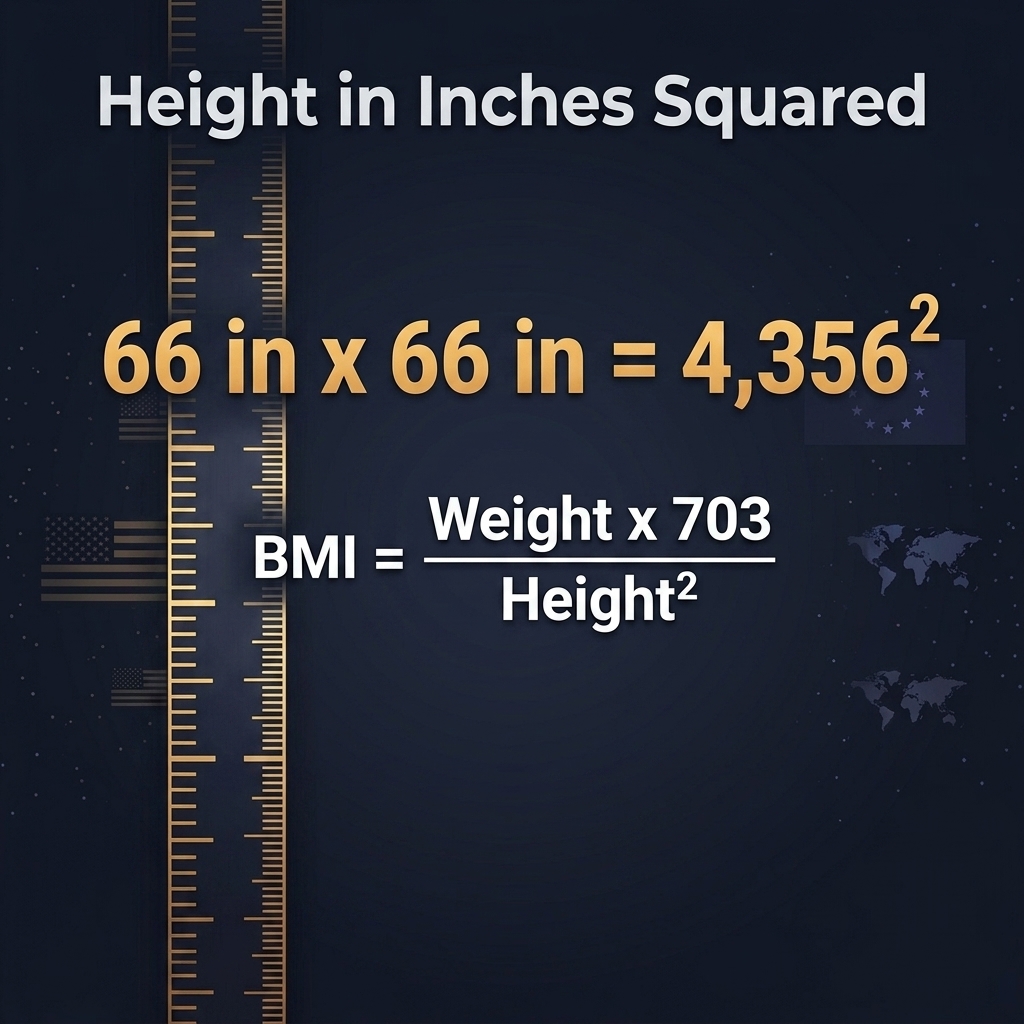
Height in inches squared means your height in total inches multiplied by itself. It is written as height(in)^2 or height x height. The result is used as the denominator in the imperial BMI formula:
BMI = (Weight in lbs x 703) / (Height in inches x Height in inches)
The 703 is a fixed conversion factor that bridges the gap between the imperial units (pounds and inches) and the metric foundation of the original BMI formula (kilograms and meters). Without it, the result would not match the standard BMI scale.
Step-by-Step: How to Calculate Height in Inches Squared
Step 1 - Convert Your Height to Total Inches
Start by converting your feet-and-inches height into a single inch number.
Formula: (Feet x 12) + remaining inches = total inches
| Height | Calculation | Total Inches |
|---|---|---|
| 5’0” | (5 x 12) + 0 | 60 in |
| 5’04” | (5 x 12) + 4 | 64 in |
| 5’05” | (5 x 12) + 5 | 65 in |
| 5’06” | (5 x 12) + 6 | 66 in |
| 5’10” | (5 x 12) + 10 | 70 in |
| 6’0” | (6 x 12) + 0 | 72 in |
Common mistake: Never write 5’6” as 5.6 and multiply by 12. That gives 67.2 inches, not 66. Always multiply feet by 12 first, then add the remaining inches separately.
Step 2 - Square the Total Inches
Multiply total inches by itself.
Example - height 5’06” (5’6”):
- Total inches: 66
- Height in inches squared: 66 x 66 = 4,356
Example - height 5’05” (5’5”):
- Total inches: 65
- Height in inches squared: 65 x 65 = 4,225
Example - height 5’04” (5’4”):
- Total inches: 64
- Height in inches squared: 64 x 64 = 4,096
Pro Tip: On a standard calculator, enter your height in total inches, then press the x (multiply) key, then press the = key - most calculators repeat the last operand, squaring the number in one extra step. Or just type the number twice: 66 x 66 = 4,356.
Full Reference Table: Height in Inches Squared
Use this table to skip the mental math entirely. Find your height, read your inches-squared value, then plug it straight into the BMI formula.
| Height | Total Inches | Inches Squared |
|---|---|---|
| 4’7” | 55 in | 3,025 |
| 4’8” | 56 in | 3,136 |
| 4’9” | 57 in | 3,249 |
| 4’10” | 58 in | 3,364 |
| 4’11” | 59 in | 3,481 |
| 5’0” | 60 in | 3,600 |
| 5’1” | 61 in | 3,721 |
| 5’2” | 62 in | 3,844 |
| 5’3” | 63 in | 3,969 |
| 5’04” | 64 in | 4,096 |
| 5’05” | 65 in | 4,225 |
| 5’06” | 66 in | 4,356 |
| 5’7” | 67 in | 4,489 |
| 5’8” | 68 in | 4,624 |
| 5’9” | 69 in | 4,761 |
| 5’10” | 70 in | 4,900 |
| 5’11” | 71 in | 5,041 |
| 6’0” | 72 in | 5,184 |
| 6’1” | 73 in | 5,329 |
| 6’2” | 74 in | 5,476 |
| 6’3” | 75 in | 5,625 |
| 6’4” | 76 in | 5,776 |
| 6’5” | 77 in | 5,929 |
| 6’6” | 78 in | 6,084 |
| 6’7” | 79 in | 6,241 |
For any height not listed here, use our Height in Inches to CM Calculator to get your exact inch total, then square it manually.
How to Use Height in Inches Squared for BMI
Once you have your inches-squared value, plug it into the formula.
Full BMI formula (imperial):
BMI = (Weight in lbs x 703) / (Height in inches squared)
Worked example - person who is 5’06” (66 inches) and weighs 150 lbs:
- Height in inches: 66
- Height in inches squared: 66 x 66 = 4,356
- Weight x 703: 150 x 703 = 105,450
- BMI: 105,450 / 4,356 = 24.2
A BMI of 24.2 falls in the healthy weight range (18.5-24.9) according to CDC guidelines.
BMI Categories (Standard Adult Reference)
| BMI Range | Category |
|---|---|
| Below 18.5 | Underweight |
| 18.5 - 24.9 | Healthy Weight |
| 25.0 - 29.9 | Overweight |
| 30.0 and above | Obese |
Pro Tip: BMI is a screening tool, not a diagnosis. It does not distinguish between muscle and fat. A muscular person at the same height can have an identical BMI to someone with much higher body fat. Always pair BMI with waist circumference, body composition, and a healthcare provider’s assessment for a complete picture.
What About Height in Inches to kg?
The BMI formula using pounds and inches converts automatically through the 703 factor. But if your weight is in kilograms, use the metric formula instead - it is simpler and needs no conversion factor.
Metric BMI formula:
BMI = Weight (kg) / Height (m) x Height (m)
To use the metric formula with your height in inches, convert to meters first: multiply your total inches by 0.0254.
| Height | Total Inches | Meters |
|---|---|---|
| 5’04” | 64 in | 1.626 m |
| 5’05” | 65 in | 1.651 m |
| 5’06” | 66 in | 1.676 m |
| 5’8” | 68 in | 1.727 m |
| 5’10” | 70 in | 1.778 m |
| 6’0” | 72 in | 1.829 m |
Example - 5’6” tall, 68 kg:
- Height in meters: 66 x 0.0254 = 1.676 m
- Height in meters squared: 1.676 x 1.676 = 2.809
- BMI: 68 / 2.809 = 24.2 (same result as the imperial calculation above)
Both formulas produce the same BMI. Use whichever matches your weight unit.
Handling Fractional Inches in the Calculation
Precise height measurements sometimes include fractions. Here is how to handle the most common ones.
0.5 Inches (Half Inch)
If your measured height falls exactly on a half-inch mark, add 0.5 to your full-inch count before squaring.
Example - 5’9.5” = 69.5 inches: 69.5 x 69.5 = 4,830.25
0.25 Inches (Quarter Inch)
Add 0.25 to your inch total.
Example - 5’9.25” = 69.25 inches: 69.25 x 69.25 = 4,795.56
0.6 and 0.8 Inches
These appear when a digital stadiometer displays decimal readings. Treat them the same way.
| Reading | Total Inches | Inches Squared |
|---|---|---|
| 5’9.25” | 69.25 | 4,795.56 |
| 5’9.5” | 69.50 | 4,830.25 |
| 5’9.6” | 69.60 | 4,844.16 |
| 5’9.8” | 69.80 | 4,872.04 |
For BMI purposes, rounding to the nearest half-inch is clinically acceptable. The difference between 69.5 and 69.8 inches squared is only 41 points - equivalent to a BMI change of roughly 0.15, which has no meaningful impact on your BMI category.
Heights of 8 Inches and 9 Inches - What These Mean in Context
You may see searches for “height 8 inches” or “height 9 inches” in reference to small objects, children measured from birth records, or specific height differences rather than full adult height.
8 inches squared: 8 x 8 = 64
9 inches squared: 9 x 9 = 81
These values are also used when measuring:
- Infant and toddler length increments tracked at pediatric checkups
- Height differences between people (e.g., one person is 8 inches taller than another)
- Object measurements where height is specified as a single-digit inch value (shelving, boxes, furniture)
For adult human height, a full height of 8 or 9 inches refers to an object or infant length, not adult stature.
Why the Imperial BMI Formula Uses 703
The original BMI formula was defined in metric units by Adolphe Quetelet in 1832. It used kilograms and meters. When the formula was adapted for US units (pounds and inches), the conversion factor 703 was added to maintain the same numeric output scale.
Where 703 comes from:
703 = 1 / (0.0254)^2 / 2.2046
In plain terms: 0.0254 converts inches to meters, and 2.2046 converts pounds to kilograms. Squaring the 0.0254 factor for the height denominator and combining everything gives 703.0696 - rounded to 703 in everyday use.
Using 703.07 instead of 703 produces a trivially more precise result. For a 150 lb person at 5’6”, the difference is 0.001 BMI units - completely negligible. Use 703.
Common Mistakes When Squaring Height in Inches
Squaring Feet Instead of Inches
Never square the feet number directly. 5.5 feet squared is 30.25 - a meaningless number in the BMI formula. Always convert to total inches (66) first, then square.
Using Decimal Feet as Inches
5’9” written as 5.9 and converted to inches by multiplying by 12 gives 70.8 inches. The correct conversion is (5 x 12) + 9 = 69 inches. One step skipped = wrong result throughout the entire BMI calculation.
Forgetting to Include the 703 Factor
Dividing weight by height-squared without multiplying by 703 gives a number roughly 700 times smaller than a real BMI. A result of 0.034 is not a BMI - it is a missing 703.
For a mistake-free calculation every time, use our Height in Inches to CM Calculator alongside the Feet to CM Calculator to verify your inch total before squaring.
Worked Examples for Common Heights
| Height | Total Inches | Inches Squared | BMI at 150 lbs | BMI at 180 lbs |
|---|---|---|---|---|
| 5’04” | 64 | 4,096 | 25.7 | 30.9 |
| 5’05” | 65 | 4,225 | 24.9 | 29.9 |
| 5’06” | 66 | 4,356 | 24.2 | 29.1 |
| 5’7” | 67 | 4,489 | 23.6 | 28.3 |
| 5’8” | 68 | 4,624 | 22.9 | 27.5 |
| 5’9” | 69 | 4,761 | 22.2 | 26.7 |
| 5’10” | 70 | 4,900 | 21.6 | 25.9 |
| 5’11” | 71 | 5,041 | 21.0 | 25.1 |
| 6’0” | 72 | 5,184 | 20.4 | 24.5 |
BMI values calculated using: (Weight x 703) / Inches Squared.
Frequently Asked Questions
What does height in inches squared mean?
Height in inches squared means your total height in inches multiplied by itself. For example, if you are 66 inches tall (5’6”), your height in inches squared is 66 x 66 = 4,356. This value is used as the denominator in the imperial BMI formula.
How do I square my height in inches for BMI?
First convert your height to total inches: multiply feet by 12 and add the remaining inches. Then multiply that number by itself. For 5’6”: (5 x 12) + 6 = 66 inches. 66 x 66 = 4,356. Divide weight in pounds multiplied by 703 by that result.
What is the BMI formula using height in inches squared?
BMI = (Weight in lbs x 703) / (Height in inches x Height in inches). The 703 is a fixed conversion factor that makes the result match the standard metric BMI scale. Without it, the output would be roughly 703 times smaller than a real BMI.
Can I use a decimal height like 69.5 inches for BMI?
Yes. Square the decimal value directly: 69.5 x 69.5 = 4,830.25. Use that value in the BMI formula as normal. For practical purposes, rounding to the nearest whole inch introduces a negligible error in most BMI calculations.
What is 5’06” (5’6”) in total inches and squared?
5’6” equals 66 total inches. Squared: 66 x 66 = 4,356. At 150 lbs: BMI = (150 x 703) / 4,356 = 24.2 (healthy weight range).
Why do I need to square height for BMI and not just use it directly?
Because the BMI formula is a ratio of weight to the square of height, not weight to height alone. Quetelet designed it this way because body weight scales with the square of height in healthy adults - a taller person has proportionally more volume, not just more length. Squaring height normalizes for that three-dimensional scaling effect.
Calculate Your Height in Inches Now
Need your exact inch total before squaring? Our free tools handle the conversion instantly:
- Height in Inches to CM Calculator - Convert inches to centimeters for metric BMI
- Feet to CM Calculator - Convert feet and inches to centimeters in one step
- CM to Feet Calculator - Convert centimeters back to feet and inches
- Height in Feet to Inches Calculator - Get your exact total inch value for BMI squaring
- Average Height by Country - See how your height compares globally
- Height Charts - Growth references for children and adults by age and gender